Our LOI guide covers every non-binding vs binding provision, deposit terms, exclusivity, and the five LOI clauses that most often derail dental deals before the purchase agreement is even drafted.
Skip to:
For the full transaction lifecycle, see our complete guide to buying and selling a dental practice: the hub for every stage from search through closing.
What Is a Dental Practice Purchase Agreement?
A dental practice purchase agreement is the legally binding contract that transfers ownership of a practice from seller to buyer. Where the letter of intent establishes a non-binding framework, the purchase agreement, almost always an asset purchase agreement (APA) in dental transactions, creates enforceable obligations that govern what is sold, at what price, under what conditions, and with what recourse if either party fails to perform after closing. Use the LOI checklist tool to score your draft LOI on the five terms that most often derail dental deals.
The APA sits at the center of a four-document closing package: the APA itself, a Bill of Sale (for tangible personal property), an Assignment & Assumption Agreement (for leases, contracts, and assumed liabilities), and the Disclosure Schedules (the factual annexes to the seller’s representations). The APA is the parent document, every other closing deliverable flows from it.
In the acquisition timeline, the APA comes after due diligence and LOI and before the closing table. The path runs: signed LOI → due diligence (30-60 days) → APA drafted and negotiated → final execution → closing. On most single-doctor practice transactions, APA negotiation adds 15-30 days to the timeline. Deals that close in under 90 days from LOI typically have an experienced transitions attorney on both sides working from a known, balanced form.
The brief distinction between an APA and a stock purchase agreement (SPA): in an asset deal, the buyer purchases individual assets and assumes only specified liabilities, leaving historical liabilities with the seller’s entity. In a stock deal, the buyer purchases the seller’s legal entity, including its history. Because dental practices almost exclusively transact as asset deals (the buyer does not want to inherit the seller entity’s liabilities or tax history), the SPA is rare outside of DSO platform acquisitions. For a full comparison, see the asset vs stock purchase guide.
The Anatomy of a Dental Practice APA
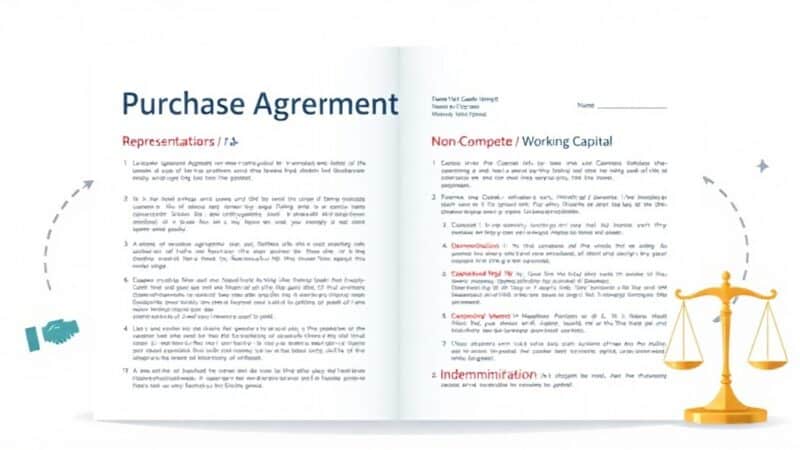
A well-drafted dental APA contains twelve standard sections. Each section carries distinct interests for buyer and seller; understanding those interests before negotiations begin is the fastest way to identify where a deal is balanced and where it is not.
| Section | Purpose | Buyer’s interest | Seller’s interest |
|---|---|---|---|
| Preamble & Definitions | Defines terms used throughout the agreement | Precise, broad definitions of “assets” and “business” | Narrow definitions that limit scope of transfer |
| Purchase & Sale of Assets | Specifies exactly what transfers and what is excluded | Comprehensive Schedule of Assets; minimal Schedule of Excluded Assets | Clear exclusions for personal items, intercompany loans |
| Allocation (IRS Form 8594) | Sets the tax character of the purchase price across asset classes | Maximize Class V (equipment) and Class VII (goodwill) to depreciate | Minimize ordinary-income-taxed classes (Class I, IV) |
| Closing Mechanics | Conditions, date, deliverables, wire instructions | Adequate diligence runway; lender-funding contingency | Fixed close date; limited buyer outs |
| Representations & Warranties | Seller’s disclosure of material facts as of signing and closing | Broad reps with no materiality scrapes | Narrow reps with materiality scrapes throughout |
| Covenants | Pre- and post-closing obligations (operate in ordinary course; transition assistance) | Seller operates normally; no cherry-picking patients or referring docs | Limited post-closing obligations; defined transition period |
| Indemnification | Recovery mechanism if reps are breached post-closing | Higher cap, lower basket, longer survival, fully-funded escrow | Low cap, high basket, short survival, escrow release on schedule |
| Working-Capital Adjustment | True-up of operating cash at close versus target level | Tight target range; independent accountant as arbiter | Mutual mechanism with wide tolerance band |
| Non-Compete & Non-Solicit | Protects acquired goodwill from seller competition | Broader radius, longer duration, non-solicit of staff and patients | Narrower scope; carve-out for teaching/academic work |
| Employment & Transition | Staff retention, associate continuity, seller’s consulting period | Continuity of hygienists, treatment coordinator; seller’s 60-90 day support | Defined and limited consulting obligation; no liability for staff departure |
| Termination Rights | Conditions under which either party can walk before closing | Financing failure; diligence-based MAE outs | Buyer financing failure does not allow indefinite delay |
| Miscellaneous | Governing law, dispute resolution, notices, integration clause | Buyer’s home state if buyer is acquiring from another state | Seller’s state; familiar courts and law |
The Schedule of Assets (Exhibit A) is one of the most practically important documents in the package. It lists every piece of equipment, every software license, every payor contract, and every patient record database that transfers. Buyers who accept a vague Schedule of Assets, “all equipment in the practice as of closing”, are accepting unknown scope. A line-itemized schedule with serial numbers, age, and functional status is standard practice and should be insisted upon. For a discussion of how the schedule of assets intersects with practice valuation, see the valuation guide.
Representations & Warranties: The Buyer’s Insurance Policy
Representations and warranties are the seller’s sworn factual statements about the practice’s condition as of a specific date, usually both the signing date and the closing date. A breach of any rep entitles the buyer to seek indemnification. The broader and more precise the reps, the stronger the buyer’s protection; the more materiality scrapes inserted, the weaker that protection becomes.
A standard dental APA groups reps into six categories, each with distinct financial exposure on breach:
- Authority reps: Seller has legal authority to sell, no conflicts with existing agreements, all consents obtained. Breach exposure: deal voidability, third-party claims.
- Financial reps: Financials prepared in accordance with GAAP (or consistent basis), no undisclosed liabilities, all taxes filed and paid, no pending audits. Breach exposure: $20,000-$200,000+ in undisclosed tax liability or creditor claims on a $1M deal. This is where a dental CPA review of three years of P&L and tax returns (Duckett Ladd CPA) pays for itself.
- Operational reps: Clinical records complete and HIPAA-compliant, all equipment in functional condition, supplies inventory accurate, IT and PMS systems operational and licensed. Breach exposure: equipment replacement ($5,000-$80,000), HIPAA remediation, PMS migration costs.
- Compliance reps: State dental license current, DEA registration valid, OSHA compliance, all payor contracts in good standing with no pending terminations or recoupments. Breach exposure: a terminated payor contract that accounts for 15% of revenue can reduce practice value by $50,000-$100,000 on a cash-flow basis. See the ADA Commons guide to overlooked purchase agreement terms for specific compliance rep language.
- Real estate reps: Lease in force, no defaults, no pending landlord terminations, no environmental conditions. Breach exposure: lease termination or remediation can range from minor inconvenience to deal collapse.
- HR reps: All employees disclosed on Schedule of Employees, no pending employment claims or OSHA complaints, benefits-plan compliance (ERISA), PTO accruals accurately stated. Breach exposure: undisclosed employment claims range from $10,000 (small wage dispute) to six figures (class action or discrimination claim).
The “No Material Adverse Change” (MAC or MAE) rep is a catch-all: seller certifies that nothing has occurred since the signing date that would materially harm the practice’s business, financial condition, or prospects. The definition of “material adverse effect” is one of the most heavily negotiated definitions in any APA. Sellers want carve-outs for industry-wide conditions, regulatory changes, and economic downturns; buyers want the fewest carve-outs possible.
A materiality scrape is the seller’s technique of inserting “material” or “in all material respects” into individual rep statements to raise the threshold for breach. Buyers should limit materiality scrapes to reps where they are genuinely standard (financial statement accuracy, for example) and resist them on compliance and license reps, where any breach, material or not, can affect practice value.
Indemnification: Cap, Basket, Survival
Indemnification is the post-closing mechanism by which a buyer recovers losses caused by the seller’s pre-closing misrepresentations or warranty breaches. Three mechanics control how much the buyer can actually recover: the cap (maximum exposure), the basket (minimum threshold before claims aggregate into a recovery), and the survival period (how long after closing claims can be brought). Negotiating these three numbers is the single highest-stakes part of APA negotiations on the seller’s side.
| Mechanic | Buyer-favorable | Seller-favorable | Common dental-deal range |
|---|---|---|---|
| Indemnification cap (general reps) | 25% of purchase price | 10% of purchase price | 15% of purchase price |
| Basket (deductible before claims aggregate) | $0 (first-dollar) | $25,000-$50,000 | $10,000 with tipping basket |
| Survival period, general reps | 24 months post-closing | 12 months post-closing | 18 months post-closing |
| Survival period: fundamental reps (title, authority, taxes) | Indefinite / statute of limitations | 3-6 years | Indefinite (per ADA guidance) |
| Escrow holdback amount | 15% of purchase price / 24 months | 5% of purchase price / 12 months | 10% of purchase price / 18 months |
The tipping basket (also called a “deductible with tip”) means the buyer absorbs all losses below the basket floor, but once aggregate losses exceed the basket, the seller is liable for the entire amount from the first dollar, not just the excess. A true deductible basket means the seller only pays losses above the basket floor. Buyers strongly prefer tipping baskets; sellers prefer true deductibles.
The escrow holdback is how the buyer’s indemnification rights are actually funded. At closing, a portion of the purchase price, typically 10%, is held in escrow by a neutral escrow agent rather than paid directly to the seller. The escrow funds indemnification claims during the survival period; what remains at the end of the survival period releases to the seller. On a $1.2M practice, a 10% holdback means $120,000 sits in escrow for 18 months. The indemnification and escrow terms link to the DPI glossary for plain-language definitions.
For buyers financing through SBA 7(a), lenders typically require the escrow holdback structure to be clearly defined in the APA. They want confirmation that the seller is not receiving 100% of proceeds at closing before the lender’s lien position is established and any post-closing liabilities are quantified.
Resources: Odgers Law Group, 17 Key Terms in a Dental Practice Purchase Agreement; JD Supra, Structuring Your Dental Practice Transaction.
Working-Capital Adjustment: How Deals Lose (or Gain) $40,000 at Closing
The working-capital adjustment is a price true-up at closing that ensures the buyer receives the practice with a normal operating cash balance, not a practice that has been cash-stripped by the seller running up collections and deferring expenses in the final weeks before close. It is one of the two provisions (alongside non-compete radius) most likely to trigger a last-minute closing dispute in dental practice transactions.
The mechanism works as follows:
- Target working capital is set in the APA, typically the trailing three-to-six-month average of current assets minus current liabilities.
- Threshold is the tolerance band around the target, commonly ±5%. A practice with a $200,000 working-capital target would have a $10,000 tolerance band (±$10,000).
- Measurement date is usually the close of business on the day before closing.
- Dispute mechanism: if buyer and seller dispute the measurement, an independent CPA (named in the APA) serves as arbiter. Their determination is final and binding.
Worked example on a $1.1M practice:
- Target working capital: $85,000
- Threshold: ±$4,250 (5%)
- Actual working capital at close: $42,000 (seller accelerated collections and ran down supply inventory)
- Shortfall: $43,000, well below the threshold floor of $80,750
- Purchase price adjustment: buyer receives $43,000 credit against the closing payment, or the equivalent amount released from escrow to buyer at close
The components that move working capital in dental transactions: accounts receivable (AR) aging and collectibility, supply inventory value, prepaid rent and insurance, and patient deposit liabilities. Vague APA language that defines working capital as simply “current assets minus current liabilities” without specifying which items are included and how AR collectibility is measured is a frequent source of six-figure disputes. The ADA Commons Dentistry and the Law publication cites working-capital definition ambiguity as one of the most commonly litigated APA terms in post-closing dental disputes.
For context on how working-capital targets relate to overhead benchmarks in the practice, see the DPI overhead guide, a practice running higher-than-average overhead will typically carry a lower working-capital buffer, which affects how the target is set.
Best practice: define each current-asset component explicitly; specify that AR older than 120 days is excluded from the working-capital calculation; name the independent CPA arbiter in the APA rather than leaving them to be agreed upon later (post-closing, agreement on anything is harder).
Allocation of Purchase Price (IRS Form 8594)
The allocation statement divides the total purchase price across seven IRS asset classes, which determines the tax character of gain for the seller and the depreciable basis for the buyer. Both parties file IRS Form 8594 with their tax returns for the year of sale; allocations must be consistent between buyer and seller or the IRS will audit both. Calculate your practice value using three methods before the purchase agreement locks in the final price.
| IRS Class | Asset Type | Typical % (GP dental) | Tax character |
|---|---|---|---|
| Class I | Cash and cash equivalents | 0-2% | Ordinary income (seller); basis = FMV |
| Class II | Actively traded personal property (securities) | 0% | Ordinary / capital depending on holding |
| Class III | Accounts receivable | 3-8% | Ordinary income (seller); basis = FMV |
| Class IV | Inventory / supplies | 2-5% | Ordinary income (seller); COGS deduction (buyer) |
| Class V | Furniture, equipment, leasehold improvements | 15-30% | §1245 recapture (seller); Section 179 / MACRS (buyer) |
| Class VI | Section 197 intangibles (non-compete, patient lists) | 5-10% | Ordinary income (seller); 15-yr amortization (buyer) |
| Class VII | Goodwill and going-concern value | 50-70% | Capital gain (seller); 15-yr amortization (buyer) |
The allocation negotiation is zero-sum in tax terms: every dollar the buyer moves from Class VII (goodwill) to Class V (equipment) is a dollar the seller moves from capital-gain rates (~20% federal) to ordinary-income or §1245 recapture rates (up to 37%). Sellers want maximum goodwill; buyers want maximum equipment and fixtures for faster depreciation via Section 179 or bonus depreciation.
The full Form 8594 instructions are available at IRS.gov, About Form 8594. For a complete analysis of how asset-versus-stock structure changes the tax outcome across the full purchase price, see the asset vs stock purchase for a dental practice guide. A dental CPA, not a general tax preparer, should finalize the allocation schedule before both parties sign the APA.
Non-Compete & Non-Solicit: How Wide, How Long, Worth How Much?
The non-compete clause prevents the selling dentist from opening or joining a competing practice within a defined radius for a defined period after closing. It protects the buyer’s investment in acquired goodwill, the premium above tangible asset value that the buyer paid on the assumption that the seller’s patients and referral relationships would remain with the practice. A non-compete that is too narrow in radius or too short in duration can reduce the value of that goodwill to zero.
| Geography | Typical radius | Typical duration | Enforceability notes |
|---|---|---|---|
| Urban metro (population 500K+) | 3-5 miles | 2-3 years | Courts strike clauses that are unreasonably broad relative to patient draw radius; document goodwill at risk |
| Mid-density suburb | 5-10 miles | 3-5 years | Most enforceable zone; document patient origin data in Disclosure Schedules |
| Rural market | 15-25 miles | 5 years | Often enforced broadly; few alternate locations within radius |
| California | Varies | Generally unenforceable post-close | Use non-solicit of patients and staff instead; consult CA dental transactions counsel |
The non-compete radius should be grounded in patient-origin data, not arbitrary mileage. A Schedule of Assets or Disclosure Schedule that includes a patient-origin map (zip-code distribution of active patients) is the best defense if a non-compete is ever challenged in court. Buyers should insist on a patient-origin analysis as part of due diligence; the analysis also helps size the non-compete appropriately rather than defaulting to a generic radius.
The non-solicit provision is related but distinct: it prohibits the seller from actively recruiting the practice’s patients or employees to a new location, even if the seller practices outside the non-compete radius. In California and a small number of other states where non-competes are routinely struck down, the non-solicit is the primary goodwill-protection mechanism. Both provisions should include clear definitions of “solicit”, a seller who sends a general announcement to former patients (“I have moved to a new practice”) is different from one who actively contacts specific patients with referral incentives.
State non-compete law varies materially. dentalattorneys.com, Dental Practice Purchase Agreements summarizes state-specific enforceability considerations; a transitions attorney licensed in the practice’s state is required for non-compete drafting and review.
Employee & Associate Transition Terms
Staff continuity is among the top three value drivers in a dental practice acquisition. A hygienist with a 15-year patient relationship or an associate who generates 40% of collections is not replaceable on short notice, and their departure in the 90 days after closing can reduce collections by $80,000-$150,000 annually. The APA’s employment and transition section must address this risk explicitly.
- Staff continuity commitment: The APA should list key employees by name (or by role if name disclosure is not yet appropriate) and specify that offers of employment at comparable compensation will be extended at closing. “At-will” employment does not prevent immediate departure, but a formal offer signals the buyer’s intent.
- Hire-back commitments: Some APAs include a seller covenant to personally encourage key staff to remain through the transition period. This is non-enforceable but signals alignment.
- Associate non-competes (separate): If the practice has an associate, their non-compete is negotiated separately, in their employment agreement, not the APA. Buyers often make the APA contingent on the associate signing an updated non-compete at close.
- Transition consulting period: The seller agrees to remain in a consulting or part-time clinical role for 60-180 days post-closing to introduce patients, support treatment coordinator relationships, and manage the referral transition. This is almost always included and is critical for practices where the seller is the primary patient-relationship holder.
- Retention bonuses: For key non-clinical staff (treatment coordinator, practice manager), a retention bonus of $2,000-$8,000 paid at the 90-day post-closing mark is a cost-effective tool to reduce departure risk. The APA or a side letter should address who funds retention bonuses and whether they are an APA obligation or a buyer’s operational decision.
- Payroll cut-off: The seller is responsible for all payroll, benefits, PTO accruals, and payroll taxes up to and including the day before closing. The APA should include a representation on outstanding PTO liabilities and whether those liabilities transfer to the buyer. Most asset deals explicitly exclude assumed PTO liability.
Real Estate, Lease, and Assignment
The practice lease is often the highest-risk non-financial document in a dental acquisition. A practice tied to a specific location, one where patients have driven for 20 years, has its goodwill embedded in that address. Lease assignment failure is one of the top five reasons dental deals collapse after APA execution.
- Landlord consent to assignment: Nearly every commercial lease requires landlord consent before the tenant’s interest can be assigned to a new entity. The buyer must obtain this consent in writing before closing. The APA should include a closing condition requiring evidence of consent (or make lack of consent a buyer termination right).
- Landlord estoppel certificate: A statement from the landlord confirming the lease is in good standing, no defaults exist, the remaining term and renewal options are as represented, and no side agreements not in the lease document exist. Required by most lenders and strongly recommended for buyer protection.
- Right of First Refusal (ROFR): If the landlord has granted a ROFR on the property, the buyer needs to know. A ROFR can complicate or block a practice acquisition if the landlord intends to sell the building.
- NNN passthrough audit: Triple-net leases pass operating expenses (taxes, insurance, maintenance) to the tenant. A seller’s representation of “NNN expenses of approximately $X” should be verified against actual invoices. NNN true-ups can add $5,000-$25,000 annually to occupancy cost.
- Environmental reps: Particularly relevant for practices in buildings constructed before 1980 (lead paint, asbestos) or those that used or stored amalgam waste. The seller’s environmental rep should affirmatively state that no known environmental conditions exist and no regulatory notices have been received.
Earnouts and Seller Financing
Earnouts and seller financing both defer a portion of the purchase price beyond the closing date, but they serve different purposes. An earnout ties post-closing payments to future practice performance (revenue or EBITDA milestones); seller financing is a fixed-amount loan from seller to buyer at a specified interest rate, subordinated to the senior lender.
In dental practice transactions, seller financing is more common than earnouts. Typical structures:
- Amount: 10-25% of purchase price carried by seller, with the balance financed through SBA 7(a) or a conventional dental practice lender. On a $1.2M deal, a 15% seller carry = $180,000 subordinated note.
- Interest rate: 6-10% (seller financing rates in 2025-2026 have tracked close to SBA prime + 1%). The seller financing note should match or slightly exceed current SBA 7(a) rates to be commercially reasonable.
- Term: 3-7 years, monthly payments. Some notes are balloon-structured (interest-only for 2 years, then amortized).
- Subordination: The SBA and most conventional lenders require the seller’s note to be fully subordinated to the senior lender’s lien. This means the seller’s payments can be deferred or stopped if the senior lender demands it, a risk sellers must understand before agreeing to carry paper.
Earnouts are used in dental practice transactions primarily when buyer and seller have a valuation disagreement and neither is willing to move to the other’s number. They are more common in multi-doctor practices or specialty practices where near-term revenue is uncertain. Earnout provisions should include: a clear milestone metric (gross collections, not net income, is preferred. Net income is controllable by the buyer); a measurement period and audit right; and a cap on total earnout payments.
The Bring-Down Certificate and Closing Conditions
The bring-down certificate is the seller’s written certification at closing that all representations and warranties made in the APA are still true and accurate as of the closing date, not just as of the signing date. It “brings down” the reps from signing to closing and is a standard closing deliverable in every dental APA.
The distinction between “as of signing” and “as of closing” reps is significant. Most reps are written to survive to the closing date: if something changes between signing and closing (a key employee resigns, a payor terminates a contract, equipment breaks), the seller must disclose it via an update to the Disclosure Schedules. A buyer who receives a materially changed bring-down certificate has the right, depending on APA language, to invoke the Material Adverse Effect clause and potentially terminate.
Standard closing conditions in a dental APA:
- All reps and warranties true and accurate in all material respects as of closing (bring-down)
- No material adverse change in the practice’s business, financials, or clinical operations since signing
- All required consents obtained (landlord, payor contracts that require assignment notice, lender)
- All regulatory filings current (state license renewal, DEA registration active)
- Lender financing confirmed and wire instructions received
- All closing deliverables executed (Bill of Sale, Assignment & Assumption, Disclosure Schedules updated, seller’s bring-down certificate, non-compete agreement)
- Working-capital certificate delivered and agreed upon (or held in escrow pending final count)
Materiality scrapes in the bring-down condition are one of the highest-stakes negotiating points. A buyer who accepts “all reps true in all material respects” at bring-down is giving the seller a wide tolerance band. A buyer who insists on “all reps true and accurate” (no materiality qualifier) is holding the seller to the original letter of every rep. Most dental deal APAs land at “material respects” for operational reps and “accurate in all respects” for fundamental reps (title, authority, no encumbrances).
The 7 Most Negotiated Provisions in 2026 Dental APAs
Seven provisions account for the majority of attorney time and deal tension in dental practice purchase agreements negotiated in 2025-2026. Each carries a measurable dollar or timeline impact:
- Indemnification cap. On a $1.2M practice, the difference between a 10% and 25% cap is $180,000 in maximum seller exposure. Sellers fight hard to keep the cap at 15% or below; buyers push for 20-25% on practices with complex regulatory histories. See the complete buyer guide for context on how the cap fits into overall risk management.
- Basket type and size. A true deductible basket versus a tipping basket on a $10,000 floor: on a deal with $35,000 in post-closing warranty claims, the tipping basket recovers all $35,000 while the deductible recovers only $25,000. Over a pool of 20 deals, basket structure is the second-highest-dollar-impact indemnification variable after the cap.
- Working-capital target definition and components. Vague language costs $20,000-$60,000 in disputes on mid-market dental deals. The target should be calculated from a trailing six-month average, stated explicitly, and should specify which AR buckets are included.
- Non-compete radius in suburban markets. A 5-mile versus 10-mile radius in a suburb with multiple competing practices is worth 8-12% of goodwill value at risk. Courts in most states require the radius to be commercially reasonable relative to the actual patient draw area.
- Earnout milestones (when present). Revenue-based milestones are preferable to EBITDA-based ones because the buyer controls EBITDA through expense decisions post-closing. Sellers should insist on revenue milestones and an audit right if the practice misses milestones.
- Tail malpractice coverage responsibility. On a claims-made malpractice policy with 10 years of active coverage, tail premium ranges from $5,000 to $30,000. The APA must assign this cost explicitly, the most common practice is seller responsibility, but deals where the seller has been practicing for 25+ years with a fully mature claims history can produce tail quotes that surprise both parties. Resources: Whiteford Law dental health care practice covers tail malpractice allocation in dental transactions.
- Lease assignment cure period. If the landlord does not consent to assignment before the closing date, how many days does the buyer have to cure (extend the closing) versus terminate? A 30-day cure period is buyer-favorable; 15 days is seller-favorable. The cure period determines who bears the cost of a slow landlord.
Mistakes That Cost Money
These are the contract-level errors that consistently produce post-closing disputes in dental practice transactions. Most are avoidable with experienced legal counsel and thorough due diligence before signing.
- Vague working-capital definition. “Current assets minus current liabilities” without specifying which AR buckets are collectible and which are excluded creates a multi-variable dispute at closing. Define every component line by line.
- No Material Adverse Effect definition. An undefined MAE clause is either unenforceable (court applies a generic standard) or triggers litigation. The ADA Commons guidance on overlooked APA terms lists MAE as the single most frequently litigated undefined term in dental purchase agreements.
- Inadequate Disclosure Schedules. Sellers who provide vague schedules (“equipment as listed in chart”) rather than itemized schedules are effectively breaching the Schedule of Assets rep at signing. Buyers who accept this are waiving the protection that specific schedules would otherwise provide.
- Missing tail-coverage allocation. Deals that close without explicit APA language on tail malpractice responsibility leave both parties assuming the other is paying, resulting in a lapsed tail, a coverage gap, and potential liability for the buyer for a pre-closing claim that surfaces post-closing.
- No independent CPA named for working-capital disputes. Agreeing post-closing on a neutral CPA to arbitrate a working-capital dispute is practically impossible. Name one in the APA; the cost of naming a CPA you never use is zero.
- Broad materiality scrapes on compliance reps. A dental license that lapses briefly, a DEA registration with a minor administrative discrepancy, or a single payor contract in default. These are not “material” in everyday language but can have material practical consequences. Compliance reps should have narrow or no materiality qualifiers.
- No patient-origin data in due diligence. Buyers who don’t request a zip-code-level patient-origin analysis cannot properly size the non-compete radius and cannot defend the non-compete if challenged. For context on how these errors connect to broader financial mistakes, see the dental practice financial mistakes guide.
- Closing contingencies not tied to specific deadlines. Open-ended “subject to financing” language without a financing contingency expiration date gives the buyer an indefinite out while the seller is locked up in exclusivity. A 45-day financing contingency with a defined cure period is standard.
Frequently Asked Questions
What is a dental practice purchase agreement?
A dental practice purchase agreement (APA) is the legally binding contract that transfers ownership of a dental practice’s assets from the seller to the buyer. It specifies which assets are sold, the total purchase price and its allocation across IRS asset classes, the seller’s representations and warranties about the practice’s condition, the indemnification mechanism for post-closing warranty breaches, and the conditions that must be met before closing can occur. Every other closing document, Bill of Sale, Assignment & Assumption Agreement, Disclosure Schedules, is subordinate to the APA.
Is the purchase agreement the same as the LOI?
No. The letter of intent is a non-binding framework agreement that captures the key deal terms before legal counsel drafts the definitive contract. Most LOI provisions, purchase price, structure, timeline, are non-binding and can shift during due diligence. The purchase agreement is the definitive, binding contract. Once signed, both parties have enforceable legal obligations; backing out without cause exposes the defaulting party to damages. The LOI comes first; the APA comes after due diligence and converts the LOI’s framework into binding obligations.
What’s the difference between an asset purchase agreement and a stock purchase agreement?
In an asset purchase agreement (APA), the buyer acquires individual assets (equipment, patient records, goodwill, lease, contracts) and assumes only the liabilities explicitly listed in the APA. Historical liabilities, tax claims, employment disputes, malpractice claims from before closing, remain with the seller’s entity. In a stock purchase agreement (SPA), the buyer acquires the seller’s legal entity itself, including all historical liabilities. Dental practices almost exclusively use APAs because buyers do not want inherited liabilities. SPAs appear in DSO acquisitions where the buyer wants to preserve the entity’s insurance credentialing or a long-term lease that cannot be easily assigned. See the asset vs stock guide for a full comparison.
What does the indemnification cap typically cover in a dental APA?
The indemnification cap is the maximum dollar amount the seller is obligated to pay to the buyer for post-closing losses caused by breaches of the seller’s representations and warranties. It covers monetary damages arising from misrepresentations about the practice’s financials, compliance status, equipment condition, employee matters, and regulatory standing. Fundamental reps (title to assets, authority to sell, undisclosed liabilities) typically have a separate, higher or unlimited cap. On dental practice transactions, the general indemnification cap is typically 15% of the purchase price; lenders and sophisticated buyers push for 20-25% on higher-risk acquisitions.
How long do representations & warranties survive after closing?
General representations and warranties in dental APAs typically survive for 12-24 months post-closing, with 18 months being the most common outcome. Fundamental representations: title to assets, authority to enter the APA, absence of undisclosed liens, and tax obligations, typically survive indefinitely or until the applicable statute of limitations expires. After the survival period ends, the seller has no further indemnification exposure on general reps, even if the buyer discovers a breach. This is why buyers should complete a thorough post-closing review during the first 12 months, when the indemnification window is most clearly open.
What is a working-capital adjustment in a dental practice sale?
A working-capital adjustment is a purchase price true-up that ensures the buyer receives the practice with a normal operating cash balance at closing. A “target” working-capital level, typically the trailing three-to-six-month average of current assets minus current liabilities, is set in the APA. If actual working capital at close is below the target by more than the defined tolerance (commonly ±5%), the purchase price is reduced by the shortfall. If it is above target, the price may increase. The adjustment prevents sellers from stripping cash, running down AR collections, or deferring expenses in the weeks before closing. Disputes over which components are included in working capital are among the most common post-closing claims in dental transactions.
How wide and long should a dental practice non-compete be?
Non-compete scope depends on geography and market density. In urban markets, a 3-5 mile radius for 2-3 years is typical and enforceable. In suburban markets, 5-10 miles for 3-5 years is the standard range. In rural markets, 15-25 miles for 5 years is common and courts routinely enforce it. In California, non-competes are generally unenforceable post-sale; buyers should use non-solicitation provisions instead. In all markets, the radius should be grounded in actual patient-origin data, a non-compete that extends significantly beyond the practice’s patient draw area will be more vulnerable to challenge in court and may be reduced by judicial blue-penciling.
What’s a typical escrow holdback in a dental APA?
A typical escrow holdback in a dental practice purchase agreement is 10% of the purchase price, held for 18 months. Buyer-favorable structures push for 15% held for 24 months; seller-favorable structures seek 5% held for 12 months. The holdback funds the buyer’s indemnification claims during the survival period without requiring the buyer to pursue the seller directly for payment. At the end of the holdback period, if no claims have been asserted (or all claims have been resolved), the remaining escrow balance is released to the seller. A neutral escrow agent, typically a title company or bank escrow department, holds the funds and disburses according to the escrow agreement executed at closing.
Who pays for tail malpractice coverage in a dental practice sale?
In the large majority of dental practice APAs, the seller pays for tail malpractice coverage because the tail policy covers pre-closing claims that arise from the seller’s clinical activity. The cost ranges from $5,000 to $30,000 depending on the number of years the claims-made policy has been in force, the specialty, and the carrier. The APA must explicitly assign this obligation. Many disputes arise in deals where the assignment was assumed rather than written. Buyers should verify tail coverage as a closing condition and confirm the carrier’s confirmation of coverage before wiring closing funds. Some deals split tail coverage costs by duration (seller pays for years 1-5 of tail; buyer funds extended reporting period beyond that), but this is non-standard.
Should the seller draft the purchase agreement or the buyer?
In practice, the buyer’s transitions attorney almost always prepares the first draft of the APA in dental practice transactions, unlike residential real estate where seller-side forms are common. The first draft establishes the baseline, and every provision not included defaults to the drafter’s advantage. A buyer who allows the seller’s attorney to draft the APA is conceding significant structural advantage. Both sides should engage independent, dental-transaction-experienced legal counsel: the buyer’s counsel drafts; the seller’s counsel negotiates and redlines. Sharing one attorney to “save money” on a $1M+ transaction is a practice the ADA Commons Dentistry and the Law publication has specifically identified as a leading cause of post-closing disputes.

Sajid Ahamed is a dental practice-management content strategist with 7+ years of experience marketing for dental practices. He writes DPI’s practice-finance and transitions guides, turning deal mechanics and financial benchmarks into decisions practice owners can act on. Connect on LinkedIn.