Dental practice loan refinancing has become a more active decision for practice owners in 2026. Loans originated when rates were lower (2020-2021) may have floated up with prime-linked variable structures, while loans originated at higher rates (2022-2023) may now be candidates for conventional refinancing at improved terms. This guide walks through the decision framework, the two main paths, breakeven math with a real example, and the traps that catch borrowers off guard. For the broader landscape of financing options beyond refinancing, see our guide to dental practice loans.
When to Refinance Your Dental Practice Loan
Refinancing is not automatically beneficial. The decision comes down to a checklist of conditions:
Rate delta of at least 1 percentage point
The widely cited rule of thumb among practice finance advisors is a rate reduction of at least 1 full percentage point. Below that threshold, closing costs typically extend your breakeven beyond 36 months, making the transaction marginal. If your current rate is 9.5% and the best new rate you can obtain is 8.75%, the 0.75-point gap is unlikely to overcome a standard origination and closing cost package on a $500K+ loan.
Loan must be at least 12 months old (SBA requirement)
If you are pursuing an SBA 7(a) refinance, the program requires that the existing loan be at least 12 months old before it is eligible for refinance under SBA rules (SBA Standard Operating Procedure 50 10 7.1). This prevents the program from being used to immediately refinance newly originated loans. Conventional dental lenders may allow earlier refinancing, but most require a 6-to-12-month seasoning period in practice.
Debt service reduction of at least 10 percent (SBA requirement)
SBA 7(a) has a formal test: the refinanced loan must reduce your total annual debt service by at least 10 percent compared to the existing loan. This is the SBA’s own threshold for demonstrating material benefit to the borrower. Source: SBA Standard Operating Procedure 50 10 7.1. Conventional lenders do not apply this test formally, but lenders still expect the economics to be clear.
Practice value has grown (enables cash-out)
If your practice has appreciated since the original loan, you may have equity available for a cash-out refinance. Practice valuations are typically based on 60-80% goodwill, with the remainder in hard assets. If your collections have grown materially since the original appraisal, a current appraisal may unlock additional borrowing capacity at up to 80% loan-to-value (LTV).
Cash flow stress (restructure via term extension)
Even without a large rate improvement, refinancing can reduce monthly payments by extending the remaining term. If your remaining term is 5 years and you are struggling with debt service, refinancing into a new 10-year term at a similar rate can materially reduce monthly obligations and improve your DSCR. This is a structuring decision, not purely a rate decision.
- Rate improvement of 1%+ available? (required for strong economics)
- Existing loan is 12+ months old? (required for SBA; best practice for conventional)
- Annual debt service will drop 10%+? (required for SBA 7(a) refi)
- Breakeven period under 36 months?
- Planning to hold the practice 3+ years?
- No active sale negotiation underway?
- DSCR still 1.25x or better on current income?
If you can check all boxes, the refinance is likely worth pursuing. Fewer than 5: evaluate carefully.
The 2 Refinance Paths
Path A: SBA 7(a) Refinance
The SBA 7(a) program allows refinancing of existing dental practice acquisition debt, including existing SBA loans (with conditions). The process mirrors a new SBA 7(a) origination. If your original acquisition paired a 7(a) with a fixed-rate 504 for a building purchase, see our SBA 7(a) vs 504 comparison before refinancing either tranche.
- Timeline: 60 to 90 days (SBA approval required in addition to lender underwriting)
- Rate: Variable at prime + 2.25-2.75%. At the WSJ Prime Rate of 6.75% (as of December 2025), that equals approximately 9.00-9.50%. Rates adjust quarterly with prime.
- Guaranty fee: SBA charges a guaranty fee based on loan amount and guarantee percentage (up to 3.5% on the portion above $150,000 for loans over $700,000, per the current SBA fee schedule at sba.gov). Verify current fee tiers at sba.gov before modeling costs.
- Working capital: SBA 7(a) allows working capital to be bundled into the refinance if the lender and SBA agree on overall loan purpose and eligibility.
- Eligibility: Cannot refinance SBA-to-SBA unless the new loan provides a 10% reduction in annual debt service or materially better terms. Existing loan must be 12+ months old.
Best for: Borrowers with existing conventional loans who can meet the SBA debt-service-reduction test and want the program’s longer terms (up to 25 years for real estate, 10 years for goodwill/equipment).
Path B: Conventional Dental-Lender Refinance
Several national lenders operate dedicated dental practice finance programs that offer streamlined refinancing without SBA involvement:
- Timeline: 30 to 45 days (no SBA review layer)
- Rate: Approximately 6 to 9% for well-qualified dental borrowers (680+ FICO, established profitable practice with 1.25x+ DSCR). Bank of America Practice Solutions, Live Oak Bank, and Wells Fargo Practice Finance all publish dental-specialty refinance programs; rates vary by loan size, DSCR, and term.
- Underwriting: Stricter than SBA (no government backstop), but faster. Lenders evaluate practice cash flow, DSCR, personal credit, and loan-to-value.
- Cash-out: Available up to 80% LTV in most conventional dental programs.
Best for: Borrowers with strong credit and DSCR who can access conventional rates below SBA variable rates, and who want faster closing.
Rate-and-Term vs Cash-Out Refinancing
Rate-and-term refinance
A rate-and-term refinance simply swaps your existing loan for a new one with better terms — lower rate, shorter term, or both. No additional cash is borrowed. This is the cleanest structure: the closing focuses entirely on improving debt service economics.
Cash-out refinance
A cash-out refinance borrows against equity in the practice above the existing loan balance. The typical LTV ceiling is 80% of appraised practice value. Proceeds are used for business purposes: equipment purchases, leasehold improvements, or working capital.
Tax note: Interest on cash-out proceeds used for business investment remains deductible under IRC Section 163. However, the deductibility of interest depends on how the proceeds are used — personal-purpose use disqualifies the deduction. Consult your CPA on tax treatment specific to your situation before proceeding.
Cash-out refinances require a current practice appraisal and full DSCR re-underwriting on the larger loan balance.
Breakeven Math: A Worked Example
The most important number in any refinance decision is the breakeven period: how many months of savings it takes to recover closing costs. Here is a concrete example:
- Balance: $600,000
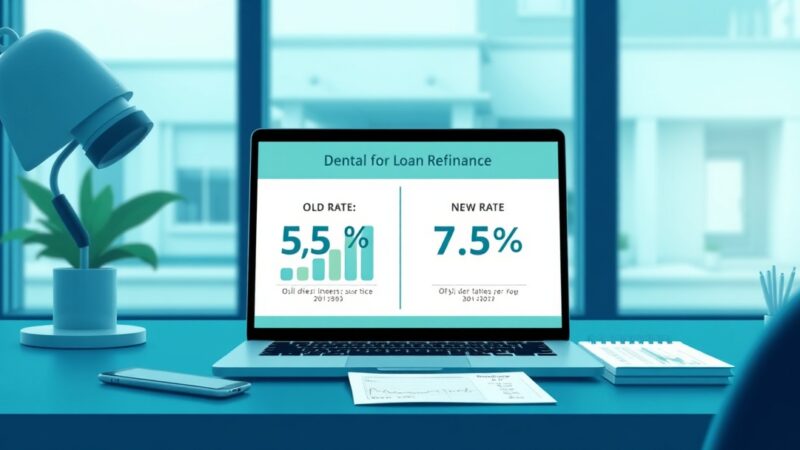
- Rate: 9.5%
- Remaining term: 8 years (96 months)
- Approximate monthly payment: $7,726 (standard amortization)
Proposed refinance:
- Balance: $600,000
- Rate: 7.5%
- New term: 10 years (120 months)
- Approximate monthly payment: $7,114
Monthly savings: $7,726 – $7,114 = approximately $612/month
Estimated closing costs (conventional refinance):
- Origination fee: 1-2% of $600K = $6,000 – $12,000
- Appraisal: $2,000 – $4,000
- Legal / closing: $2,000 – $3,000
- Total range: approximately $10,000 – $19,000
Breakeven: $15,000 (midpoint closing costs) divided by $612 (monthly savings) = approximately 24.5 months
Interpretation: If you plan to hold the practice for 3 or more years, and closing costs fall in the $10,000-$15,000 range, this refinance pays off. If closing costs reach $19,000, your breakeven is approximately 31 months — still reasonable for a long-hold practice.
For SBA 7(a) refinances, add the SBA guaranty fee (varies by loan amount; see current tiers at sba.gov). On a $600,000 loan, total SBA closing costs including the guaranty fee can reach $25,000 or more, pushing the breakeven to 40+ months. Run these numbers carefully before choosing SBA over conventional.
Use our loan calculator to run breakeven math on your specific balance, rate, and term. For cash-out refinances, the valuation calculator estimates your LTV headroom.
What to Watch For
Prepayment penalties on your existing loan
SBA 7(a) loans with a term of 15 years or more carry a prepayment penalty in the first three years: 5% of the prepaid amount in year 1, 3% in year 2, 1% in year 3. After year 3, no penalty applies. If your existing SBA loan is under 3 years old and has a 15-year term, you must factor the prepayment penalty into your closing cost calculation. Conventional dental loans vary widely — read your note carefully before assuming there is no penalty.
SBA “substantially the same terms” rule
SBA will not approve a refinance of an existing SBA loan unless the new terms meaningfully improve on the existing loan (primarily through the 10% debt-service-reduction test). If your current SBA rate and the proposed SBA rate are close, the SBA pathway may be blocked. Confirm with your lender’s SBA specialist before investing time in the application.
Do not refinance during an active sale negotiation
If you are in active discussions to sell the practice, refinancing is almost always the wrong move. A refinance triggers a full underwriting review that may surface issues, adds closing costs you will not recoup, and can complicate the buyer’s acquisition financing when liens are recently refiled. If your sale timeline is under 24 months, skip the refinance.
DSCR re-underwriting risk
Refinancing triggers full re-underwriting. If your DSCR has slipped below 1.25x since the original loan was underwritten (collections down, expenses up), you may be declined or offered less favorable terms than you expected. Lenders do not assume the original underwriting still holds. Prepare current financials and know your DSCR before applying.
When NOT to Refinance
- Rate improvement is less than 1 percentage point — the economics rarely justify closing costs
- Remaining term is under 3 years — breakeven period will exceed remaining loan life
- Planning to sell within 24 months — closing costs and lien complexity will not pay off
- Recent credit events (missed payments, judgments, tax liens) — you will not qualify for materially better terms, and the application process surfaces derogatory history
- DSCR below 1.25x — re-underwriting is likely to result in denial or a higher-rate offer that does not improve your position
Frequently Asked Questions
Next Steps and Related Guides
Refinancing is one tool in a broader practice finance strategy. Before committing to a refinance, understand the original loan structures you may be working with:
- SBA 7(a) Loans for Dental Practices: 2026 Process and Approval Guide — covers original SBA 7(a) origination, which is the baseline for understanding SBA refinance eligibility
- SBA 7(a) vs 504 for Dental Practices — if your original loan included a real-estate component, the 504 structure affects refinancing options
- Dental Equipment Financing (2026) — if your refinance goal is to free up cash for equipment investment, equipment-specific financing may be more efficient than a full practice loan refinance
- Dental Practice Loans: 2026 Comparison Guide — the hub article covering all financing options across the practice lifecycle
For the math: the loan calculator runs breakeven analysis on your current vs proposed loan, and the valuation calculator estimates LTV headroom for cash-out scenarios.