Marketing is the one area where dental practice owners consistently either underinvest or spend money badly. The two failure modes look different on the surface. The underinvestor relies entirely on word-of-mouth and watches new patient numbers slowly decline; the bad spender pays $3,000-$5,000 per month to a dental marketing agency for vague “digital marketing” services and can’t tell you what the ROI is. Both are leaving significant revenue on the table.
Effective dental marketing in 2026 runs on a predictable infrastructure. The foundation is your Google Business Profile and your ability to rank for local search queries: “dentist near me,” “[city] dentist,” “emergency dentist [city]”, because that’s where the highest-intent new patients are actively searching. A well-optimized local SEO presence costs almost nothing to maintain once it’s set up and generates a compounding return over time.
Your website is the conversion layer on top of local SEO. Most dental websites do a poor job of answering the question every new patient is actually asking: “Why should I choose this practice over the one down the street?” The answer isn’t your technology list or your friendly team photo. It’s social proof, clear pricing transparency, online booking, and content that demonstrates genuine clinical expertise. A mediocre website can waste a significant local SEO investment by failing to convert the traffic it receives.
Reviews are the single highest-leverage marketing asset most dental practices have and most actively neglect. Practices with 100+ Google reviews at 4.8 stars consistently outperform practices spending $4,000/month on paid ads, because reviews function as always-on social proof for every new patient who Googles your name. Building a systematic review collection process is a one-time project with a permanent payoff.
Beyond local SEO and reputation, the marketing stack that works for most practices includes targeted Google Ads for high-value services (implants, Invisalign, sleep apnea), a structured patient referral program, and a reactivation system for patients who haven’t been seen in 18+ months. Video content, when done authentically, builds familiarity and trust at scale, particularly on social media and on your website’s service pages.
This library organizes dental marketing by function. The pillar guide gives you the full strategic framework; the topic guides below let you go deep on the specific channels and tactics most relevant to your practice’s current growth stage. Whether you’re trying to fill a new associate’s schedule or scale past $2M in production, the answers are here.
Start Here: The Complete Guide
Dental Practice Marketing: Complete Strategy Guide
The comprehensive guide to building a dental marketing system. Local SEO, paid ads, reputation management, referrals, and content strategy in one complete framework.
Topic Guides
Getting More New Patients
-
How to Get More Dental Patients: 15 Proven Strategies
Fifteen specific, actionable tactics for new patient acquisition, from Google Ads and referral programs to reactivation campaigns and employer partnerships. -
How to Grow Your Practice Through Community Engagement
Low-cost community marketing strategies that build brand recognition and generate referrals without paid advertising. -
Dental Marketing Tactics for Attracting Fee-for-Service Patients
How to attract patients who choose a practice based on value and trust rather than in-network status, essential for practices reducing insurance dependence.
Website & Local SEO
-
Dental Website Design: What Converts Visitors to Patients
The elements that make dental websites convert: page structure, trust signals, online booking, and mobile performance benchmarks. -
Dental SEO Guide: How to Rank Your Practice Website
Local SEO fundamentals for dental practices: Google Business Profile optimization, on-page SEO, citation building, and link acquisition strategies.
Reputation & Social Proof
-
Google Reviews for Dentists: How to Get More 5-Star Reviews
A systematic approach to review collection, when to ask, how to ask, which platforms matter most, and how to respond to negative reviews professionally. -
Social Proof for Dentists: How Reviews and Testimonials Drive Decisions
The psychology behind social proof in healthcare and the specific formats: reviews, testimonials, before/after galleries, case studies, that convert the most patients. -
How to Collect and Use Patient Testimonials
HIPAA-compliant patient testimonial collection, the formats that perform best on your website and social media, and where to display them for maximum impact.
Video & Content Marketing
-
Video Marketing for Dental Practices: What to Film and Where to Post
The video types that build trust and drive bookings: practice tours, procedure explainers, team introductions, patient testimonials, plus distribution strategy. -
Using Video for Dental Patient Education and Communication
How in-practice video tools improve case acceptance, reduce chairside explanation time, and increase patient satisfaction scores.
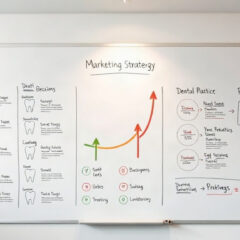
Dental marketing in 2026 is no longer a matter of paying for ads and waiting for the phone to ring. It is a systematic combination of organic visibility (local SEO, Google Business Profile, reviews), paid acquisition (Google Ads, Meta Ads), and retention programs (referral systems, patient communication platforms). The practices that grow consistently run all three layers in sequence, not in isolation.
Industry benchmarks for dental patient acquisition put cost-per-new-patient at $150-$300 across paid channels, with lifetime value ranging $8,000-$15,000 per retained patient. That ratio makes marketing one of the highest-return capital allocations available to a practice owner. The challenge is not whether to invest. It is how to sequence investment so each layer reinforces the next.
BrightLocal’s 2026 Local Consumer Review Survey shows 97% of consumers read online reviews for local businesses, and 31% now require a 4.5-star minimum rating to contact a practice. Reviews are the most leveraged marketing asset a dental office can build, and they are free to generate once the system is in place.
Key Benchmarks
| Channel | Cost Per New Patient | Quality Signal |
|---|---|---|
| Google Business Profile (organic local) | $0-$50 (free traffic) | Highest, in-market intent |
| Internal patient referrals | $0-$100 (incentive only) | Highest, lifetime value 2-3x |
| Google Ads (search) | $150-$300 | High, active search intent |
| Meta Ads (Facebook/Instagram) | $100-$250 | Moderate, brand building |
| Direct mail (targeted) | $200-$450 | Low-moderate |
| Insurance plan inclusion | $50-$150 effective | Moderate, price-shopping |
| SEO (organic search) | $20-$100 long-term | High, scalable |
Use the Overhead Calculator, Break-Even Calculator, or related tools to benchmark your practice against these ranges.
The Five-Layer Marketing Stack Every Practice Needs
1. Google Business Profile foundation
A fully optimized GBP with 50+ reviews, 100+ photos, weekly posts, and complete service categories is the single highest-ROI marketing asset most practices own. Google Business Profile traffic converts at 3-5x the rate of paid search for local intent queries.
2. Review generation system
Systematic review requests at checkout, post-appointment text reminders, and response to every review within 48 hours. Getting from 15 reviews to 50+ reviews consistently moves conversion rates on every other marketing channel upward. See review generation strategies.
3. Local SEO and website
Dental-specific local SEO, mobile-first design, and page speed under 2.5 seconds. Technical SEO, content depth on procedure pages, and schema markup for local business and dentist entity types. See the SEO for dentists guide.
4. Paid acquisition for scale
Google Ads for active-intent searches, Meta Ads for retargeting and brand building. Budget scales with capacity, adding paid traffic before the schedule can absorb new patients wastes spend. See 15 proven patient acquisition strategies.
5. Referral and retention systems
Internal patient referral programs, personalized thank-you notes, specialist referral relationships, and patient communication platforms (Weave, Birdeye, RevenueWell). Retention marketing delivers the highest-quality new patients at the lowest cost.
Frequently Asked Questions
How much should a dental practice spend on marketing?
Industry benchmarks place healthy dental marketing spend at 3-7% of gross collections for mature practices and 7-12% for growth-stage or startup practices. Practices below 3% typically see stagnant new patient flow; practices above 12% usually have either a startup situation or an inefficient spend allocation.
What is the best marketing channel for a dental practice?
Google Business Profile combined with a review generation system is the highest-ROI channel for most practices, with zero marginal cost and the highest intent-quality traffic. Google Ads is second for practices with capacity to absorb new patients. Internal referrals from existing patients produce the highest lifetime-value patients at the lowest cost.
How many Google reviews does a dental practice need?
The minimum threshold for credibility is 15-25 reviews at 4.5+ stars. The inflection point where Google prioritizes your listing in local 3-pack results is typically 50+ reviews with consistent recent activity. Practices below 10 reviews are functionally invisible in competitive local search.
Does paid search (Google Ads) work for dental practices?
Yes, for practices with capacity and a conversion system to handle the leads. Typical cost-per-new-patient runs $150-$300 through Google Ads. The math works if your average first-year patient value exceeds $1,500. It does not work if your schedule cannot absorb new patients or your phone conversion rate is below 25%.
How long does dental SEO take to show results?
Local SEO improvements (GBP optimization, review generation, citation building) show results in 30-90 days. Content-driven SEO for procedure and condition queries typically takes 6-12 months to rank competitively. Both require consistent execution over 12+ months to compound.
Content grounded in industry data from ADA Health Policy Institute, Bureau of Labor Statistics, Dental Economics, and broker-reported transition data, combined with applied practice consulting experience.