The EPA’s Dental Office Category Rule (40 CFR Part 441) requires most U.S. dental practices discharging to a public sewer and placing or removing amalgam to install and maintain an amalgam separator meeting a 95% removal standard (ISO 11143), follow two best management practices, and file a one-time compliance report with their Control Authority. Oral surgeons, orthodontists, periodontists, prosthodontists, oral pathologists, oral and maxillofacial radiologists, and mobile units are fully exempt. But the federal rule is a floor, not a ceiling, local sewer authorities (POTWs) often layer on stricter requirements, and a practice fully compliant federally can still be out of compliance locally. This guide covers the separator rule in full, plus the other waste streams, sharps, extracted teeth, lead foil, expired drugs, film chemicals, and biohazard waste, a practice owner is responsible for under different federal and state authorities.

Does the EPA Amalgam Separator Rule Apply to Your Practice?
The rule applies to the roughly 103,000 U.S. dental facilities discharging wastewater into a publicly owned treatment works, or POTW, a municipal sewer system, per EPA’s Dental Effluent Guidelines page. Three categories owe nothing under the rule, not even a compliance report, per EPA’s Frequently Asked Questions on the Dental Office Category Rule (EPA 822-S-17-002):
- Specialty-exclusive practices: oral pathology, oral and maxillofacial radiology, oral and maxillofacial surgery, orthodontics, periodontics, and prosthodontics.
- Mobile units: a self-contained van, trailer, or equipment set providing dentistry at multiple locations.
- Practices that never discharge amalgam wastewater to a POTW: for example, an office on a septic system, or using a retaining tank that captures 100% of amalgam wastewater and never releases it.
A fifth group has a lighter obligation: practices that don’t place amalgam and don’t remove it except in limited emergencies are exempt from the separator and BMP requirements, but must still file a compliance report certifying that status. Everyone else, general and pediatric dentists who routinely place or remove amalgam and discharge to a POTW, is fully subject to the rule.
Citation Capsule: Under 40 CFR 441.10, the Dental Office Category Rule fully exempts oral pathology, oral and maxillofacial radiology, oral and maxillofacial surgery, orthodontics, periodontics, prosthodontics, and mobile units from every requirement of the rule, including the compliance report itself (EPA FAQ, Nov. 2017).
The Separator Standard: 95% Removal, ISO 11143
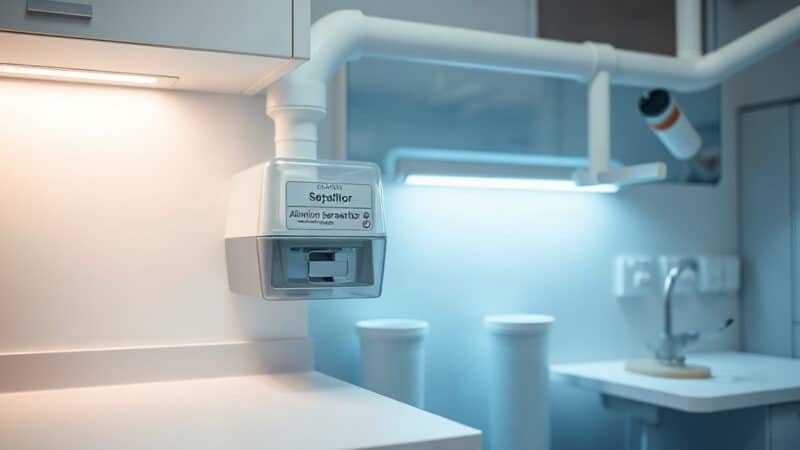
Where the rule applies, 40 CFR 441.30(a) requires an amalgam separator, or an equivalent device, that achieves at least a 95% removal efficiency under the ISO 11143 testing standard (2008 or a later version). EPA’s rule also allows non-separator technologies to satisfy the standard as an “equivalent device,” provided they hit the same removal efficiency. The compliance report just needs to describe what’s installed and how it performs.
A grandfather clause matters for older practices: a separator installed before June 14, 2017 can keep running past the general standard until June 14, 2027, or until it’s replaced, whichever comes first. As long as it’s still functioning properly. A practice using a grandfathered unit still had to file the one-time compliance report by the applicable deadline, and if that practice changes hands, the new owner may keep using the grandfathered separator under the same terms, but still owes a fresh compliance report (more on ownership transfers below).
The One-Time Compliance Report: Deadlines, Contents, and Who Signs It
Despite the name, “one-time” doesn’t mean “never again”. It means one report per triggering event, and a change of ownership is a triggering event. Deadlines depend on when the practice started discharging to a POTW, per EPA’s compliance FAQ:
| Situation | Compliance deadline | Report deadline |
|---|---|---|
| Existing source (discharging before July 14, 2017) | July 14, 2020 | October 12, 2020 |
| New source (first discharge after July 14, 2017) | Immediately upon first discharge | Within 90 days of first discharge |
| Ownership transfer of an existing source | N/A, standards already apply | By October 12, 2020, or within 90 days of the transfer if it occurred after July 15, 2020 |
| Ownership transfer of a new source | N/A, standards already apply | Within 90 days of the transfer |
If your practice has been open and discharging since before mid-2017, both original deadlines have passed, the trigger that matters going forward is almost always an ownership change.
Per 40 CFR 441.50(a), the report must include the facility’s name, address, and contact information; the operator(s)’ and owner(s)’ names; a description of the dental chairs and separators installed (make, model, installation year); certification that the separator(s) meet the performance standard and that both BMPs are followed; and either third-party servicer information or a description of in-house maintenance. It must be signed and certified by a responsible corporate officer, a general partner or proprietor, or a duly authorized representative: not just any staff member.
The report goes to your Control Authority: usually your local wastewater utility, but a state environmental agency (always the case in Alabama, Connecticut, Mississippi, Nebraska, and Vermont) or a U.S. EPA Regional Office in other cases. EPA runs no national submission portal; confirm you’re using your Control Authority’s current form. A sample federal template is posted at EPA’s Dental Effluent Guidelines page, but it’s a starting point, not a substitute for your local form.
Record Retention: What an Inspector Asks For First
40 CFR 441.50(b) sets a minimum three-year retention period for separator-related records, kept physically or electronically and available on request:
| Record | What it must show | Retention |
|---|---|---|
| Inspection records | Dates, personnel, results, and any follow-up action taken | 3 years minimum |
| Amalgam retaining container changes | Dates the collection container was replaced | 3 years minimum |
| Amalgam pickup and disposal | Dates and the name of the receiving facility | 3 years minimum |
| Repairs or replacement | Dates and a description of the work | 3 years minimum |
| Manufacturer’s operating manual | Current manual for the equipment in use | Life of the equipment |
This is separate from, and much shorter than, the multi-year and multi-decade schedules for OSHA training and exposure records covered in DPI’s OSHA compliance checklist. Keep amalgam records in their own file rather than assuming one retention calendar covers both.
The Two Prohibited Practices (Rule Requirements, Not Optional Tips)
40 CFR 441.30(b) writes two best management practices directly into the rule: both drain-side, governing what staff do at the sink and operatory, not just what equipment is installed:
- No discharging waste amalgam to a POTW. Covers amalgam from chair-side traps, screens, vacuum pump filters, tools, cuspidors, or any other collection device. Capture and recycle it, don’t rinse it down a drain.
- No oxidizing or acidic cleaners in lines that carry amalgam wastewater. Dental unit water lines, chair-side traps, and vacuum lines discharging amalgam wastewater can’t be cleaned with bleach, chlorine, iodine, peroxide, or anything oxidizing or below pH 6 / above pH 8. This applies specifically to amalgam-carrying lines, not the separate water-supply lines feeding handpieces, ultrasonic scalers, or air/water syringes.
The ADA (guidance, not federal mandate) adds practical detail in its Amalgam Separators and Waste Best Management resource: recycle extracted teeth that contain amalgam rather than placing them in biohazard, sharps, or general trash; recycle used disposable amalgam capsules the same way; never rinse an amalgam-containing trap or vacuum filter over a sink; and use precapsulated alloy rather than bulk mercury. ANSI/ADA Standard No. 109 defines “amalgam waste” broadly: scrap amalgam, trap and vacuum filters, saliva ejectors used in amalgam procedures, used capsules, amalgam-restored extracted teeth, and any contaminated item. A practice meeting only the federal minimum while ignoring the ADA’s extracted-teeth and capsule guidance is leaving an obvious gap.
One more wrinkle: amalgam collected in your separator is generally hazardous waste under RCRA due to its mercury and silver content. Most dental offices qualify as “Very Small Quantity Generators” (under 100 kg of hazardous waste and under 1 kg of acute hazardous waste per month, counting all hazardous waste generated, not just amalgam), exempting them from most RCRA paperwork, but confirm your actual monthly totals with your state hazardous waste authority rather than assuming.
The Point Most Compliance Content Skips: Your Local POTW Can Require More
Every EPA source used in this article says the same thing in different words: the federal rule is a floor, not a ceiling. Both the EPA compliance FAQ and the regulation’s own preamble state plainly that “dental facilities may be subject to additional or more stringent state or local requirements than those in the rule.” That means a practice can complete every federal step above. Separator installed, BMPs followed, compliance report filed, three years of records on hand, and still be out of compliance with its own city or county sewer authority.
In practice, POTWs commonly layer on things the federal rule doesn’t require at all: their own reporting cadence, their own inspection program, industrial discharge permits, pretreatment fees, or a specific approved-equipment list. None of that shows up if you only read 40 CFR Part 441. Before assuming you’re covered, call your Control Authority and ask what they require beyond the federal minimum: most competing content on this topic, largely written by separator vendors, skips this step entirely, and it’s the one most likely to catch a practice off guard at inspection.
Beyond Amalgam: The Full Dental Waste Management Picture
Amalgam separator compliance is the highest-profile waste rule a practice deals with, but it’s one line item in a broader responsibility spanning several agencies plus state law:
| Waste stream | Primary authority | Typical handling | Records to keep |
|---|---|---|---|
| Amalgam (scrap, traps, capsules) | EPA (40 CFR 441) | Separator + recycling vendor; never rinsed to drain | Inspection, pickup, and repair logs, 3 years |
| Sharps | OSHA (handling) + state medical/biomedical waste authority (disposal) | Puncture-resistant sharps containers; licensed medical waste hauler | Hauler manifests per state requirement |
| Extracted teeth with amalgam | EPA / ADA guidance | Recycle through amalgam waste stream, not biohazard or trash | Amalgam pickup log |
| Extracted teeth without amalgam | State medical/biomedical waste authority | Regulated medical waste unless returned to patient per state rule | Hauler manifests per state requirement |
| Lead foil / lead aprons | State environmental agency (RCRA characteristic waste) | Many states require recycling rather than trash disposal | Recycler receipts per state requirement |
| Fixer / developer (remaining film processing) | State environmental agency (silver-bearing waste) | Silver recovery unit, then licensed disposal or recycling | Recovery/disposal records per state requirement |
| Expired pharmaceuticals / controlled substances | DEA (21 CFR Part 1317) + state pharmacy law | On-site destruction to a non-retrievable state, reverse distributor, or authorized take-back | Destruction/transfer documentation per DEA rule |
| Disinfectants and other hazardous chemicals | OSHA HazCom + state hazardous waste rules | Follow SDS disposal guidance; do not pour down the drain | SDS library, current for every product on-site |
| General biohazard / red-bag waste | State medical waste authority | Red-bag containers; licensed biomedical waste hauler | Hauler manifests per state requirement |
Sharps handling and bloodborne pathogen exposure control is covered in depth in DPI’s OSHA Compliance Checklist: this article covers what happens to waste after it leaves the operatory, not OSHA’s exposure-control requirements.
For expired controlled substances, DEA regulations at 21 CFR 1317.05 give a registered practitioner three lawful paths: on-site destruction rendering the substance “non-retrievable,” delivery to a registered reverse distributor, or return to the registered supplier or manufacturer. Discarding controlled substances in general or biohazard waste is not compliant.
For the remaining streams, extracted teeth without amalgam, lead foil, film chemicals, and general biohazard waste, the controlling authority is typically state environmental or medical waste law rather than a single federal rule, and requirements vary meaningfully by state. Treat the table as a starting checklist for a conversation with your state agency and waste hauler, not a substitute for confirming your state’s specific rules.
Cost and Inspection: What to Expect
DPI has not independently verified separator hardware, installation, or recycling-contract pricing, and won’t publish a number we can’t stand behind on a regulatory topic. Directionally: expect a one-time hardware and installation cost plus a recurring line item for amalgam recycling/pickup and periodic maintenance or replacement. Get at least two vendor quotes covering both the hardware and the ongoing service contract, and have each vendor confirm in writing that the unit meets the ISO 11143 / 95% removal standard. That’s the figure your compliance report has to certify.
Most POTW inspections aren’t amalgam-specific sweeps. They’re general pretreatment visits where an inspector asks to see the compliance report on file, the separator’s operating manual, and the three-year inspection and pickup log. A missing or unsigned report, or a gap in the pickup log, is the kind of finding that turns a routine visit into a follow-up demand letter. Keeping the report, manual, and log in one folder that front-desk or office-manager staff can produce on request is the easiest way to shorten an inspection.
Buying or Selling a Practice: Compliance Doesn’t Transfer Automatically
A change of ownership is a compliance-report trigger. The old owner’s filing does not carry over, even if nothing about the equipment or operations changes. Buyers should treat this like OSHA and HIPAA diligence: confirm a separator is installed and ISO 11143-compliant, request the seller’s compliance report and three years of records, and budget for filing a new report within 90 days of closing. Sellers should have a current, complete compliance file ready to hand over. See DPI’s guide to buying a dental practice and guide to selling a dental practice for the rest of that diligence list.
A Practical Compliance Checklist
- Confirm applicability. Check the exemption categories above before assuming the rule applies.
- Verify your separator meets the standard. Get written vendor confirmation of 95% removal under ISO 11143, or confirm grandfather-clause eligibility if installed before June 14, 2017.
- File or re-file the compliance report. Especially after an ownership change, confirm your Control Authority and use their current form.
- Call your Control Authority about local requirements. Ask what they require beyond the federal minimum.
- Build the three-year record file. Inspection, container-change, pickup/disposal, and repair records, plus the operating manual.
- Train staff on the two BMPs. No amalgam down the drain, no oxidizing or acidic cleaners in amalgam-carrying lines.
- Map the rest of your waste streams. Confirm sharps, extracted teeth, lead foil, expired drugs, and biohazard waste with your state agency.
Frequently Asked Questions
Does every dental practice need an amalgam separator?
No. Practices exclusively performing oral pathology, oral and maxillofacial radiology, oral and maxillofacial surgery, orthodontics, periodontics, or prosthodontics are fully exempt, as are mobile units and practices that don’t discharge amalgam wastewater to a public sewer. General and pediatric practices that place or remove amalgam and discharge to a POTW are subject to the rule.
What removal efficiency does an amalgam separator need to meet?
At least 95%, measured under the ISO 11143 testing standard, per 40 CFR 441.30(a). Non-separator “equivalent devices” are allowed if they meet the same removal efficiency.
Who do I send the one-time compliance report to?
Your Control Authority, usually your local wastewater utility, though it’s your state environmental agency in Alabama, Connecticut, Mississippi, Nebraska, and Vermont, or a U.S. EPA Regional Office in some cases. There’s no single national submission portal; contact your Control Authority for their current form.
Do I need to file a new report if I buy or sell a dental practice?
Yes. A change of ownership requires the new owner to submit a new report, even if nothing about the equipment or operations changes. Deadlines depend on whether the practice was an existing or new source at the time of transfer.
How long do I need to keep amalgam separator records?
A minimum of three years for inspection, container-replacement, pickup/disposal, and repair records, per 40 CFR 441.50(b). Keep the manufacturer’s operating manual for as long as the equipment is in use.
Can my city or county require more than the federal rule?
Yes, and often does. The federal rule is explicitly a floor, not a ceiling. Local POTWs can require additional reporting, inspections, permits, or equipment specifications. Confirm directly with your Control Authority rather than assuming federal compliance is sufficient.
Is amalgam waste hazardous waste?
Generally yes, under RCRA, due to mercury and silver content, but most dental offices qualify as Very Small Quantity Generators based on total monthly hazardous waste output, exempting them from most RCRA paperwork. Confirm your generator status with your state hazardous waste authority.
How do I dispose of expired controlled substances in a dental practice?
DEA regulations (21 CFR 1317.05) allow a registered practitioner to destroy the substance on-site using a non-retrievable method, deliver it to a registered reverse distributor, or return it to the registered supplier or manufacturer. General trash or biohazard disposal is not compliant.
This article is general information for dental practice owners and is not legal, environmental compliance, or regulatory advice. Amalgam separator, waste management, and hazardous waste requirements vary by state, county, and local sewer authority, and can change; confirm current requirements with your Control Authority, state environmental agency, and a qualified compliance professional before acting. Last updated: September 5, 2026, based on primary sources fetched and cited above.
Related Resources
- Dental Practice OSHA Compliance Checklist: the Bloodborne Pathogens, Hazard Communication, and PPE standards that govern how waste is handled before it leaves the operatory, plus 2026 penalty figures.
- HIPAA Compliance for Dental Practices: the third pillar of DPI’s compliance coverage, for the privacy and security side of running a practice.
- Practice Management: DPI’s hub for the operational side of running a dental practice, including compliance, staffing, and finance.