OSHA compliance for a dental practice means meeting five federal standards, Bloodborne Pathogens (29 CFR 1910.1030), Hazard Communication (1910.1200), Personal Protective Equipment (1910.132), Respiratory Protection (1910.134) where applicable, and Ionizing Radiation (1910.1096): each backed by a written program, documented training, and specific recordkeeping. As of September 2026, the maximum penalty for a serious or other-than-serious violation is $16,550, and willful or repeat violations top out at $165,514 per violation, with failure-to-abate penalties accruing at up to $16,550 per day past the deadline (OSHA’s 2026 civil penalty schedule carried the 2025 amounts forward after a lapsed CPI-U data release cancelled the usual inflation adjustment). Most dental OSHA inspections are complaint-driven, not random, and the single most commonly cited gap is a missing or stale written Exposure Control Plan. This checklist covers every standard, the current penalty table, an 8-step self-audit, and the document retention periods inspectors ask for first.
The OSHA Standards That Actually Apply to a Dental Practice
Dental offices are not exempt from OSHA because they are small or because they are healthcare, not manufacturing. The OSHA General Industry standards apply in full, and five of them cover nearly every compliance gap that shows up in a dental office inspection.
Bloodborne Pathogens Standard: 29 CFR 1910.1030
This is the standard OSHA inspectors reach for first in any dental office, and the one most frequently cited. It requires a written Exposure Control Plan, updated annually and any time new procedures or equipment change occupational exposure, plus universal precautions, engineering controls (sharps disposal, safer needle devices), free Hepatitis B vaccination for at-risk staff, and post-exposure follow-up. Training on this standard is required at hire and annually thereafter.
Hazard Communication Standard: 29 CFR 1910.1200
Covers every chemical in the office: disinfectants, sterilization solutions, amalgam, acid etch, nitrous oxide. Requires a written Hazard Communication program, a current Safety Data Sheet (SDS) for every hazardous chemical on-site, GHS-compliant container labeling, and employee training. OSHA’s revised HazCom rule (finalized 2024) pushed the employer compliance deadline for updated labels, written programs, and training from July 20, 2026 to November 20, 2026 after a January 2026 extension, practices still using pre-2024 SDS formats or labeling should not wait until the deadline to start updating.
Personal Protective Equipment: 29 CFR 1910.132
Requires a written PPE hazard assessment for clinical and sterilization areas, and documentation of PPE selection (gloves, masks, eyewear, gowns) tied to the specific tasks performed in that operatory or sterilization bay.
Respiratory Protection: 29 CFR 1910.134 (Task-Dependent)
Applies when staff wear N95 respirators or equivalent, most commonly for aerosol-generating procedures. Triggers a written respiratory protection program, medical evaluation, and fit testing for any employee required to wear a tight-fitting respirator.
Ionizing Radiation: 29 CFR 1910.1096
Governs dental X-ray equipment: operator training, area monitoring or dosimetry where indicated, and posted radiation area signage. This standard interacts with state dental board radiography rules, which are often stricter than the federal floor.
2026 OSHA Maximum Penalties for Dental Practices
These are the current published maximums as of September 2026. There was no Consumer Price Index inflation adjustment for 2026, the Bureau of Labor Statistics did not release October 2025 CPI-U data on schedule, and the Federal Civil Penalties Inflation Adjustment Act allows no alternative calculation, so OSHA carried the 2025 dollar amounts forward unchanged (per the Federal Register notice published May 27, 2026).
| Violation Type | Maximum Penalty (2026) | What Triggers It |
|---|---|---|
| Other-Than-Serious | $16,550 per violation | Technical violation with limited or no direct hazard to employees |
| Serious | $16,550 per violation | Violation where a hazard exists that could cause death or serious physical harm |
| Willful | $165,514 per violation (min. $11,823) | Intentional disregard of, or plain indifference to, OSHA requirements |
| Repeat | $165,514 per violation | Substantially similar violation cited in the prior 5 years, now a final order |
| Failure-to-Abate | Up to $16,550 per day past the deadline, uncapped | Hazard not corrected by the date set in a prior citation |
Citation Capsule: As of September 2026, OSHA’s maximum civil penalty is $16,550 per serious or other-than-serious violation and $165,514 per willful or repeat violation, unchanged from 2025 because the 2026 inflation adjustment was cancelled (Federal Register, May 27, 2026; osha.gov/penalties). A missed abatement deadline can compound daily with no statutory ceiling, a 30-day failure-to-abate on a single serious violation can exceed $490,000.
For context on where this money actually comes from in a practice’s operating budget, see how these staffing and overhead line items get modeled in our dental office overhead breakdown, which is unrelated to compliance risk but shows how a single five- or six-figure fine compares to typical monthly operating costs.
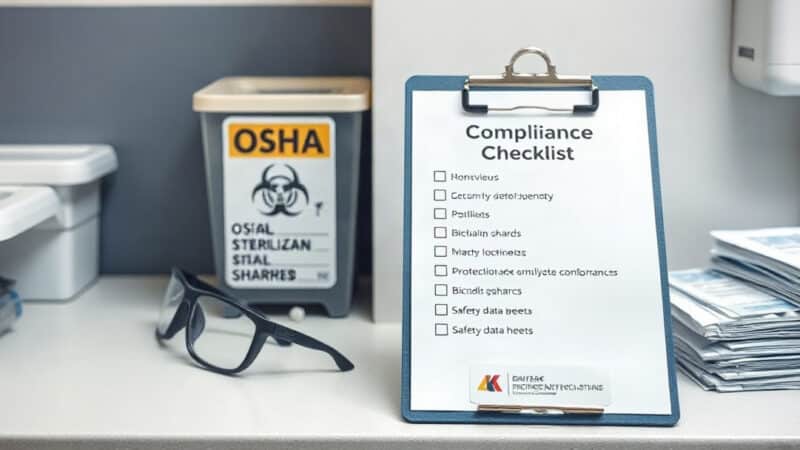
The Full Dental OSHA Compliance Checklist
Organize compliance work into these seven buckets. Every item below maps to something an inspector will ask to see, in roughly the order they ask for it.
1. Written Programs
- Bloodborne Pathogens Exposure Control Plan (reviewed and updated at least annually, 1910.1030(c)(1)(iv))
- Hazard Communication written program, current SDS binder or digital library for every hazardous chemical on-site
- PPE hazard assessment, documented in writing per work area
- Respiratory Protection Program, if any staff wear tight-fitting respirators
- Emergency action plan and fire prevention plan
2. Training and Documentation
- Bloodborne pathogens training at hire and annually, with sign-in sheets and content outline retained
- Hazard communication training covering GHS labels and SDS access, at hire and when new hazards are introduced
- PPE training specific to each employee’s assigned tasks
- Fit testing and medical evaluation records for any respirator wearer
- Radiation safety training for anyone operating dental X-ray equipment
3. Engineering Controls
- Sharps disposal containers, puncture-resistant, labeled, and not overfilled
- Safer medical devices (retractable/self-sheathing needles) evaluated annually with frontline staff input, documented on the Sharps Injury Log evaluation
- Eyewash stations where corrosive or irritant chemicals are used, tested and logged
- Handwashing facilities accessible in every clinical area
4. Personal Protective Equipment
- Gloves, masks, protective eyewear, and gowns available and correctly sized for every clinical staff member
- PPE removal and disposal procedures posted and followed at chairside
- Employer-provided (not employee-purchased) PPE, per 1910.132(h)
5. Exposure Control
- Hepatitis B vaccination offered free of charge within 10 working days of initial assignment, with declination forms on file for anyone who opts out
- Post-exposure evaluation and follow-up procedure with a named healthcare professional
- Universal precautions applied to all patient contact regardless of known infection status
6. Recordkeeping
- OSHA 300 log (injury and illness log) if the practice is not exempt by size, plus the 300A annual summary posted February 1, April 30
- Sharps Injury Log, maintained separately, retained 5 years
- Medical records for exposure-related events, retained for the duration of employment plus 30 years (1910.1020)
- Training records, retained a minimum of 3 years from the date of training
7. Signage
- Biohazard labels on sharps containers, regulated waste, and contaminated equipment
- Radiation area signage in and around X-ray rooms
- Emergency exit and fire equipment signage per general industry standards
- SDS access location posted or communicated to all staff
What Actually Triggers an OSHA Inspection at a Dental Practice
Most dental practices never see a random OSHA visit. Federal OSHA’s own enforcement data and industry compliance trackers point to three real triggers, and understanding which one applies changes how you prepare.
Complaint-driven. The most common trigger by far. A current or former employee files a written complaint, typically alleging a specific hazard, often bloodborne pathogens exposure control, missing PPE, or a sharps injury that wasn’t handled per protocol. OSHA is legally obligated to respond to formal complaints, and the resulting inspection is usually scoped narrowly to the alleged hazard, though inspectors can expand scope if they observe other violations in plain view.
Referral. A report from another government agency (a state dental board, a hospital emergency department treating an occupational exposure, or a workers’ compensation claim) can trigger a referral inspection.
Programmed inspection. Less common for a single dental office, these come from industry-wide injury and illness rate data or from National Emphasis Programs targeting specific hazards. With OSHA facing significant staffing constraints in 2026. Industry estimates put federal inspector coverage at roughly one inspector per 84,000 covered workers, programmed inspections increasingly concentrate on higher-injury industries, making complaint- and referral-driven inspections the dominant real-world risk for a typical dental practice.
The practical implication: your best defense isn’t hoping you’re never picked for a random audit. It’s making sure that if a disgruntled employee or a sharps injury report ever puts your name in front of an OSHA area office, the exposure control plan, training logs, and sharps log are already in order.
How to Run an Internal OSHA Self-Audit
Run this eight-step self-audit annually, and after any change in staff, procedures, or equipment. Budget a half-day for a single-location general practice.
- Pull every written program and check the review date. The Exposure Control Plan must show an annual review date within the last 12 months. If it doesn’t, that’s your first fix, before anything else.
- Cross-check the SDS library against what’s actually in the office. Walk the sterilization area and every operatory, list every chemical product, and confirm a current SDS exists for each one. Flag anything reformulated or discontinued.
- Audit training records against current staff. Every current employee should have bloodborne pathogens and hazard communication training on file, dated within the required interval, with a legible sign-in sheet or LMS completion record.
- Inspect engineering controls physically. Check sharps containers for overfill lines, confirm eyewash stations flow and are logged, and verify safer-device evaluation documentation is current.
- Verify PPE availability and fit. Confirm gloves, masks, and eyewear are stocked in the correct sizes and that no employee is supplying their own PPE.
- Review the Hepatitis B vaccination and declination file. Every current clinical employee should have either a vaccination record or a signed declination on file.
- Confirm the Sharps Injury Log and OSHA 300 log are current and correctly retained. Check that retention periods match the schedule in the table below, not just “we still have the folder somewhere.”
- Walk the signage. Confirm biohazard labels, radiation signage, and the OSHA 300A summary (during posting season) are visible where required.
Penalty Tiers and Required Document Retention Periods
Two numbers matter most when an inspector walks in: how much a gap could cost, and how long you’re required to have kept the document that would have closed it.
| Requirement | Retention / Amount | Standard |
|---|---|---|
| Serious / other-than-serious violation, max penalty | $16,550 per violation | 29 CFR 1903.15 |
| Willful / repeat violation, max penalty | $165,514 per violation | 29 CFR 1903.15 |
| Failure-to-abate, daily accrual | Up to $16,550/day, no cap | 29 CFR 1903.15 |
| Bloodborne pathogens training records | 3 years from training date | 1910.1030(h)(2) |
| Sharps Injury Log | 5 years | 1904.33 / 1910.1030(h)(5) |
| OSHA 300 injury and illness log | 5 years | 1904.33 |
| Employee medical / exposure records | Duration of employment + 30 years | 1910.1020(d) |
| Hazard Communication SDS records | 30 years (as exposure records, where applicable) | 1910.1020(d) |
Frequently Asked Questions
What does OSHA compliance mean for a dental practice?
It means maintaining written programs, documented training, and required records for the specific OSHA standards that apply to dental work, primarily Bloodborne Pathogens (1910.1030), Hazard Communication (1910.1200), and PPE (1910.132), plus Respiratory Protection and Ionizing Radiation where the practice’s procedures trigger them.
Do small dental practices have to comply with OSHA?
Yes. OSHA’s general industry standards apply regardless of practice size. Some recordkeeping exemptions exist for very small employers (10 or fewer employees, tracked by prior calendar year headcount) under the OSHA 300 log requirement, but the written programs, training, and PPE requirements still apply.
How much can OSHA fine a dental office in 2026?
Up to $16,550 per serious or other-than-serious violation, and up to $165,514 per willful or repeat violation, as of September 2026. Failure-to-abate penalties can accrue at up to $16,550 per day past the correction deadline with no statutory cap.
What is the most commonly cited OSHA violation in dental offices?
Gaps in the Bloodborne Pathogens Exposure Control Plan: most often a missing annual review, incomplete Hepatitis B vaccination or declination records, or an outdated safer-device evaluation, are the most frequently cited issues in dental settings, based on industry compliance-tracking data.
How often does the Exposure Control Plan need to be updated?
At least annually, and whenever new tasks, procedures, or equipment change occupational exposure, per 1910.1030(c)(1)(iv).
What triggers an OSHA inspection at a dental office?
Most dental inspections are complaint-driven, filed by a current or former employee. Referrals from other agencies (state dental boards, hospitals treating an exposure incident) and programmed inspections tied to industry injury data are less common triggers.
How long do OSHA training records need to be kept?
Bloodborne pathogens training records must be kept for 3 years from the date of training. Employee medical and exposure records have a much longer retention requirement of employment duration plus 30 years under 1910.1020.
Does OSHA require Hepatitis B vaccination for dental staff?
OSHA requires employers to offer Hepatitis B vaccination free of charge to employees with occupational exposure, within 10 working days of initial assignment. Employees may decline, but a signed declination form must be kept on file.
What is the OSHA HazCom deadline dental practices need to know about in 2026?
Employer compliance with the updated Hazard Communication Standard’s labeling, written program, and training requirements was extended from July 20, 2026 to November 20, 2026, following a January 2026 Federal Register extension. Practices should not wait until the deadline to update SDS formats and labels.
Do dental hygienists and assistants need separate OSHA training from dentists?
No, OSHA training requirements apply by task and exposure risk, not by job title. Anyone with reasonably anticipated occupational exposure to blood or hazardous chemicals needs the same core Bloodborne Pathogens and Hazard Communication training, tailored to their specific duties.
Is dental X-ray equipment covered by a separate OSHA standard?
Yes. Ionizing Radiation (29 CFR 1910.1096) covers X-ray operator training and area signage requirements, and typically works alongside stricter state dental board radiography rules, which practices must also meet.
Can an OSHA violation be reduced or dismissed?
Yes. Penalties can be adjusted downward based on employer size, good faith, and violation history, and employers can contest citations through the informal conference process or a formal appeal to the Occupational Safety and Health Review Commission.
Related Resources
This is the anchor post in DPI’s new compliance cluster. Two companion pieces are in production and will cover amalgam separator compliance under the EPA’s dental effluent rule, and HIPAA compliance specifics for dental practices in 2026. Both will be linked here once published.
For related operational and staffing context already live on DPI:
- Dental Practice SOPs: how written programs like an Exposure Control Plan fit into a practice’s broader standard operating procedure library
- Dental Practice Cybersecurity: the adjacent compliance risk most practices underweight relative to OSHA
- Dental Staff Hiring and Compensation: where OSHA training requirements need to be built into onboarding from day one
Last updated: September 5, 2026. Penalty figures reflect OSHA’s 2026 civil penalty schedule as published by the Federal Register on May 27, 2026; figures are unchanged from 2025 due to a cancelled inflation adjustment and should be reconfirmed against osha.gov/penalties before relying on them for a specific citation response.