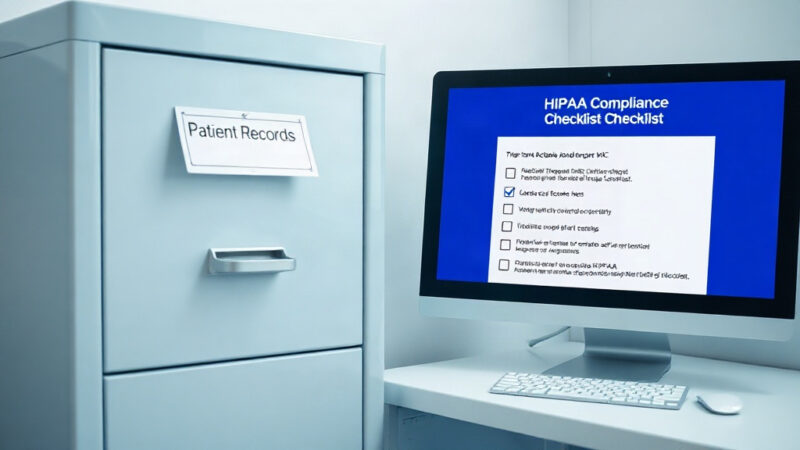
A dental practice is a HIPAA “covered entity” the moment it transmits health information electronically for insurance claims, eligibility checks, or remittances, which describes nearly every practice in the country (45 CFR §160.103). Covered entities must comply with three federal rules: the Privacy Rule (use and disclosure of patient information), the Security Rule (protecting electronic PHI), and the Breach Notification Rule. The single most-cited deficiency in OCR enforcement is a missing or outdated Security Risk Analysis: HHS guidance is explicit that this is ongoing, not a one-time project. Civil penalties run in four tiers from $145 to $2,190,294 per violation category per year as of 2026 (45 CFR §160.404; 45 CFR Part 102). This guide covers the three rules, the dental-specific risk areas most compliance content skips: intraoral photos on personal phones, open-bay operatories, review responses, practice transitions, and links every regulatory claim to its federal source.
For related reading, see our guide on efficient dental clinic management.
Does HIPAA Apply to Your Dental Practice?
Yes, almost certainly. Under 45 CFR §160.103, a “covered entity” includes any health care provider who transmits health information in electronic form in connection with a transaction covered by the HIPAA Administrative Simplification rules: electronic insurance claims, eligibility inquiries, remittance advice, or referral authorizations. A practice that submits claims electronically, checks eligibility online, or uses a cloud-based practice management system is a covered entity regardless of size. The narrow group outside this definition, a cash-only practice that never transmits anything electronically to a payer, is rare.
HIPAA also reaches beyond the practice itself. Any vendor who creates, receives, maintains, or transmits protected health information (PHI) on the practice’s behalf is a “business associate” under the same regulation, and is directly liable for parts of the HIPAA Rules in its own right.
The HHS Office for Civil Rights (OCR) enforces HIPAA. Audits and investigations are triggered by patient complaints, breach reports, or, less commonly, random compliance reviews. For related reading, see our guide on dental practice economics.
The Privacy Rule: What It Requires
The Privacy Rule (45 CFR Part 164, Subpart E) governs the use and disclosure of PHI, any individually identifiable health information in any format: paper, electronic, or oral. Key requirements:
- Notice of Privacy Practices (NPP): every patient receives your NPP at first contact, with a signed or documented good-faith acknowledgment on file.
- Minimum necessary standard: share only the PHI a specific purpose requires, front-desk staff scheduling appointments don’t need full clinical notes.
- Permitted disclosures: PHI may be used and disclosed for treatment, payment, and health care operations without additional authorization; marketing uses require written authorization, with narrow exceptions.
- Reasonable safeguards and incidental disclosure: HHS guidance makes clear the Rule doesn’t require eliminating every risk of an overheard conversation or a glimpsed sign-in sheet. It requires reasonable safeguards and minimum-necessary discipline for the underlying disclosure, covered in detail below.
The Security Risk Analysis: The Deficiency OCR Cites Most
The Security Rule (45 CFR Part 164, Subpart C) applies to electronic PHI (ePHI) and requires administrative, physical, and technical safeguards. Its foundational requirement, and the single most commonly cited gap in OCR investigations, is the Security Risk Analysis, a required implementation specification under the Security Management Process standard: “Conduct an accurate and thorough assessment of the potential risks and vulnerabilities to the confidentiality, integrity, and availability of electronic protected health information held by the covered entity” (45 CFR §164.308(a)(1)(ii)(A)).
Two points from HHS’s Risk Analysis guidance are where most practices go wrong. First, it’s not one-time: “The risk analysis process should be ongoing. In order for an entity to update and document its security measures ‘as needed,’ which the Rule requires, it should conduct continuous risk analysis to identify when updates are needed” (45 CFR §§164.306(e), 164.316(b)(2)(iii)). Second, there’s no fixed schedule: “The Security Rule does not specify how frequently to perform risk analysis… Some covered entities may perform these processes annually or as needed… depending on circumstances of their environment.” A new PMS, a change in ownership, a security incident, or new cloud imaging software should all trigger a fresh look, independent of any annual calendar. A risk analysis binder from three years ago with no updates since is not compliance. It’s the exact gap OCR investigators ask about first.
Administrative, Physical, and Technical Safeguards
- Administrative: designate a Security Officer (often the office manager); maintain the risk analysis and a corresponding risk management plan; train staff at hire and periodically thereafter; keep a tested backup and disaster-recovery plan.
- Physical: control access to workstations that touch ePHI; keep screens out of other patients’ sightlines; auto-lock idle workstations; use certified destruction for retired hard drives, not simple deletion.
- Technical (45 CFR §164.312): unique logins for every workforce member (no shared passwords, a required spec); automatic logoff; audit controls logging who accessed which record and when; encryption of ePHI, currently “addressable”: implement it, or document why an equivalent safeguard is used instead, not that it’s optional.
Is the Security Rule Changing? What’s Proposed vs. Final
In December 2024, HHS OCR published a Notice of Proposed Rulemaking to substantially update the Security Rule, including making multi-factor authentication and encryption of ePHI mandatory rather than addressable. As of this writing, this is a proposed rule, not a final one: it drew heavy public comment in 2025 and its path to finalization has been affected by a broader regulatory review, so nothing in it is currently enforceable. Don’t let a vendor tell you MFA is “now required by HIPAA”; it’s required by good security practice and many cyber-insurance policies, but the federal Security Rule itself hasn’t been amended yet.
The Breach Notification Rule: Thresholds and Timelines
A “breach” under 45 CFR §164.402 is any acquisition, access, use, or disclosure of unsecured PHI not permitted under the Privacy Rule that compromises its security or privacy, and it is presumed to be a breach unless a documented four-factor risk assessment shows low probability the PHI was compromised. Those factors: the nature and extent of the PHI (including re-identification risk); who received it; whether it was actually acquired or viewed; and how far the risk has been mitigated. What happens next depends on how many people were affected:
| Requirement | Fewer than 500 individuals | 500 or more individuals |
|---|---|---|
| Notify affected individuals | Without unreasonable delay, no later than 60 calendar days after discovery | Without unreasonable delay, no later than 60 calendar days after discovery |
| Notify HHS Secretary | Annually, no later than 60 days after the end of the calendar year in which the breach was discovered | Without unreasonable delay, no later than 60 days after discovery (contemporaneous with individual notice) |
| Notify the media | Not required | Required if the breach affects more than 500 residents of a single state or jurisdiction, notify prominent media outlets serving that area, on the same 60-day timeline |
| Regulatory citation | 45 CFR §164.408(c) | 45 CFR §§164.404, 164.406, 164.408(b) |
One detail practices frequently miss: encrypted PHI that is lost or stolen is generally not a reportable breach at all, because it isn’t “unsecured” PHI under the Rule: another concrete reason encryption matters even while it remains an addressable, not required, technical safeguard.
Business Associate Agreements: Who Actually Needs One
A Business Associate Agreement (BAA) is a required contract with any vendor who creates, receives, maintains, or transmits PHI on the practice’s behalf. HHS’s guidance on business associates lists cloud service providers, EHR/imaging vendors, IT contractors with system access, independent transcriptionists, and, explicitly, “a third-party vendor artificial intelligence (AI) chatbot on a provider’s patient portal” as business associates. Missing BAAs are among the most common findings in OCR audits.
| Vendor or service | BAA needed? | Why |
|---|---|---|
| Practice management / imaging software vendor (cloud PMS, EHR, imaging platform) | Yes | Creates, receives, maintains, or transmits PHI as its core function |
| Dental billing service or clearinghouse | Yes | Processes claims containing PHI on the practice’s behalf |
| IT support / managed services provider with remote access to systems holding ePHI | Yes | Has routine access to ePHI while providing support |
| Document shredding / record destruction service | Yes | Handles PHI-bearing records as its function, even briefly, not incidental access |
| Patient answering service or call center that accesses schedules/records | Yes | Accesses PHI to perform scheduling or triage on the practice’s behalf |
| AI scribe, transcription tool, or chatbot with patient portal access | Yes | HHS guidance specifically names AI chatbots and transcription vendors as business associates when they touch PHI |
| Janitorial service or electrician with no intended PHI access | No | Access, if any, is incidental and unintended, the conduit/incidental-access exception applies |
| Health plan receiving a claim for payment | No | Each party acts as its own covered entity in a treatment/payment exchange, not as the other’s business associate |
| US Postal Service or a courier transmitting sealed records | No | The “conduit exception” applies to entities that only transmit PHI without accessing its content |
Request BAAs from every vendor before sharing patient data, and don’t accept “we don’t need one” from a vendor whose product plainly touches PHI. Most major platforms have a template ready.
HIPAA Penalty Tiers: What’s Actually at Stake
Civil penalties are set at 45 CFR §160.404 in four culpability tiers, adjusted annually for inflation under 45 CFR Part 102. Current amounts as of 2026:
| Tier | Culpability | Per-violation range (2026) | Annual cap per violation category (2026) |
|---|---|---|---|
| 1 | Did not know, and by reasonable diligence would not have known | $145-$73,011 | $2,190,294 |
| 2 | Reasonable cause, not willful neglect | $1,461-$73,011 | $2,190,294 |
| 3 | Willful neglect, corrected within 30 days of discovery | $14,602-$73,011 | $2,190,294 |
| 4 | Willful neglect, not corrected within 30 days | $73,011-$2,190,294 | $2,190,294 |
These figures took effect with HHS’s January 2026 inflation adjustment and are republished annually, so confirm current amounts before relying on them for a specific matter. Criminal penalties for knowing misuse of PHI are handled separately by the Department of Justice, outside OCR’s civil enforcement authority.
Patient Right of Access: Timelines and Fees
Under 45 CFR §164.524, a covered entity must give a patient access to their own PHI, including dental records and images, no later than 30 calendar days from the request. If the practice can’t meet that window, it may take one 30-day extension, but only by notifying the patient in writing, within the original 30 days, of the reason and the new date. Only one extension is permitted per request.
Fees are also constrained: a “reasonable, cost-based fee” may cover only labor for copying, supply costs (paper or a CD/USB drive), postage if mailed, and preparation of a summary if agreed to, it may not include verifying identity, searching for and retrieving the record, or maintaining record systems, even where state law would otherwise allow it. DPI editorial note: access requests are a frequent, low-visibility source of exposure precisely because the failure mode is usually process, not malice, a request left unanswered past 30 days because “we’ll get to it” is a documented violation the moment it crosses that line.
Dental-Specific HIPAA Risk Areas
These are the risk areas specific to how a dental practice actually operates.
Intraoral Photos and Imaging on Personal Devices
An intraoral photo, panoramic film, or CBCT scan linked to a patient’s identity is PHI the moment it’s captured, and ePHI once stored or transmitted digitally. The recurring failure mode: a clinician snaps a photo on a personal phone “to show the doctor,” and it sits unencrypted in the camera roll, outside any audit log or backup policy, potentially synced to a personal cloud account. Policy should either prohibit clinical photography on personal devices or route it through a secured, practice-owned device with automatic deletion once filed to the chart.
Operatory Layout and Incidental Disclosure
Open-bay operatories are common and not inherently a HIPAA violation, but they raise the incidental-disclosure bar. HHS’s guidance is explicit that the Privacy Rule “does not require that all risk of incidental use or disclosure be eliminated,” citing “speaking quietly when discussing a patient’s condition… in a waiting room or other public area” as a reasonable safeguard. Applied to an open bay: keep treatment-plan and cost discussions below a volume audible to the next chair, and position monitors and paperwork away from other patients’ sightlines.
Front-Desk Sign-In Sheets and Calling Patients by Name
A sign-in sheet listing only patient names is a permitted incidental disclosure. HHS guidance explicitly cites sign-in sheets as the kind of unavoidable disclosure the Privacy Rule tolerates given reasonable safeguards. The same covers calling a name in the waiting room. The line is crossed by adding clinical detail: a sheet or callout referencing a procedure, diagnosis, or balance turns a permitted incidental disclosure into an avoidable one.
Text and Email Appointment Reminders
Standard SMS and unencrypted email aren’t secure, so they shouldn’t carry clinical detail. A generic reminder (“You have an appointment tomorrow at 2pm”) is broadly acceptable; a text naming a procedure or balance is not, unless sent through a HIPAA-compliant platform under a BAA. Document each patient’s communication preference.
Reviews and Social Media: A Real Enforcement Risk
Responding to a negative review by referencing a patient’s name, appointment date, treatment, or balance, even to correct the record, discloses PHI without authorization. It’s a common, avoidable violation because it happens in public: the safer response acknowledges the concern generically without confirming the reviewer was ever a patient. See DPI’s Dental Practice Local SEO playbook for a review-response process that protects reputation and compliance together.
PMS and Imaging Software: Access Controls, Audit Logs, and Staff Termination
Unique logins and audit logs (45 CFR §164.312) are what let a practice answer “who looked at this chart, and when.” Two gaps recur: shared front-desk logins that make audit logs meaningless, and terminated employees whose PMS, imaging, and cloud accounts stay active past their last day. Access revocation belongs on the termination checklist itself; see DPI’s Dental Cybersecurity guide for deeper technical safeguards.
Practice Transitions: Records When a Practice Is Sold
HIPAA obligations don’t pause during a sale. The buyer typically assumes custodial responsibility for existing records and must honor Right of Access requests; the purchase agreement should address record custody, patient notification, and whether existing BAAs are assigned or re-executed. Compliance history belongs in diligence alongside the financials, see DPI’s guides to buying and selling a dental practice, and the amalgam separator guide for the parallel environmental transfer requirements.
Third-Party AI and Transcription Tools
AI scribes and ambient-listening note tools are proliferating in dental practices, and HHS’s business associate guidance now names this category directly: an AI chatbot or tool touching PHI on a covered entity’s behalf is a business associate and needs a BAA. Before adopting one, confirm in writing whether the vendor will sign a BAA, where data is processed, and whether patient data trains the vendor’s models.
Most Common HIPAA Violations in Dental Practices
- No current Security Risk Analysis: the single most cited deficiency in OCR investigations, and the one most practices assume they’ve “already done” once.
- Missing or incomplete BAAs: especially with newer cloud tools, AI add-ons, or answering services adopted informally without a compliance review.
- Inadequate or undocumented staff training: training that happened but was never logged is functionally the same as training that didn’t happen, from an audit perspective.
- Improper disposal of records or devices: paper in recycling, hard drives sold or discarded without certified destruction.
- Slow or ignored Right of Access requests: missing the 30-day window is a documented violation regardless of intent.
- Access left active after termination: former staff retaining PMS or cloud logins past their last day.
HIPAA Compliance Checklist for Dental Practices
- [ ] Privacy and Security Officer designated
- [ ] Notice of Privacy Practices current, with acknowledgment on file for every patient
- [ ] Security Risk Analysis completed and reviewed on an ongoing basis, with a risk management plan addressing its findings
- [ ] BAAs in place with every vendor touching PHI: cloud PMS, imaging, billing, IT support, answering services, shredding, and any AI/transcription tools
- [ ] HIPAA and security training documented for all current staff, at hire and periodically thereafter
- [ ] Unique logins for every workforce member and audit logs enabled and reviewed on PMS and imaging systems
- [ ] Access revocation built into the staff termination checklist
- [ ] Workstation and monitor placement, plus a clinical-photography-on-personal-devices policy, reviewed for incidental-disclosure risk
- [ ] ePHI encrypted in transit and at rest, or a documented reason and equivalent safeguard on file, with a tested backup and disaster recovery plan
- [ ] Breach response procedure written, including the 60-day/500-individual decision tree above
- [ ] Right of Access process documented and tracked against the 30-day clock
HIPAA compliance is one piece of a broader practice governance framework. For growth strategies that integrate compliance with operational excellence, see our guide on effective growth strategies for dental practices, and DPI’s OSHA Compliance Checklist for the parallel safety-compliance picture.
Frequently Asked Questions
What is the penalty for HIPAA violations in dental practices?
Civil penalties fall into four tiers based on culpability, from $145 to $73,011 per violation for unknowing violations up to $73,011 to $2,190,294 per violation for uncorrected willful neglect, with an annual cap of $2,190,294 per violation category as of 2026 (45 CFR §160.404, 45 CFR Part 102). These figures adjust for inflation annually, so confirm the current amounts before relying on them for a specific matter.
Do dental X-rays and intraoral photos fall under HIPAA?
Yes. Any image linked to a patient’s identity is PHI, and once stored or transmitted digitally it’s ePHI subject to the full Security Rule: encryption in transit, access controls, and audit logging all apply. Images captured on personal, unmanaged devices are a common and avoidable compliance gap.
Is calling a patient’s name in the waiting room a HIPAA violation?
No. HHS’s guidance on incidental disclosures specifically treats sign-in sheets and normal waiting-room practices as permitted incidental disclosures when reasonable safeguards are in place. The line is crossed when clinical detail is added: a callout or sign-in sheet that includes a diagnosis, procedure, or balance is no longer incidental.
Do AI scribes and transcription tools need a Business Associate Agreement?
Yes, if they create, receive, maintain, or transmit PHI on the practice’s behalf. HHS’s business associate guidance now specifically names AI chatbots and transcription vendors that touch PHI as business associates, requiring a BAA before adoption.
How long does a dental practice have to respond to a patient’s records request?
Thirty calendar days, with one permitted extension of up to 30 additional days if the practice notifies the patient in writing, within the original window, of the reason and the new date (45 CFR §164.524).
This article is general information, not legal advice. HIPAA requirements are fact-specific and penalty amounts adjust annually; confirm current requirements with a qualified health care attorney or compliance professional before acting. Last updated: October 2026, based on primary sources fetched and cited above.
Related Resources
- Dental Practice OSHA Compliance Checklist, the workplace-safety compliance pillar alongside HIPAA.
- Dental Amalgam Separator Requirements & Waste Management, the environmental-compliance pillar, with the same ownership-transfer questions.
- Dental Cybersecurity: Protect Your Practice from Breaches: deeper technical detail behind the Security Rule.
- Dental Practice Local SEO: The 2026 Playbook, a review-response process that protects reputation and compliance together.
- Practice Management: DPI’s hub for running a dental practice.