
Why Is Dental Staff Compensation So Hard to Get Right?
Practice owners frequently cite staffing as their top operational challenge. Not because the skills don’t exist in the market, but because compensation data is fragmented, role definitions vary, and the labor market has tightened dramatically since 2021. The Bureau of Labor Statistics reports that hygienist employment is projected to grow 9% through 2032, but the supply of hygienists is growing slower than demand in most markets, creating persistent wage pressure (BLS, 2024).
For related reading, see our guide on associate dentist compensation models.
For related reading, see our guide on efficient dental clinic management.
For related reading, see our guide on dental practice growth strategies.
Getting compensation wrong in either direction hurts your practice. Underpay and you face turnover every 18-24 months, draining time and money on recruiting and training. Overpay without matching productivity expectations and your staffing percentage creeps above 30%, threatening profitability. Compensation missteps are among the common financial mistakes that erode practice profitability: and staffing is often the most expensive one to unwind.
For broader context on building a high-performing practice, see our guide on effective growth strategies for dental practices.
What Are the 2026 Compensation Benchmarks by Role?
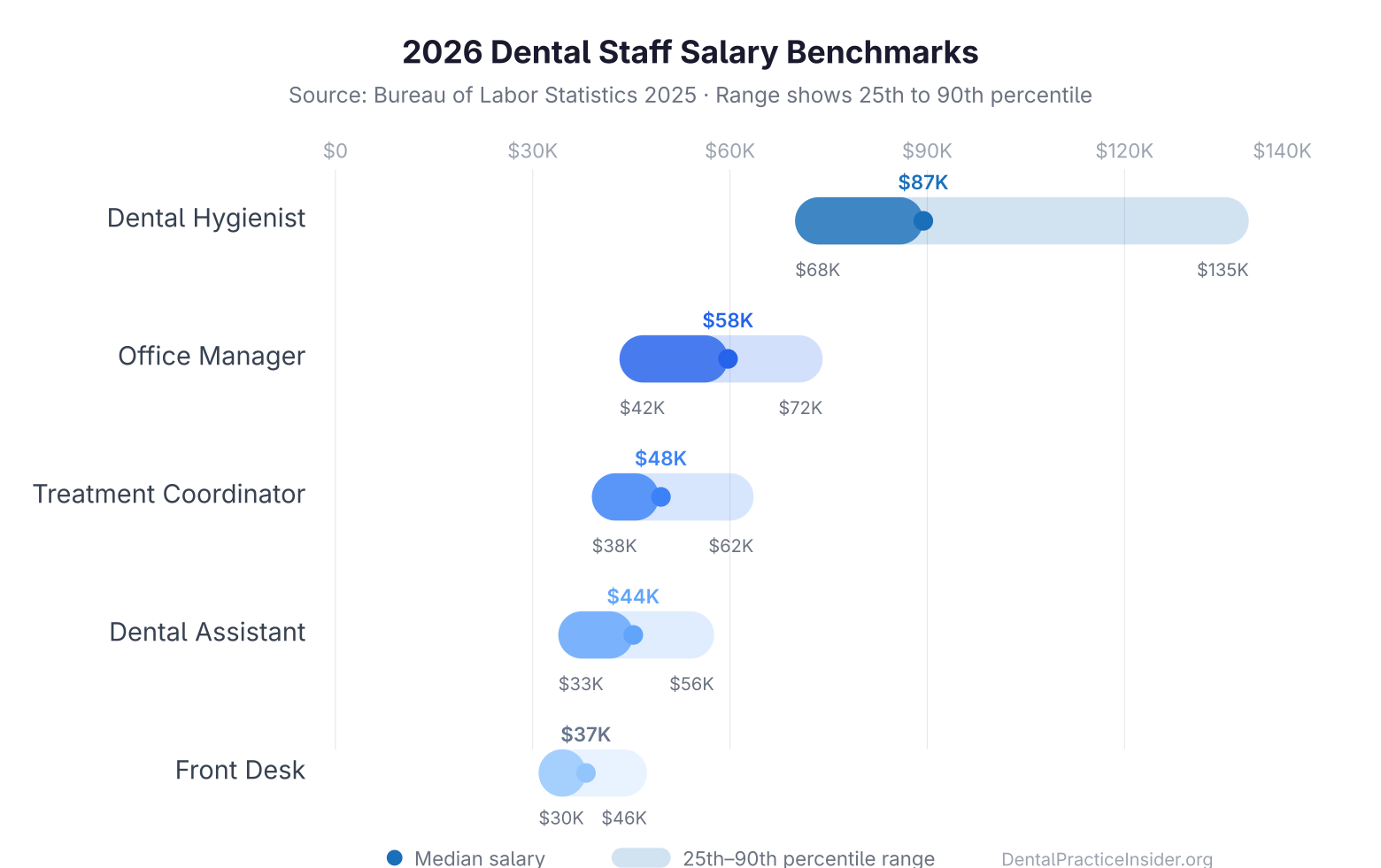
The following salary ranges reflect national median data aggregated from multiple sources including the BLS Occupational Employment and Wage Statistics, Dental Economics compensation surveys, and the ADAA annual workforce report (2025).
For related reading, see our guide on dental practice economics.
Dental Hygienist Salary
| Experience Level | Annual Salary | Hourly Rate | Notes |
|---|---|---|---|
| Entry (0-2 years) | $68,000-$78,000 | $33-$38/hr | New graduates, limited speed |
| Mid-level (3-7 years) | $79,000-$95,000 | $38-$46/hr | Core hygiene team |
| Senior (8+ years) | $96,000-$115,000 | $46-$55/hr | High production, may train others |
| Specialty markets (CA, NY, WA) | $110,000-$135,000 | $53-$65/hr | High cost-of-living premium |
The median hygienist salary in the US reached $83,700 in 2025, up 6.2% from 2023, outpacing general healthcare wage growth of 4.1% (BLS, 2025).
Dental Assistant Salary
| Role | Annual Salary | Hourly Rate |
|---|---|---|
| Dental Assistant I (entry) | $38,000-$46,000 | $18-$22/hr |
| Dental Assistant II (certified) | $46,000-$56,000 | $22-$27/hr |
| Lead/Senior Dental Assistant | $55,000-$68,000 | $26-$33/hr |
| Orthodontic Assistant | $46,000-$62,000 | $22-$30/hr |
| Surgical Assistant (oral surgery) | $52,000-$72,000 | $25-$35/hr |
Front Office and Administrative Staff
| Role | Annual Salary | Notes |
|---|---|---|
| Receptionist / Scheduling Coordinator | $38,000-$50,000 | Phone skills, scheduling software proficiency |
| Treatment Coordinator | $45,000-$65,000 | Often commission-based on case acceptance |
| Billing / Insurance Coordinator | $45,000-$62,000 | Revenue impact justifies premium pay |
| Office Manager | $60,000-$90,000 | Wide range based on practice size and scope |
| Marketing Coordinator | $48,000-$65,000 | Growing role in mid-to-large practices |
What Is a Best-Practice Dental Hiring Process?
Most small practices hire reactively, posting a job when someone quits, rushing to fill the seat. This approach leads to poor hires and high turnover. A structured process takes more time upfront but dramatically improves quality of hire.
Stage 1: Define the Role Before You Post
Write a clear job description that includes:
- Specific clinical or administrative responsibilities
- Required certifications (CDA, RDH license, CPR, radiation safety)
- Software proficiency requirements (Dentrix, Eaglesoft, Curve, etc.)
- Compensation range. Posting salary ranges increases qualified applicant volume by 30% (LinkedIn, 2024)
- Schedule and hours
Stage 2: Source Candidates Strategically
Don’t rely on Indeed alone. The best hires often come from:
- Hygiene and assisting school placement offices: excellent for entry-level roles
- State dental association job boards: candidate pool is already vetted as licensed professionals
- Specialized job boards: DentalPost, Dental Jobs Now, iHire Dental
- Employee referrals: pay a $500-$1,000 referral bonus; existing staff know people who will fit your culture
Stage 3: Structured Interview Questions
Use behavioral and situational questions to assess fit beyond credentials:
- “Tell me about a time a patient was unhappy with their care. How did you handle it?”
- “Describe your approach to a patient who is anxious or refuses treatment.”
- “Walk me through how you stay on schedule during a busy clinic day.”
- “How do you prioritize when three things need your attention at once?” (front office)
- “What production metrics are you used to hitting per day?” (hygiene)
Stage 4: Working Interview
For clinical roles, a paid half-day or full-day working interview is standard practice and legally required compensation in most states. This reveals skills that no resume or phone screen can: hand speed, patient communication style, instrument technique, and how the candidate handles a fast-paced schedule.
For related reading, see our guide on growing through patient retention.
What Benefits Package Do Dental Practices Typically Offer?
Benefits are increasingly important in the hiring decision, especially for hygienists and office managers comparing multiple offers. A competitive 2026 benefits package includes:
| Benefit | Market Prevalence | Estimated Annual Cost per Employee |
|---|---|---|
| Health insurance (employer contribution) | 68% of practices | $3,500-$8,000 |
| Paid time off (10-15 days) | 85% of practices | ~$3,000-$5,000 |
| CE allowance ($500-$1,500/year) | 72% of practices | $500-$1,500 |
| Uniform/scrub allowance | 80% of practices | $200-$500 |
| 401(k) with match | 42% of practices | $800-$2,500 |
| Dental coverage (free or discounted) | 90% of practices | $500-$1,200 |
| Paid holidays (6-10 days) | 88% of practices | ~$2,000-$3,500 |
How Do You Retain Dental Staff Long-Term?
The national turnover rate for hygienists is approximately 18% annually and 28% for assistants, both significantly higher than healthcare averages (Dental Economics, 2025). Each departure costs an estimated $8,000-$20,000 when you account for recruiting, onboarding, and productivity loss during the learning curve.
Retention Strategies That Work
- Annual compensation reviews tied to production metrics. Don’t wait for someone to ask for a raise. Schedule a formal review every January and tie increases to quantifiable performance: hygiene production per patient, case acceptance rates, schedule fill rates.
- Career development pathways. Assistants who see a path to lead assistant or treatment coordinator role stay longer. Create those titles and define what it takes to earn them.
- Schedule predictability. Inconsistent hours are a top reason staff leave their positions. Protect your team’s schedule from last-minute changes where possible.
- Recognition and culture. Monthly team lunches, shout-outs in team meetings, birthday acknowledgments, low-cost, high-impact retention tools that many practices overlook.
- Bonus structures. Team-based production bonuses (e.g., $X per month over a production threshold, split among the team) align incentives and reward collective wins.
How Do You Calculate If Your Staffing Cost Is Too High?
The industry benchmark for staff cost (all wages + benefits + payroll taxes) is 22-28% of gross production. If you’re above 30%, investigate whether:
- You’re overstaffed relative to patient volume
- Your production per provider is below target
- Overtime hours are excessive
- Part-time employees are being paid for hours they’re not fully utilized
Use this formula: Total Annual Staff Cost ÷ Annual Gross Production × 100 = Staffing %. Run this calculation monthly and review quarterly.
For related reading, see our guide on dental hygienist shortage solutions when traditional hiring strategies fall short.
Frequently Asked Questions
What is the average dental hygienist salary in 2026?
The national median is approximately $83,700-$87,000 annually based on 2025 BLS data and 2026 salary trend projections. High cost-of-living markets like California, Washington, and New York average $110,000-$135,000.
How long should it take to hire a dental hygienist?
In most markets, plan for 4-8 weeks from job posting to first day of work. Urban markets with high hygienist demand (Seattle, San Francisco, Austin) can stretch to 10-12 weeks. Start recruiting before you’re in a staffing crisis.
Should dental hygienists be paid hourly or on production?
Most practices pay hygienists an hourly rate with a production bonus layer. A common structure: $38-$46/hour base, plus a bonus once hygiene production exceeds 3x the hygienist’s daily wage. Pure production pay models are legal but can create quality-of-care incentive issues if not structured carefully.
Is it legal to not offer benefits to part-time dental staff?
For employees working under 30 hours per week, federal law (ACA) does not require employer-sponsored health insurance. However, some states have broader requirements. Consult your employment attorney for state-specific guidance.
What should I pay a dental office manager?
Office manager compensation ranges from $60,000 to $90,000 depending on practice size, scope of responsibilities, and market. Practices with multiple locations or $2M+ in revenue often pay $85,000-$100,000 for an experienced manager. Performance bonuses tied to collection rate or overhead targets are common at this level.
For more resources on this topic, see our complete guide to dental practice management.