
What Is the Average Dentist Salary in 2026?
The U.S. Bureau of Labor Statistics (BLS, 2025) reports a mean annual wage of $166,810 for general dentists. The American Dental Association’s Health Policy Institute (ADA HPI, 2024) puts median net income for practice owners closer to $239,000 once ownership earnings are factored in. That gap tells the whole story: ownership dramatically changes the income equation.
For related reading, see our guide on dental staff hiring and compensation.
Here are the core numbers to anchor your expectations:
- 10th percentile: ~$85,000 (new associate, high cost-of-living market)
- Median general dentist: ~$166,000 (BLS)
- 75th percentile: ~$208,000
- 90th percentile: ~$239,000+
- Practice owner median: ~$239,000 (ADA HPI, 2024)
How Does Income Differ by Dental Specialty?
Specialty training adds years and debt, but the income premium is real. BLS occupational data and ADA HPI survey results consistently show specialists outperning generalists by 30-90%.
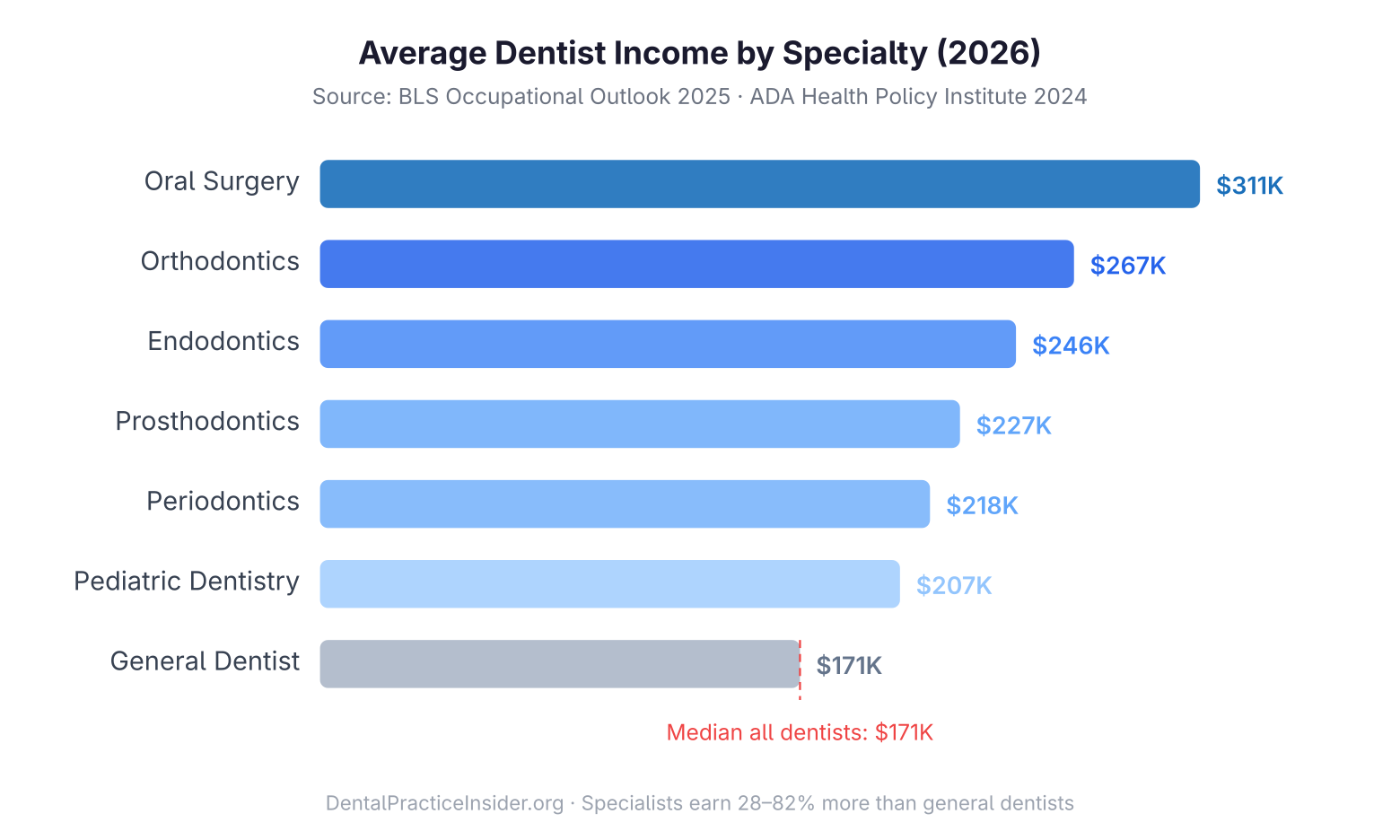
General dentists earn a median of approximately $239,000 per year as practice owners, while specialists such as oral surgeons earn a median of $311,460 per year (BLS, 2025).
| Specialty | Median Annual Income | Source / Year |
|---|---|---|
| Oral & Maxillofacial Surgery | $311,460 | BLS, 2025 |
| Orthodontics | $267,280 | BLS, 2025 |
| Endodontics | $245,000-$280,000 | ADA HPI, 2024 |
| Periodontology | $220,000-$255,000 | ADA HPI, 2024 |
| Pediatric Dentistry | $196,000-$230,000 | ADA HPI, 2024 |
| Prosthodontics | $185,000-$220,000 | ADA HPI, 2024 |
| General Dentistry (owner) | ~$239,000 | ADA HPI, 2024 |
| General Dentistry (associate) | ~$135,000-$155,000 | ADA HPI, 2024 |
Oral surgeons benefit from higher procedure fees and fewer insurance restrictions. Orthodontists capture recurring revenue through multi-visit treatment plans. If you are specialty-agnostic and optimizing for income, oral surgery and orthodontics consistently lead.
For related reading, see our guide on improving dental practice profitability.
How Does Dentist Income Vary by State?
Geography shapes income more than most dentists expect. States with lower dentist-to-population ratios often pay more because competition for patients is lower and fee-for-service rates hold up.
| State | Mean Annual Wage (General Dentist) |
|---|---|
| Delaware | $268,000 |
| New Hampshire | $256,000 |
| Minnesota | $248,000 |
| Iowa | $243,000 |
| Alaska | $238,000 |
| California | $189,000 |
| New York | $184,000 |
| Florida | $161,000 |
High cost-of-living states don’t automatically mean high dentist pay. California and New York have dense dentist populations that compress fees and income. Rural Midwest and upper New England consistently rank high: less competition, loyal patient bases, and strong insurance rates.
Solo Practice vs. Group Practice vs. DSO: Which Pays More?
This is the most consequential income decision you’ll make. The numbers split sharply.
Solo Practice Owner
After overhead (typically 58-65% of collections), a solo owner producing $900,000/year clears roughly $315,000-$378,000 in net income. The range is wide because overhead discipline matters enormously. A practice with tight payroll and low lab fees can clear 40% margins; a poorly managed one might net 30% or less.
Group Practice Associate
Group associates typically earn 28-35% of collections or a base plus production bonus. At $600,000 in annual production, that’s $168,000-$210,000. No ownership risk, no capital required, but no equity either.
For related reading, see our guide on associate dentist compensation models.
DSO-Employed Dentist
DSOs offer guaranteed bases of $130,000-$175,000 plus production bonuses. Total compensation packages frequently range from $160,000 to $220,000. Benefits are often stronger than private practice offers. Autonomy is lower. Growth ceiling is capped unless you move into leadership.
What Factors Most Affect a Dentist’s Income?
- Ownership vs. employment: Owners earn 30-50% more on average (ADA HPI, 2024)
- Production efficiency: Hygiene team productivity and schedule density drive collections more than chair hours alone
- Fee-for-service mix: Reducing PPO dependency directly raises net margins
- Specialty services offered: Adding implants, Invisalign, or sleep appliances raises revenue per patient visit
- Geographic market: Rural underserved areas often have lower cost of living and higher PPO rates
- Team turnover: Each front desk turnover costs $8,000-$12,000 in productivity losses (SHRM estimates)
Are Dentist Incomes Rising or Falling?
Nominal incomes are up. Real purchasing power is more complicated. ADA HPI data shows average practice owner net income grew roughly 12% from 2020 to 2024 in nominal terms. Inflation over the same period ran near 20%, meaning real income declined for many dentists who didn’t aggressively raise fees or add services.
DSO expansion has also created a floor effect: associate wages are rising (because DSOs compete for talent), but ownership premium is compressing in some markets as group practices scale. The dentists protecting income in 2026 are those actively managing overhead, diversifying revenue, and building patient retention systems.
For a longer-term perspective on building sustainable income, see our guide on maintaining a fulfilling dental career and our close look on retirement preparation for dental practitioners.
How Can You Maximize Your Income as a Dentist?
- Buy or start a practice rather than staying an associate long-term
- Raise fees annually: ADA HPI data shows most practices leave $30,000-$60,000/year on the table by not doing this
- Add high-margin procedures: implants ($1,500-$5,000 net per case), sleep appliances ($800-$1,800 net)
- Reduce low-reimbursing PPO plans systematically over 18-24 months
- Invest in hygiene production: a hygienist producing $450,000+/year is normal in well-run offices
- Track your overhead by category monthly: staff, lab, supplies, facility, marketing each have a benchmark to beat
For a complete overview of financial management guides and resources, visit our Dental Practice Finances resource library.
For related reading, see our guide on how DSO affiliation affects dentist income compared to private practice ownership.
GP dentists who add a clear aligner program to their practice typically increase annual income by $150,000-$250,000 in year one, see our clear aligner profitability analysis for case economics and ROI timeline.
Frequently Asked Questions
Do dentists make more than doctors?
Most physicians out-earn general dentists, but dental specialists (especially oral surgeons and orthodontists) match or exceed many physician specialties. Primary care physicians earn $230,000-$260,000 on average, comparable to dental specialty income.
How much do new dentists make right out of dental school?
New associates typically earn $120,000-$150,000. Some DSOs offer starting packages of $160,000+ with sign-on bonuses in underserved markets. Geographic flexibility dramatically increases your starting offer.
Is dentistry still a good career financially?
Yes, with caveats. Average student debt for dental graduates now exceeds $300,000 (ADA HPI, 2024). With $200,000+ earning potential and a clear path to ownership, the ROI is strong, but requires financial discipline and a deliberate career plan from day one.
Can a dentist make $500,000 a year?
Yes. Multi-specialty group practice owners, high-volume implant providers, and orthodontists with efficient systems regularly clear $400,000-$600,000 in net income. It requires ownership, strong production, and lean overhead, not just clinical skill.
Does practice location inside a city vs. suburb affect income?
Suburbs typically offer better income-to-cost ratios. Urban practices face higher rent, more competition, and often worse PPO rates. Many top-earning dentists practice in mid-sized suburban markets with strong household incomes and limited specialist access.