
TL;DR — DSOs vs Independent Dental Practices
- DSOs now control 25–30% of U.S. dental offices and are growing at 15–20% annually through acquisition — understanding this market shift is essential for every independent owner.
- DSO affiliation offers capital access, reduced administrative burden, and purchasing power; the trade-off is clinical autonomy and long-term equity.
- Independent practices that compete on relationship quality, continuity of care, and community connection consistently outperform DSOs on patient retention metrics.
- The DSO acquisition market has created exit valuations of 6–8× EBITDA for well-run practices — understanding this market can inform your long-term ownership strategy.
- Hybrid models (partial DSO partnership, group practices) represent a growing middle ground that offers some DSO benefits while preserving more autonomy than full affiliation.
The DSO question has become impossible for independent dental practice owners to ignore. Whether you’re considering an affiliation offer, trying to compete against a DSO-backed practice that opened nearby, or planning a long-term ownership exit strategy, the DSO landscape affects your decisions in ways it didn’t a decade ago.
This guide covers what DSOs are, how they compete, where independent practices have genuine advantages, and how to use an understanding of the DSO market to make better strategic decisions for your practice — regardless of whether affiliation is something you want to pursue. These decisions connect directly to the broader framework in our guide to effective growth strategies for dental practices.
What Exactly Is a DSO and How Do They Operate?
A Dental Service Organization (DSO) is a business entity that provides non-clinical management and administrative services — billing, HR, marketing, purchasing, technology infrastructure — to a group of dental practices, in exchange for management fees or equity in the practices. The legal structure varies by state (many states prohibit non-dentist ownership of dental practices, requiring DSOs to use professional corporation structures), but the economic model is consistent: centralize administrative functions across many practices to reduce per-practice overhead, and use scale to negotiate better contracts with suppliers and insurance carriers.
For related reading, see our guide on efficient dental clinic management.
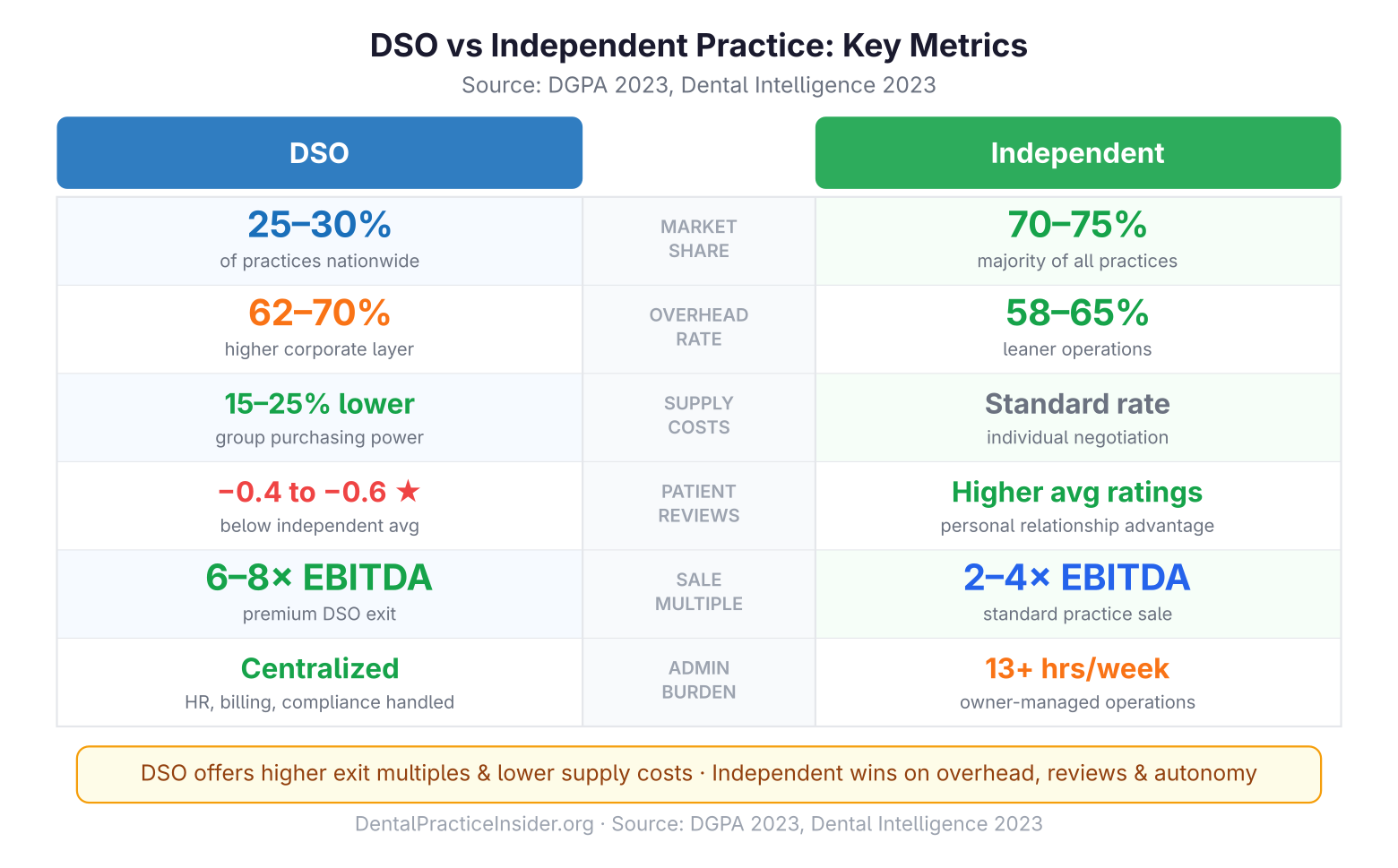
DSO growth has been substantial and sustained. The Dental Group Practice Association estimated in 2023 that DSO-affiliated practices represented approximately 25–30% of all U.S. dental offices, up from roughly 10% a decade ago. That growth is primarily through acquisition — DSOs acquire established independent practices rather than building de novo — which means the competitive pressure on independent practices comes from within existing markets, not from new entrants in underserved areas.
What Advantages Do DSOs Have Over Independent Practices?
Understanding DSO advantages honestly is the starting point for building a competitive independent practice. DSOs outperform on:
Purchasing Power and Overhead Reduction
A DSO operating 200 practices purchases supplies, equipment, and lab services at volumes that produce significant discounts unavailable to a solo practice. Supply costs for a DSO-affiliated practice are typically 15–25% lower than a comparable independent practice, representing $20,000–$40,000 in annual savings at typical supply volumes. This structural cost advantage is difficult for an independent practice to match — the exception being participation in group purchasing organizations (GPOs) like Dental Blue Book or Benco’s group purchasing programs, which aggregate purchasing power across unaffiliated practices.
Administrative Infrastructure
DSOs provide centralized billing, insurance credentialing, HR, payroll, marketing, and technology infrastructure. For practice owners whose primary frustration with practice ownership is administrative burden — which the ADA estimates consumes 13+ hours per week for the average owner-dentist — this is a genuine and substantial benefit. The tradeoff is that administrative decisions are no longer the owner’s to make independently.
Capital Access
DSOs can fund equipment upgrades, technology investments, and facility renovations that would require a bank loan for an independent practice. Access to capital is particularly important for practices in growth phases or those needing significant infrastructure investment.
Recruitment and Retention of Associates
Larger organizations can offer benefits packages — health insurance, 401(k) matching, student loan assistance programs — that a two- or three-person independent practice cannot match economically. In competitive markets for dental professionals, this creates a recruiting disadvantage for small independent practices.
Where Do Independent Practices Have Genuine Competitive Advantages?
The advantages of independent practice are not simply emotional — they’re measurable and strategically deployable against DSO competition.
Continuity of Care and Relationship Quality
The most consistent complaint about DSO-affiliated practices in patient reviews is provider turnover. When patients return for recall appointments and see a different dentist each time, the trust relationship that drives treatment acceptance, referrals, and long-term retention degrades. A 2023 analysis of patient reviews across DSO-affiliated and independent practices found that independent practices scored 0.4–0.6 stars higher on average across Google, Yelp, and Healthgrades — primarily driven by continuity-related comments (Dental Intelligence, 2023).
For related reading, see our guide on growing through patient retention.
Independent practices that make continuity explicit — scheduling patients with the same hygienist consistently, noting patient preferences and history in clinical notes that are surfaced at every visit, and building the doctor-patient relationship over years — are competing on the dimension where DSOs structurally cannot match them.
Clinical Autonomy and Treatment Philosophy
Independent practice owners make clinical decisions based solely on patient need and their own clinical judgment. DSO-affiliated practices may operate under protocols or production targets that create pressure — explicit or implicit — toward certain treatment patterns. The vast majority of DSO dentists practice ethically within this structure, but the perception of independence is itself a patient trust factor that independent practices can use in their messaging.
Community Connection
Independent practices that are genuinely embedded in their communities — sponsoring local events, participating in school oral health programs, employing people from the neighborhood — create goodwill that no marketing budget can replicate. Community connection is also a localized moat: a DSO can open a competing practice within a mile, but it cannot replicate 15 years of community presence and the referral networks that come with it.
Flexibility and Speed of Decision-Making
Independent owners can implement a new technology, change an office policy, or respond to a patient complaint in hours. DSO-affiliated practices route many of these decisions through a management structure that may require weeks of approval. In a patient experience context, speed of response to complaints or concerns is a significant driver of patient recovery and retention.
How Does the DSO Acquisition Market Affect Independent Practice Valuation?
The DSO acquisition market has created practice valuations that would have seemed extraordinary a decade ago. Well-run practices in desirable markets are transacting at 6–8× EBITDA (earnings before interest, taxes, depreciation, and amortization), compared to historical multiples of 2–4× that characterized practice sales between dentists. The difference is DSO buyers competing for acquisitions: they can pay higher multiples because they can realize purchasing and administrative synergies that an individual buyer cannot.
For practice owners who are 5–10 years from their intended exit, understanding the DSO acquisition market is essential strategic context:
- EBITDA is the key valuation driver: A practice generating $300,000 in EBITDA at a 6× multiple is worth $1.8 million to a DSO buyer. A practice generating $200,000 in EBITDA at the same multiple is worth $1.2 million. Optimizing EBITDA over the 3–5 years before exit is the highest-ROI pre-sale investment.
- Growth trajectory matters: DSOs pay premium multiples for practices on an upward trajectory — growing patient count, increasing production, improving margins. A flat or declining practice commands the low end of the multiple range regardless of absolute EBITDA level.
- Systems and documentation increase value: A practice with documented protocols, trained team, and systematized operations is worth more than one dependent on the owner’s personal relationships and knowledge — because the buyer can retain the value after the seller exits.
For complete financial planning as you think about your practice’s long-term trajectory, see our guide to dental practice economics and key metrics.
What Are the Hybrid and Middle-Ground Options Between Independent and DSO?
The binary framing of “stay independent vs. join a DSO” understates the range of available structures:
Partial Affiliation / Minority Stake Sales
Many DSOs now offer transactions in which the practice owner sells 40–60% to the DSO, retaining partial ownership and clinical control while gaining access to capital, administrative support, and a partial liquidity event. The remaining equity is typically bought out 5–7 years later at a second multiple. For owners who want some exit liquidity now but aren’t ready to fully transition out, this structure has genuine appeal.
Group Practice Consolidation
Independent dentists in the same market are increasingly forming loose or formal group practice structures — sharing administrative staff, purchasing agreements, and technology infrastructure while maintaining independent clinical ownership. This captures some DSO purchasing advantages without the loss of ownership control.
Dental Cooperative Models
Emerging cooperative structures allow independent practices to pool purchasing, marketing, and administrative resources while each practice maintains independent clinical and operational control. Several regional dental cooperatives have demonstrated that independent practices can achieve 10–15% overhead reductions through collective purchasing without the governance tradeoffs of DSO affiliation.
How Should Independent Owners Compete Strategically Against DSOs in Their Market?
Competing against a DSO isn’t primarily a marketing problem — it’s an operational and positioning one. The strategies that work:
- Make continuity explicit: Communicate and schedule around consistent provider relationships. Make provider continuity a feature, not an assumption.
- Invest in team stability: High team turnover signals a struggling practice and erodes the continuity advantage. Team retention is a strategic priority in DSO-competitive markets.
- Own the community relationship: Show up in the community in ways that a 200-practice corporation cannot. The ROI on community presence is difficult to measure but consistently shows up in referral patterns over time.
- Specialize strategically: A solo practice that is known as the best provider of a specific service — implants, sleep apnea, pediatric anxiety management — can dominate a market niche that a generalist DSO practice cannot compete in at the same level.
For how operational excellence and patient experience reinforce independent practice’s competitive position, see our guide to modern dental practice management best practices.
Last Updated: March 2026
For related reading, see our guide on a detailed DSO vs. private practice comparison with 2026 income data.
Sources
- Dental Group Practice Association. DSO Market Share Report. DGPA, 2023.
- Dental Intelligence. Independent vs. DSO Patient Review Analysis. Dental Intelligence, 2023.
For more resources on this topic, see our complete guide to dental practice management.