For related reading, see our guide on dental practice growth strategies.
Should You Start from Scratch or Buy an Existing Practice?
This question deserves an honest answer before you commit capital. De novo practices offer full design control, zero inherited problems, and stronger equity upside in growing markets. The tradeoff: 12–18 months of below-breakeven cash flow and a steeper initial learning curve.
For related reading, see our guide on dental practice loans and financing.
Buying an existing practice gives you immediate cash flow, an established patient base, and proven collections history. Startup risk is lower; integration risk takes its place. Our guide to buying a dental practice covers that path in detail.
For this guide, we’ll assume you’re building from the ground up.
What Goes Into a Dental Practice Business Plan?
Your business plan does two jobs: it forces you to think rigorously about the business, and it gets you financed. Lenders want to see all of the following:
- Executive summary: Practice concept, target market, ownership structure
- Market analysis: Local population demographics, dentist-to-resident ratio (ADA benchmark: 1 dentist per 1,500–2,000 residents), competitor mapping within 5 miles
- Service offerings: Core services plus planned specialties (implants, orthodontics, sedation)
- Financial projections: Month-by-month revenue, expense, and cash flow for 36 months
- Startup cost schedule: Itemized build-out, equipment, working capital, and contingency
- Marketing plan: Pre-opening and ongoing patient acquisition strategy
- Owner credentials: CV, dental school, continuing education, leadership experience
Work with a dental-specific CPA and consultant on financial projections. Generic templates miss the production-per-visit, hygiene-to-doctor ratio, and overhead benchmarks that lenders in this space expect.
How Do You Choose the Right Location?
Location selection is the most irreversible decision you’ll make. A bad location with a great dentist still fails. Evaluate sites using these criteria:
Demographics
Target zip codes with median household income of $55,000+, population growth trending positive, and favorable age distribution (high percentage of working-age families, ideally with children). Families consume more dental services per year than singles.
Competition density
Use ADA member databases and Google Maps to count active dentists within a 3-mile radius. More than one dentist per 1,200 residents is saturated. Under one per 2,000 is favorable. Check whether nearby dentists are accepting new patients—that signals unmet demand.
Visibility and accessibility
High-traffic arterial roads, strip malls with anchor tenants (grocery, pharmacy), and proximity to employers all drive walk-in and new patient traffic. Ground-floor access with ample parking (minimum 1 space per operatory plus 4 for staff) is non-negotiable.
Space requirements
Plan 1,200–1,800 sq ft per operatory (total space divided by number of ops). A 4-operatory starter practice needs 1,600–2,400 sq ft. Leave room to add 1–2 more operatories as you grow—retrofitting HVAC, plumbing, and electrical costs far more than planning for it upfront.
How Do You Finance a New Dental Practice?
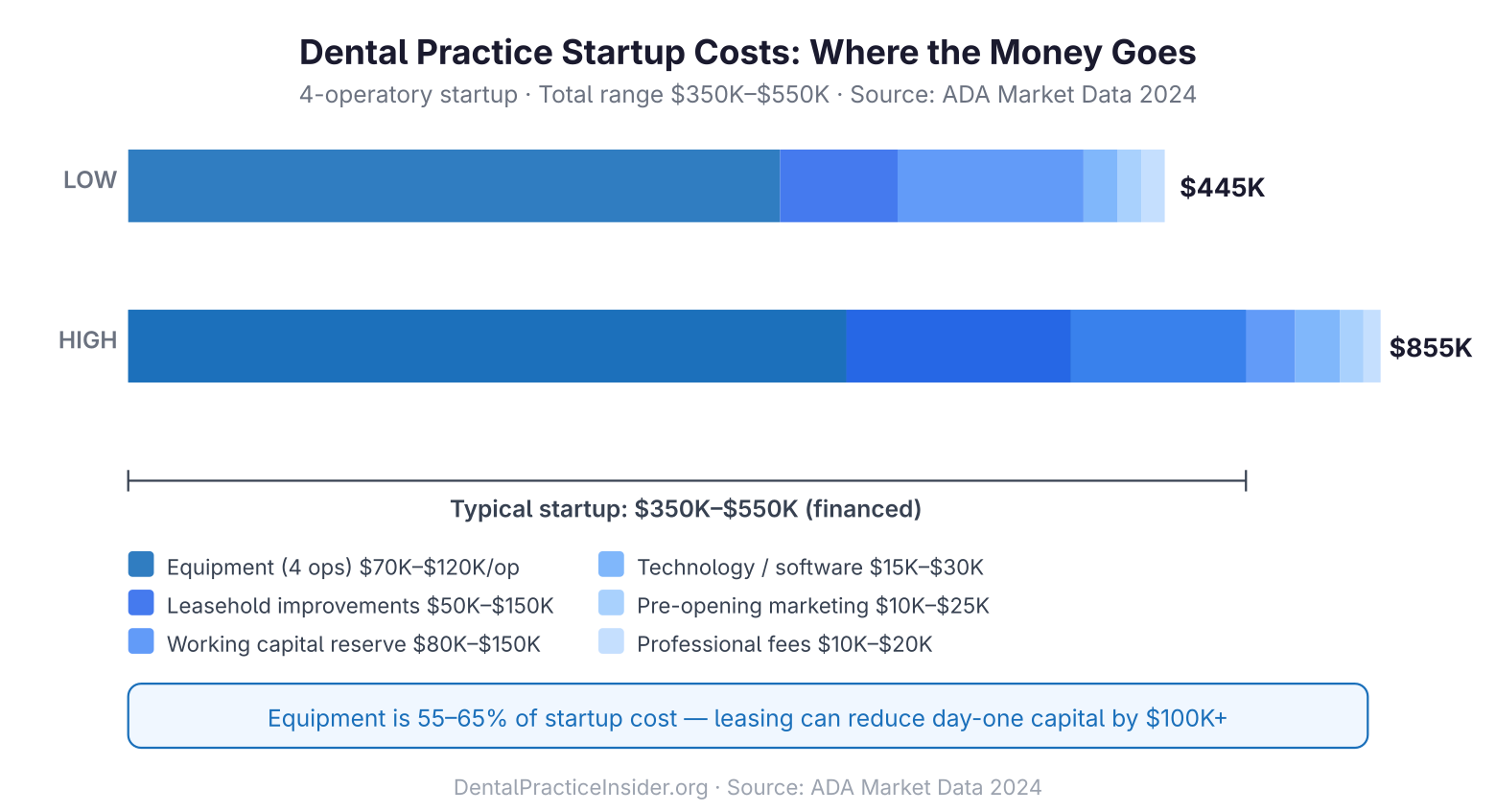
The good news: dental practice financing is mature and accessible. Banks and specialized lenders understand the model. Expect to borrow $350,000–$550,000 depending on market and build-out scope.
Dental-specific lenders
Bank of America Practice Solutions, TD Bank Healthcare, Provide (formerly known as Cana Capital), and LiveOak Bank are leaders in this space. They offer 100% financing to qualified borrowers—meaning no down payment required if your credit profile and business plan are strong.
SBA 7(a) loans
SBA loans carry government guarantees that reduce lender risk. This often translates to better rates for borrowers with thinner credit files or lower FICO scores. Expect 10–25 year terms at prime + 2.75–3.5%. Processing takes 60–90 days longer than conventional dental loans.
Equipment financing
Digital X-ray systems, CBCT, dental chairs, CAD/CAM units, and sterilization equipment can often be financed separately at 0% promotional rates through manufacturer programs (Patterson, Henry Schein, Benco). Separating equipment from real estate debt gives you flexibility.
See our full breakdown of dental practice financing options for rate comparisons and lender details.
What Equipment Does a New Dental Practice Need?
Equipment costs run $70,000–$120,000 per operatory fully equipped. Budget for:
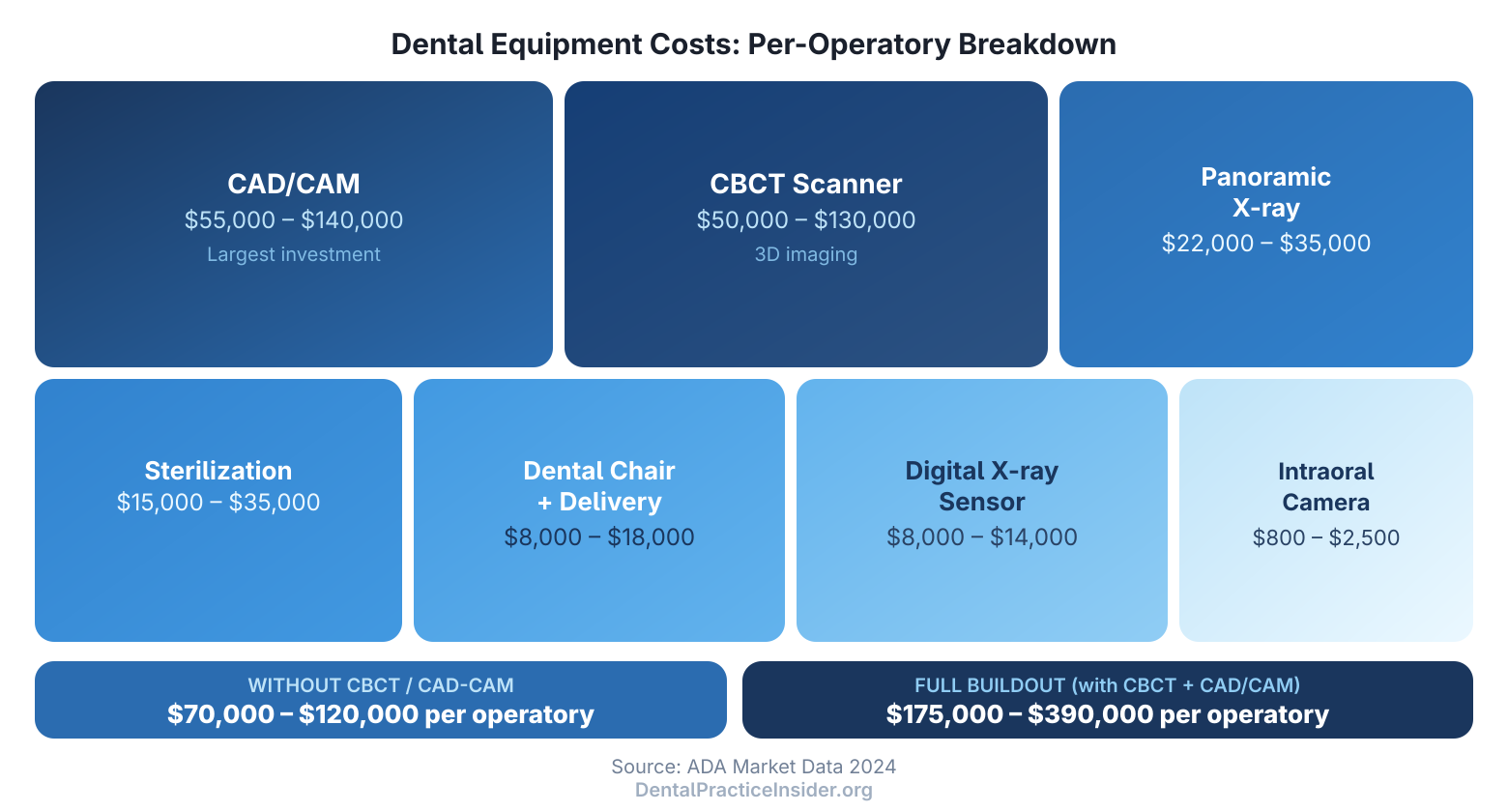
- Dental chairs and delivery units: $8,000–$18,000 per chair (A-dec, Pelton & Crane)
- Digital X-ray sensors: $8,000–$14,000 per sensor; panoramic $22,000–$35,000
- CBCT (cone beam CT): $50,000–$130,000 (critical for implants)
- CAD/CAM milling unit: $55,000–$140,000 (Cerec, Planmeca)
- Intraoral cameras: $800–$2,500 per operatory
- Sterilization equipment: $15,000–$35,000 (autoclave, ultrasonic cleaners)
- Practice management software: Dentrix, Eaglesoft, or Open Dental ($3,000–$8,000/year)
- Digital marketing tools: Website, reputation management platform ($200–$600/month)
Buy technology that integrates. Fragmented systems that don’t talk to each other waste staff hours and create billing errors. Prioritize a software ecosystem over individual feature sets.
How Do You Staff a New Practice?
Hire for culture, train for skill. Your opening team creates the patient experience that either builds word-of-mouth or kills it. For a 4-operatory startup, plan for:
- 1 full-time front desk / treatment coordinator
- 1 business manager (can double as billing for first 12 months)
- 2 dental assistants
- 1 full-time hygienist (add a second by month 12 if growth holds)
Staff payroll should stay under 25–28% of collections. That’s tight for a startup but critical for survival in the first year. Use a dental staffing recruiter—generic job boards miss the dental-specific candidates you need.
What Licenses and Permits Do You Need?
Requirements vary by state but typically include:
- State dental license (confirm active status and any reciprocity requirements)
- DEA registration (if prescribing controlled substances)
- State controlled substance license
- Business entity registration (LLC, PLLC, or PC depending on state)
- Employer Identification Number (EIN) from the IRS
- NPI number (National Provider Identifier) for billing
- Building occupancy permit and certificate of occupancy (CO)
- OSHA compliance documentation
- HIPAA policies and procedures (required before seeing first patient)
- Dental board facility registration (required in most states)
Start the licensing process 6–9 months before your target opening date. State boards and credentialing bodies move slowly. A delayed license can push your opening date by months.
How Do You Market a New Dental Practice Before Opening?
Your marketing clock starts the day you sign your lease—not your opening day. Six to nine months of pre-opening activity gives you a patient base on day one instead of starting from zero.
- Google Business Profile: Create and verify immediately. Add “Coming Soon” photos and business hours. Collect pre-opening reviews from friends and colleagues if permitted.
- Website: Launch a holding page with your name, location, services, and a “Schedule Your First Appointment” form within 60 days of lease signing.
- Direct mail: Target 5,000–10,000 households within 3 miles. New mover lists convert at 2–4x the rate of general population mailers.
- Social media: Document the build-out on Instagram and Facebook. Behind-the-scenes content builds trust before you see a single patient.
- Insurance credentialing: Begin 6+ months early. Some plans take 90–120 days to process.
- Referral network: Introduce yourself to every physician, pediatrician, and orthodontist in the area before opening.
For ongoing patient growth strategies, our guide on dental practice marketing mastery covers the full acquisition playbook.
What Is the Realistic Timeline to Open a Dental Practice?
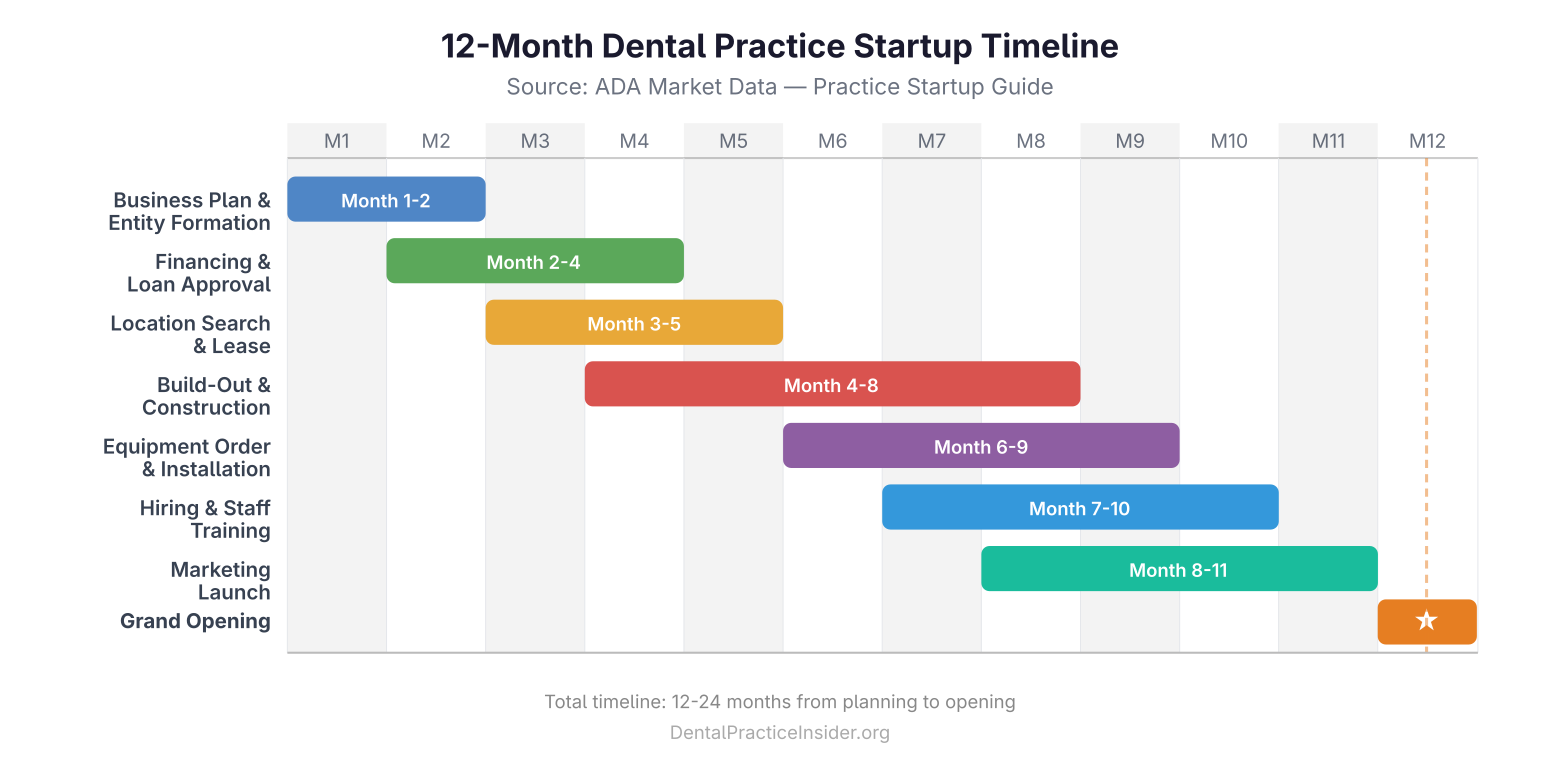
| Month | Milestone |
|---|---|
| 1–2 | Business plan finalized, market analysis complete |
| 2–3 | Financing secured, entity formed, CPA and attorney engaged |
| 3–4 | Location selected, lease negotiated and signed |
| 4–6 | Architect drawings, permits submitted, contractor selected |
| 4–8 | Insurance credentialing applications submitted |
| 6–10 | Construction and build-out |
| 8–10 | Equipment ordered and installed |
| 9–11 | Staff hired and trained, software configured |
| 10–12 | Marketing campaigns launch, soft opening with family/friends |
| 12+ | Grand opening, full patient acquisition mode |
Frequently Asked Questions
How much does it cost to start a dental practice?
Total startup costs typically range from $350,000 to $550,000 for a 4-operatory practice. High-cost markets (California, NYC) can exceed $700,000. This includes build-out, equipment, software, working capital, and marketing—not personal living expenses during the ramp-up period.
How long before a new dental practice is profitable?
Most well-executed de novo practices reach monthly breakeven within 12–18 months. Full profitability (enough to comfortably service debt and draw a competitive salary) typically arrives at 18–30 months. Speed depends heavily on pre-opening marketing and first-year patient acquisition pace.
Do you need a partner to start a dental practice?
No. Solo ownership is the most common model. Partners add capital and clinical capacity but introduce governance complexity. If considering a partnership, formalize everything in a detailed buy-sell agreement before opening day—not after.
Can a dental associate open a practice while still employed?
Yes, but review your employment contract first. Many associate agreements include non-compete clauses restricting where you can open within a defined radius and time period. Have an attorney review before signing anything.
What’s the biggest mistake dentists make when starting a practice?
Underestimating working capital needs. Most dentists budget for the build-out and equipment but forget that the practice will run at a loss for 6–18 months. A working capital reserve of $80,000–$150,000 is the difference between surviving the ramp-up and closing early.