Why Is Getting New Dental Patients Harder Than It Used to Be?
The digital shelf is crowded. BrightLocal’s 2024 Local Consumer Review Survey found that 98% of consumers used the internet to find a local business in the past year—and dental practices aren’t exempt. Your patients are searching on Google before they call. If you’re not visible, you don’t exist.
For related reading, see our guide on managing online reviews for dentists.
DSO expansion has intensified competition in most metro markets. Corporate groups have dedicated marketing teams, larger ad budgets, and centralized review management. Independent practices that don’t treat marketing as a core business function lose ground every quarter.
The good news: most practices run weak marketing by default. That gap is your opportunity.
Strategy 1: Dominate Local SEO
When someone types “dentist near me,” the three businesses in the Google Map Pack capture 44% of all clicks (BrightLocal, 2024). Rank in that pack and you get consistent, free inbound patient calls.
- Google Business Profile (GBP): Complete every field. Upload 20+ photos (office, team, before/after work with consent). Post weekly updates. Answer every question in the Q&A section.
- Review volume and recency: Aim for 50+ Google reviews with a 4.7+ rating. Recency matters—practices with recent reviews outrank those with older review profiles even if totals are higher.
- NAP consistency: Your name, address, and phone number must be identical across every directory listing (Yelp, Healthgrades, Zocdoc, WebMD). Inconsistencies suppress local rankings.
- Localized website content: Create individual pages for each service (implants, Invisalign, emergency dentistry) that include your city name naturally in the H1, meta title, and body text.
Strategy 2: Run Google Ads (Search, Not Display)
Google Search Ads capture intent at its peak. Someone searching “emergency dentist [city]” or “dental implants near me” is ready to book—not browsing. Average CPC in dental ranges from $4–$12 for general terms to $25–$50 for implant-specific searches. A $2,000/month budget in a mid-size market typically generates 15–40 new patients per month depending on landing page quality and offer.
Key success factors for dental Google Ads:
- Send ad clicks to dedicated landing pages—not your homepage
- Include a phone number in every ad (call extensions convert at 2x vs. text clicks)
- Run location targeting at 5–10 mile radius maximum
- Exclude competitor searches unless you have strong brand differentiation
- Track calls as conversions, not just form submissions
Strategy 3: Build a Structured Patient Referral Program
Word-of-mouth is the highest-trust acquisition channel. But most practices treat it as passive luck. Make it active.
For related reading, see our guide on building patient trust and relationships.
- Ask at checkout: “If you know anyone who needs a great dentist, we’d love to take care of them.”
- Send referral cards home with patients—physical cards convert better than digital-only programs
- Track referral sources in your practice management software (source field on every new patient)
- Thank referrers by name, with a handwritten note and a small token (dental product kit, local restaurant gift card)
- Create a “Friends and Family” day 2x per year for new patients referred by existing ones
A patient who refers 3 friends over their lifetime is worth 4x their individual patient value. Protecting and growing your referral base is the highest-use growth activity in your practice.
Strategy 4: Activate Lapsed Patients
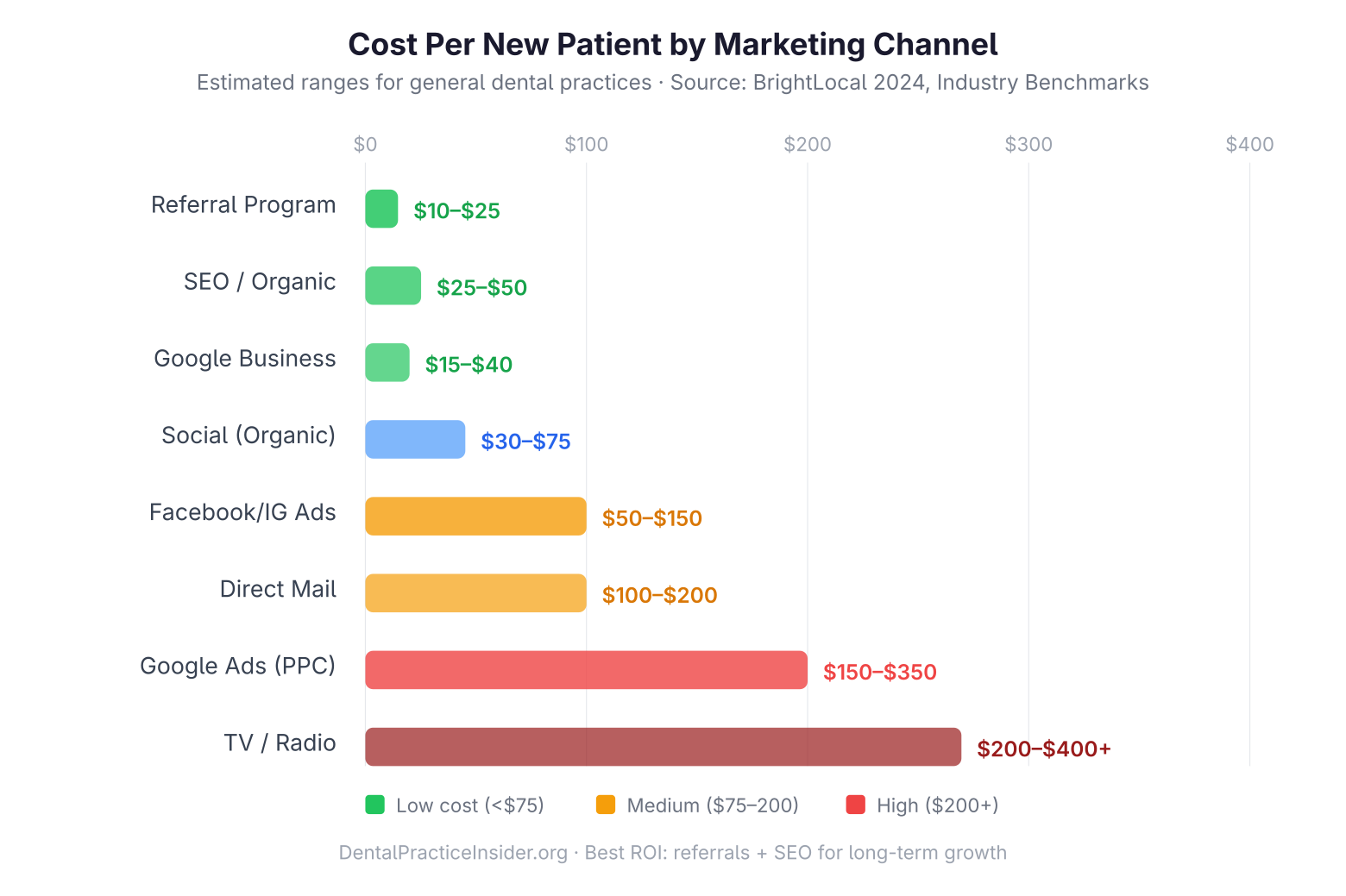
Most practices have 200–600 inactive patients (those who haven’t been seen in 18+ months) sitting in their database. Reactivating one inactive patient costs $8–$25 in outreach. Acquiring a brand-new patient costs $150–$400 via paid advertising.
Run a quarterly reactivation campaign:
- Pull patients not seen in 18+ months from your PMS
- Send a three-touch sequence: email, text, then phone call (in that order, 7–10 days apart)
- Use a genuine message: “We noticed it’s been a while and wanted to make sure you’re taken care of.”
- Offer a priority scheduling slot—not a discount (discounting trains patients to wait for deals)
Strategy 5: Systemize Online Review Collection
73% of consumers say reviews older than 3 months are no longer relevant (BrightLocal, 2024). You need a steady review flow—not a one-time push. Automate it:
- Set your PMS to trigger a review request text 2–4 hours after checkout
- Use Podium, Birdeye, or NiceJob for automated review sequences
- Target Google as the primary platform; Healthgrades and Yelp secondarily
- Respond to every review—positive and negative—within 24 hours
Strategy 6: Optimize Your Website for Conversion
Traffic without conversion is wasted. A dental website should convert 3–6% of visitors into appointment requests. Most practice sites convert at under 1% because they are designed to look good rather than to generate calls.
For related reading, see our guide on dental website design and optimization.
- Phone number in the header on every page—clickable on mobile
- “New Patient Special” or “Book Online” CTA button above the fold
- Load time under 2.5 seconds (Google PageSpeed Insights; slow sites lose rankings and visitors)
- Before/after photo gallery with patient consent and real results
- Insurance accepted page—this is one of the top 3 pages patients visit
Strategy 7: Partner with Local Employers
Large employers within 5 miles are a direct-access patient pipeline. Offer to do lunch-and-learn presentations on oral health. Provide corporate discount cards for employees. Partner with HR departments during open enrollment periods when employees are selecting dental plans.
Strategy 8: Use Social Media to Build Trust, Not Just Followers
Facebook and Instagram rarely generate immediate bookings. Their value is trust-building with people who found you elsewhere. Post consistently (3–4x per week minimum):
- Team spotlights and behind-the-scenes content (high engagement)
- Patient before/after with written consent
- Educational content (myth-busting, oral health tips)
- Community involvement (sponsorships, charity events)
Strategy 9: Run Community Events
Host a free community dental screening day or oral health fair annually. Partner with local schools for fluoride programs or oral hygiene education. Sponsoring youth sports leagues gets your name on jerseys seen by hundreds of parents. Community presence builds the word-of-mouth that paid media can’t buy.
Strategy 10: Add Online Booking
49% of dental patients prefer booking online to calling (Zocdoc, 2024). If you don’t have online booking, you’re losing appointments to competitors who do. Most PMS platforms (Dentrix, Eaglesoft, Open Dental) support online booking integrations. Set it up and publicize it on your website, GBP, and social profiles.
Strategies 11–15 at a Glance
- 11. Physician and specialist referrals: Introduce yourself to every primary care doctor, pediatrician, cardiologist, and OB-GYN within 5 miles. Research consistently links oral health to systemic conditions—these referral relationships run both directions.
- 12. Geo-targeted Facebook Ads: Run lookalike campaigns targeting people who match your best existing patients. Works best for elective services (implants, cosmetic dentistry, Invisalign) rather than emergency appointments.
- 13. New mover direct mail: New residents are 4–6x more likely to switch dentists than established residents. Target new mover lists within 5 miles monthly for consistent new patient flow.
- 14. Newsletter and email retention: Monthly email to your patient list keeps you top of mind, drives recall appointments, and generates internal referrals. Open rates in dental hover around 28–35%—well above industry average.
- 15. Offer a new patient special: A clearly priced offer (exam, X-rays, cleaning for $X for uninsured patients) removes friction for price-sensitive shoppers. Post it on your website, GBP, and in ads.
For the full marketing playbook with channel-specific budget recommendations, see our guide on dental practice marketing mastery.
Frequently Asked Questions
How many new patients should a dental practice get per month?
A solo general practice should aim for 25–40 new patients per month to sustain healthy growth. Fewer than 20 typically means the practice is slowly losing patients through attrition faster than it replaces them. More than 60 often requires adding clinical capacity.
What is the cheapest way to get new dental patients?
Reactivating lapsed patients and generating referrals from existing patients are the lowest-cost strategies. Google Business Profile optimization is the most cost-effective paid/earned strategy—the clicks are free once you rank, and the setup cost is mostly time.
Do dental discount plans help attract patients?
In-house membership plans can attract uninsured patients and increase case acceptance for elective treatment. Avoid using discounts as your primary acquisition message—it attracts price-sensitive patients who will leave for a cheaper option and undermines your fee schedule.
How long does it take to see results from dental marketing?
Google Ads: 2–4 weeks to optimize. Local SEO: 3–6 months for meaningful ranking movement. Referral programs: 60–90 days to build momentum. Reactivation campaigns: results within 30 days of launch. Commit to at least 6 months on any channel before evaluating whether to continue.
For related reading, see our guide on SEO for dental websites.
Should I hire a dental marketing agency or do it in-house?
Dental-specific agencies outperform general marketing agencies because they understand the conversion funnel, HIPAA constraints, and dental-specific ad policies. For Google Ads and SEO, agency management typically delivers better ROI than in-house management unless you have a full-time marketing hire with dental experience.