
Last Updated: March 2026
Online reviews are the single most powerful trust signal available to a dental practice. They influence search rankings, convert hesitant patients, and determine whether a first-time caller becomes a loyal patient — or calls someone else. The short answer: ask every satisfied patient systematically, respond to every review, and monitor your reputation across all platforms.
For related reading, see our guide on SEO for dental websites.
For related reading, see our guide on dental website design and optimization.
This post is part of the Dental Practice Marketing Mastery guide, which covers the full patient acquisition system that reviews support.
For related reading, see our guide on video marketing for dental practices.
Why Do Online Reviews Matter So Much for Dental Practices?
Dental anxiety is real, and it extends to choosing a dentist. Patients picking a new provider for the first time have no prior experience to draw on — they rely heavily on the experiences of others. BrightLocal’s 2024 Consumer Review Survey found that 88% of patients trust online reviews as much as personal recommendations from friends and family. That is a remarkable number with direct practice implications.
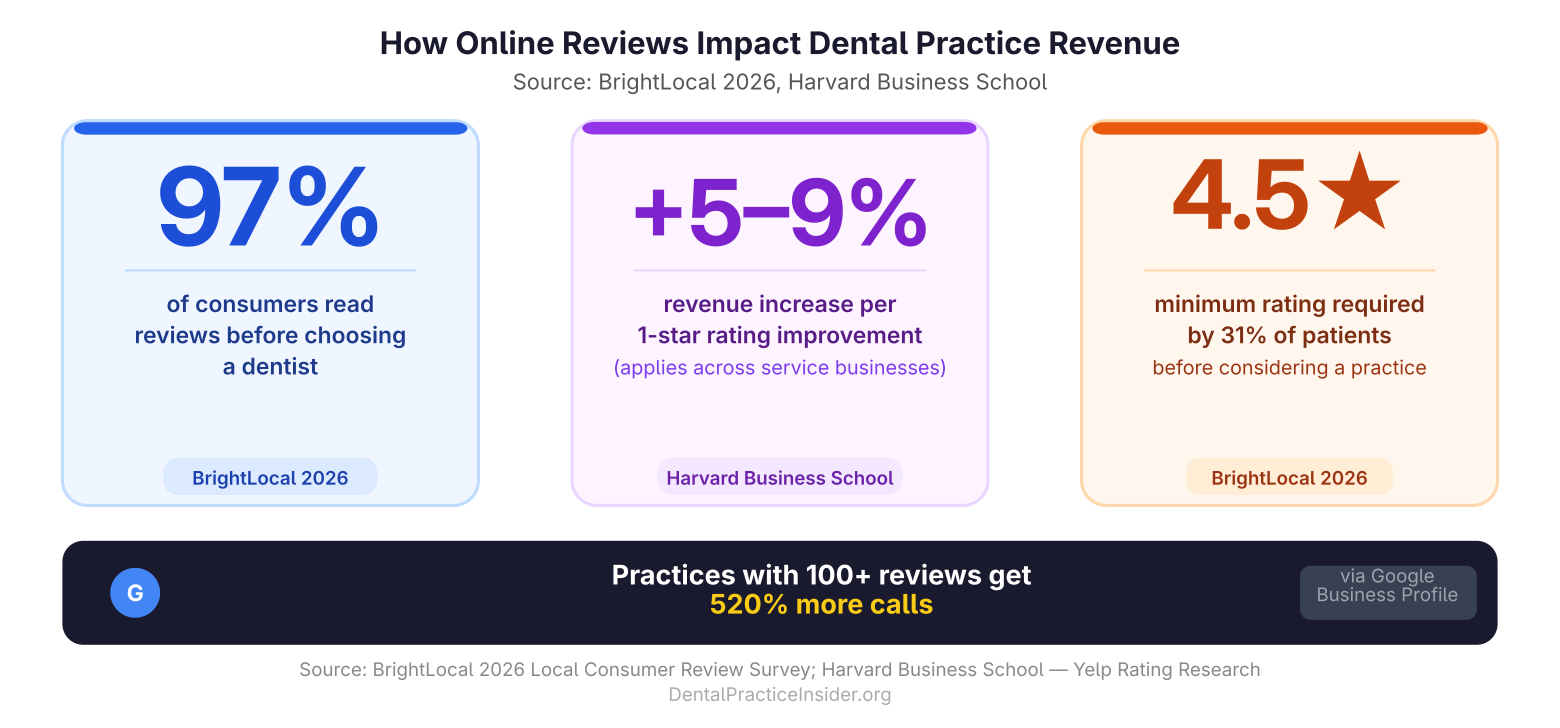
Beyond patient psychology, reviews are a confirmed local SEO ranking factor. Google’s local algorithm uses review quantity, score, and recency as signals of practice prominence. A practice with 400 four-star reviews will routinely outrank a competitor with 30 five-star reviews, even if the competitor has a technically superior website. Volume matters.
The financial impact is equally concrete. A Harvard Business School study found that a one-star increase in Yelp rating leads to a 5–9% increase in revenue for service businesses. For dental practices, this translates directly to case acceptance rates and new patient bookings.
Which Review Platforms Should Dentists Prioritize?
Not all review platforms carry equal weight. Priority ranking for dental practices:
- Google (highest priority): Google reviews feed directly into local search rankings and appear in the Local Pack. Every patient should be asked for a Google review first.
- Healthgrades: The dominant healthcare-specific review platform. Many patients specifically search “dentist healthgrades” before booking — your profile here needs active management.
- Yelp: Significant in urban markets and among younger demographics. Yelp penalizes practices that solicit reviews, so never ask patients directly — instead, remind them you’re on Yelp.
- Facebook: Reviews on your practice’s Facebook page appear in search and provide social validation for patients who find you through Facebook ads or referrals.
- Zocdoc and WebMD: Patients who use these platforms to find providers rely heavily on reviews within the platform itself.
How Do You Generate a Steady Stream of New Patient Reviews?
The biggest obstacle to review generation is not patient unwillingness — it is the failure to ask at the right moment in the right way. Most patients are happy to leave a review; practices just never ask.
A systematic review generation process:
- In-chair verbal request: Train your team to make a brief, natural ask at checkout after a positive appointment. “We’d really appreciate it if you left us a Google review — it helps other patients find us.” Simple, authentic, effective.
- Text message follow-up: Send an automated review request text 2–4 hours after appointment checkout. This is when patient satisfaction is highest and the experience is fresh. Include a direct link to your Google review page — removing friction dramatically increases follow-through rates.
- Email follow-up: A follow-up email the next morning for patients who didn’t respond to the text. Keep it brief, personal, and include the direct review link.
- QR code cards: At checkout, hand patients a small card with a QR code linking directly to your review page. Effective for older demographics who are less responsive to texts.
Platforms like Podium, Birdeye, and NexHealth automate this process and integrate with major practice management systems. The ROI of these tools is typically measured in weeks given the direct impact of reviews on new patient acquisition.
How Should Dental Practices Respond to Negative Reviews?
How you respond to a negative review matters as much as the review itself. Potential patients read the response as a signal of how your practice handles problems. A professional, empathetic response to a one-star review often converts more patients than the negative review loses.
The HIPAA constraint: You cannot confirm, deny, or discuss any patient’s treatment or visit in a public response. Any response that acknowledges a reviewer as a patient and reveals information about their care violates HIPAA. This limits your response language significantly.
A HIPAA-compliant negative review response framework:
- Thank the reviewer for their feedback
- Acknowledge that their experience did not meet expectations (without confirming details)
- Express genuine concern — not defensiveness
- Invite them to contact the office directly to discuss
- Keep the response brief — under 100 words
Example: “Thank you for sharing this feedback. We’re sorry to hear your visit wasn’t a positive experience — this is never our intention. We’d welcome the opportunity to speak with you directly. Please call us at [phone] and ask to speak with [name] — we’d like to understand what happened and make it right.”
Never argue with a reviewer publicly. Never post patient information. Never offer refunds or incentives publicly in a review response.
How Do You Handle Fake Reviews?
Fake reviews — from competitors or disgruntled non-patients — are a real problem for dental practices. The correct response is not panic; it is a methodical process:
- Google: Flag the review using the “Report review” option and provide a detailed explanation of why it violates Google’s policies. Document the report with screenshots. Google’s response time is inconsistent — some reviews are removed in days; others require multiple escalations.
- Respond publicly: Without confirming or denying the reviewer is a patient, respond professionally stating that you have no record of this experience and invite them to contact you directly. This signals to prospective patients reading the review that the claim may not be legitimate.
- Build review volume: The best defense against fake negative reviews is a high volume of real positive reviews. A single one-star fake review among 300 reviews is far less damaging than one among 30.
What Reputation Monitoring Tools Should Dental Practices Use?
You cannot manage what you don’t monitor. Most practices discover negative reviews days or weeks after they’re posted — long after the opportunity to respond promptly has passed. Set up monitoring to catch reviews immediately:
- Google Business Profile notifications: Enable email notifications in GBP settings for every new review. Free and immediate.
- Google Alerts: Set alerts for your practice name and dentist name to catch mentions across the web, not just review platforms.
- Podium, Birdeye, or RepuGen: These paid platforms aggregate reviews from all major platforms into a single dashboard, send real-time alerts, and provide sentiment analysis and response templates.
Review management pairs tightly with the broader concept of social proof — the psychological principle that makes reviews so persuasive in the first place. See our guide on social proof in dentistry for the full framework. For building credibility through patient stories specifically, see how patient testimonials build dental practice authority.
Can Dentists Incentivize Patients to Leave Reviews?
No — and the legal exposure is significant if you do. The FTC requires clear disclosure of any compensation given in exchange for a review. Google’s and Yelp’s terms of service explicitly prohibit offering incentives for reviews. Violations can result in removal of your entire review profile, not just the incentivized reviews.
The correct approach is to make it easy, not to make it rewarding. A frictionless review request — with a direct link, sent at the right moment — will generate far more authentic reviews than any incentive program, and without the regulatory risk.
Key Takeaways
- 88% of patients trust online reviews as much as personal recommendations
- Google reviews are the top priority — they directly affect local search rankings
- Systematic asking (text + email + verbal) after positive appointments is the most effective generation strategy
- HIPAA constraints require all public review responses to avoid confirming patient details
- High review volume is the best defense against occasional negative or fake reviews