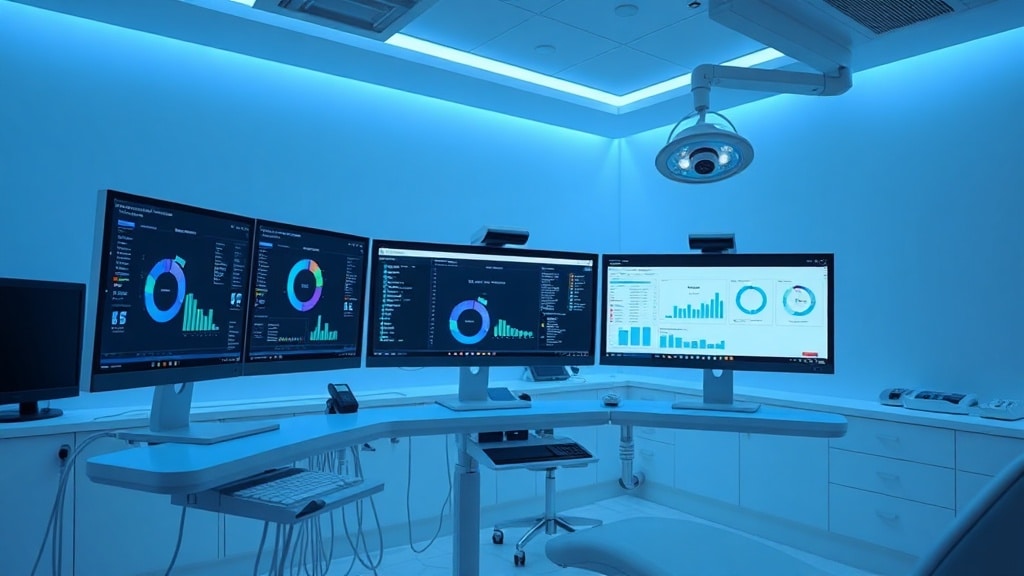
TL;DR — Dental Practice Efficiency
- Operational overhead above 65% of collections is the primary efficiency warning sign — most practices can cut 5–8 points through scheduling and workflow improvements alone.
- No-show and last-minute cancellation rates above 8% indicate a broken scheduling or communication system, not random bad luck.
- The highest-ROI efficiency investments are: optimized scheduling templates, automated patient communication, and standardized clinical workflows.
- Team role clarity and documented protocols reduce the owner-dentist’s administrative burden by 5–10 hours per week without adding staff.
- Technology improves efficiency only after workflows are standardized — software on top of a broken process produces a more expensive broken process.
Dental practice efficiency is not about doing more in less time — it’s about eliminating the waste that prevents your clinical and administrative teams from performing at their best. The ADA Health Policy Institute reports that dental practice owners spend an average of 13 hours per week on administrative tasks that could be delegated, automated, or eliminated entirely (ADA, 2023). That’s roughly one full clinical day lost every week — time that would generate far more value in the chair than behind a desk reviewing insurance claims.
This guide covers the operational systems, scheduling strategies, technology integrations, and team management frameworks that consistently reduce overhead, minimize disruption, and free practice owners to focus on the work that actually drives growth. These principles connect directly to the broader framework in our guide to effective growth strategies for dental practices.
What Is the True Overhead Benchmark for a Well-Run Dental Practice?
Before optimizing operations, you need a clear benchmark. Industry data from the ADA and dental-specific CPA firms consistently places healthy practice overhead in the following ranges:
- Staff costs (wages + benefits): 22–28% of collections
- Dental supplies: 5–7% of collections
- Lab fees: 8–10% of collections (general practice)
- Occupancy (rent + utilities): 5–8% of collections
- Total overhead target: 55–62% of collections
A practice running at 70%+ overhead isn’t just inefficient — it’s structurally unsustainable. At that level, a practice generating $1M in collections retains only $300,000 before owner compensation and debt service, leaving almost no margin for equipment investment, team raises, or financial reserves. The first step in any efficiency initiative is calculating your actual overhead percentage and identifying which category is out of range.
How Does Scheduling Optimization Reduce Operational Waste?
Scheduling is the operating system of a dental practice. Every inefficiency downstream — idle chair time, rushed appointments, unprepared clinical teams, irritated patients — typically traces back to a scheduling problem upstream.
Block Scheduling by Procedure Type
Block scheduling organizes the day into production blocks (crown preps, implants, complex restorative) and hygiene/maintenance blocks. This approach allows the clinical team to prepare instruments, materials, and patient records in advance, reducing setup time between appointments by 30–50% compared to mixed-procedure days. Block scheduling also improves the patient experience — patients in complex procedures aren’t rushed because a hygiene overrun compressed the afternoon.
Managing No-Shows Systematically
An 8%+ no-show rate is correctable with the right system. Research published in the Journal of the American Dental Association found that multi-touch reminder sequences (automated text + email 48 hours out, plus a confirmation call 24 hours out for high-value appointments) reduce no-shows by 40–60% compared to single-touch reminder systems (JADA, 2021). Identify your top 20 no-show offenders by name — they account for a disproportionate share of disrupted days — and implement a mandatory pre-payment or credit card hold policy for that group.
Overbooking Intelligently
Strategic overbooking — scheduling 10–15% more appointment slots than your actual capacity, based on your historical no-show rate — ensures the schedule stays full without creating patient backups. Most practice management software supports this with “short-call lists” of patients who want to be contacted if an earlier appointment opens up.
What Clinical Workflow Changes Produce the Largest Efficiency Gains?
Clinical workflow inefficiency is often invisible to practice owners because it’s baked into the daily routine — it feels normal, not wasteful. Common high-impact areas include:
Standardized Room Setup Protocols
Documenting setup procedures for each procedure type — with a physical or digital checklist — eliminates the search-and-retrieve time that happens when instruments aren’t in their designated place. Clinics that implement room standardization consistently report 10–15 minutes recovered per provider per day. At $300/hour production, that’s $50–$75 recovered daily, or $12,000–$18,000 annually per provider.
Delegation to the Full Scope of Licensed Staff
Many practices underutilize their dental assistants and hygienists by having the dentist perform tasks that legally fall within the assistant’s or hygienist’s scope. Auditing your clinical workflow against your state’s scope-of-practice regulations and redistributing work accordingly is often the single fastest way to increase production per hour without adding staff.
Same-Day Treatment Protocols
Training the team to identify and present same-day treatment opportunities — a small carious lesion that can be addressed while the patient is already numb, a sealant on an adjacent tooth — increases production per visit without extending appointment time. Same-day treatment also benefits patients by reducing the number of visits required for their overall care plan.
How Should a Dental Practice Approach Technology Integration?
Technology is a force multiplier for an already-efficient practice. Implemented on top of a broken workflow, it amplifies the inefficiency rather than fixing it. The sequence matters: standardize workflows first, then automate the standardized process.
Practice Management Software
Dentrix, Eaglesoft, and Open Dental are the three dominant practice management platforms. All three support scheduling, billing, patient records, and reporting. If you’re on any of these platforms and not using their reporting modules to track production per visit, collection rate, and schedule fill rate monthly, you’re paying for capabilities you aren’t using. Start there before evaluating new software.
Patient Communication Platforms
Two-way texting and automated recall represent the clearest ROI in dental technology. Platforms like Weave, Lighthouse 360, and NexHealth integrate with existing PMS software and automate the reminder, recall, and review-request sequences that would otherwise require dedicated front desk time. Average cost is $300–$600/month; typical return is 8–12 additional kept appointments per month.
Digital Imaging and CAD/CAM
Intraoral scanners eliminate the labor cost, lab fee, and appointment delay associated with traditional impressions for crown cases. Practices with in-house CAD/CAM (CEREC, Planmeca) can complete single-tooth restorations in one visit, improving patient experience and capturing the lab fee margin internally. The capital investment ($100,000–$150,000) typically pays back in 18–36 months at average crown volume for a busy general practice.
What Team Management Practices Drive Operational Efficiency?
Operational efficiency is a team achievement. A practice with excellent systems but a disengaged or poorly trained team will underperform a practice with simpler systems and a highly aligned, well-trained one. The management practices that have the clearest impact on efficiency include:
Role Clarity and Accountability
Every team member should have a written job description that includes their specific metrics — not just responsibilities. The front desk coordinator owns the schedule fill rate and accounts receivable aging. The hygienist owns reappointment rate at checkout. The treatment coordinator owns case acceptance rate. When each person owns a number, accountability is built into the role rather than requiring constant managerial intervention.
Brief Daily Huddles
A 10-minute morning huddle reviewing the day’s schedule — noting high-value patients, same-day treatment opportunities, and patients with outstanding treatment plans — prepares the team to produce effectively rather than react to the day as it unfolds. Practices with consistent daily huddles consistently report higher production days than those without them, controlling for other variables.
For related reading, see our guide on morning huddle templates for dental practices.
Structured Monthly Metric Reviews
Set aside 60 minutes monthly to review the practice’s core metrics as a leadership team: production, collections, overhead by category, new patient count, and retention rate. Trends are more important than absolute numbers — a metric moving in the wrong direction two months in a row requires a root-cause conversation before it becomes a three-month trend requiring a structural fix.
For details on the specific financial metrics that translate operational efficiency into profitability, see our guide to dental practice economics and key metrics.
How Do You Build Operational Resilience Against Disruption?
The COVID-19 pandemic exposed the operational fragility of practices that had no documented procedures, no cross-trained staff, and no financial reserves. A resilient practice can absorb a provider absence, an equipment failure, or a sudden drop in scheduled production without catastrophic disruption.
For related reading, see our guide on modern dental practice management.
The key resilience-building practices are:
- Documented standard operating procedures for every recurring task: If only one person knows how to do something critical, it’s a single point of failure. Document and cross-train.
- 3-month operating reserve: Industry consultants universally recommend maintaining 3 months of fixed expenses in liquid reserves. For most practices, this is $60,000–$150,000 — a meaningful amount that takes 2–4 years to accumulate when approached deliberately.
- Diversified revenue streams: Practices that generate 20%+ of revenue from elective services (clear aligners, whitening, sleep apnea) are significantly more resilient during insurance reimbursement cuts or economic downturns than those 100% dependent on insurance-driven restorative.
For a complete view of how operational systems connect to patient experience, see our guide to patient retention strategies for dental practices.
What Is a Practical Implementation Sequence for Efficiency Improvements?
Trying to fix everything simultaneously is the most reliable way to fix nothing. A sequenced approach works better:
Month 1: Calculate actual overhead by category. Identify the highest-variance item (usually staff costs or lab). Implement block scheduling and daily huddles.
Month 2: Activate automated patient communication and audit your no-show rate. Identify the top 20 chronic no-shows and implement a pre-payment policy for that group.
Month 3: Conduct a scope-of-practice audit and redistribute tasks to fully utilize licensed staff. Document room setup protocols for the top 10 procedure types.
Month 4–6: Evaluate and implement one technology upgrade based on your specific bottleneck (typically patient communication platform or digital imaging, depending on current setup). Review and refine metrics monthly.
By month 6, a practice that executes this sequence consistently should see overhead reduced by 3–5 percentage points, no-shows reduced by 30–50%, and the owner-dentist recovering 5–8 administrative hours per week for clinical or strategic work.
Last Updated: March 2026
Sources
- American Dental Association Health Policy Institute. Dentist Income and Expenditure Survey. ADA, 2023.
- Journal of the American Dental Association. “Effectiveness of appointment reminder systems in reducing no-show rates.” JADA, 2021.