| System | Lab cost/case | Median GP fee | Gross margin | Year-1 net per case* |
|---|---|---|---|---|
| Invisalign Comprehensive | $1,500-$1,900 | $5,500 | 40-58% | $2,200-$3,200 |
| ClearCorrect Unlimited | $700-$1,200 | $4,500 | 55-70% | $2,500-$3,400 |
| SureSmile | $800-$1,300 | $4,800 | 52-68% | $2,400-$3,300 |
*Net per case after $80/appt clinical-time cost across 8-12 visits. Source: DPI 2026 GP aligner economics analysis. Detailed methodology and ROI timeline in the sections below.
Run the numbers for your practice →
How Large Is the Clear Aligner Market Opportunity?
The global aligner therapy market was valued at $4.5 billion in 2024 and is projected to reach $9.2 billion by 2030, growing at a compound annual growth rate of 16.8% (Grand View Research, 2025). North America represents approximately 42% of global revenue, with the US market alone generating $1.9 billion in 2024.
For related reading, see our guide on dental practice growth strategies.
For related reading, see our guide on dental practice loans and financing.
For related reading, see our guide on retirement planning for dentists.
For related reading, see our guide on improving dental practice profitability.
More practically for dental practices: patient demand is high and growing. Approximately 52% of adults say they are “somewhat” or “very” interested in teeth straightening, and 78% of those who are interested prefer aligner therapy over traditional braces (American Association of Orthodontists, 2024). This demand is sitting in your hygiene chairs every day. The question is whether you have the offering to capture it.
For more on adding high-margin services to improve practice performance, see our guide on improving dental practice profitability.
What Are the Profit Margins on Clear Aligners?
Aligner therapy profitability varies significantly based on the platform you choose and your case fee structure. Here’s a realistic breakdown for a typical complete case:
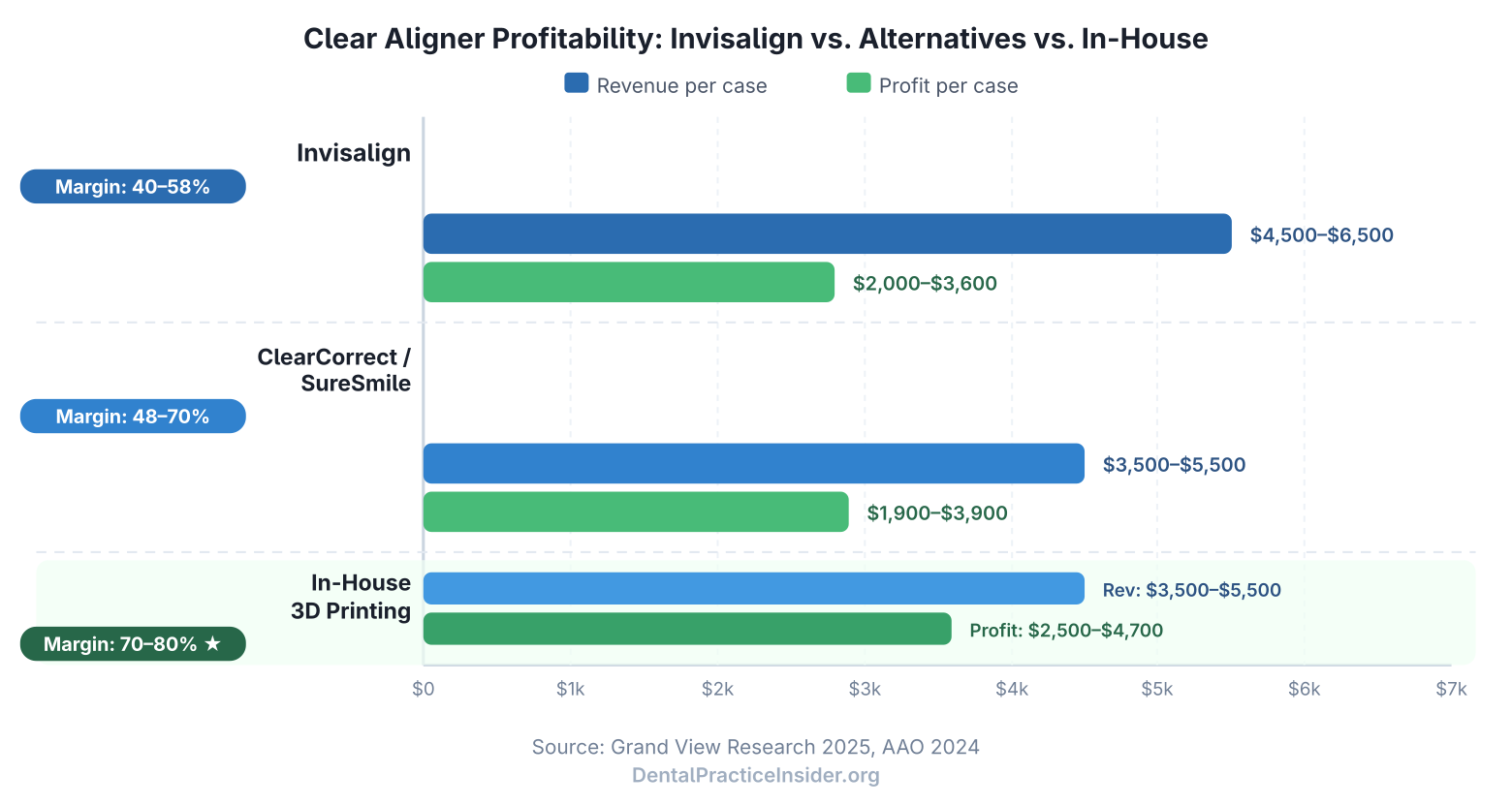
Case Economics: Invisalign Complete
| Item | Typical Cost/Revenue |
|---|---|
| Patient case fee (GP setting) | $4,500-$6,500 |
| Invisalign lab cost (per case) | $1,500-$1,900 |
| Clinical time (8-12 appointments × $80 cost) | $640-$960 |
| Retainer (included or additional) | $0-$400 additional |
| Gross profit per case | $2,000-$3,600 |
| Gross margin | 40-58% |
Case Economics: Alternative Clear Aligners (Candid Pro, SureSmile, ClearCorrect)
| Item | Typical Cost/Revenue |
|---|---|
| Patient case fee | $3,500-$5,500 |
| Lab cost per case | $500-$1,100 |
| Clinical time cost | $640-$960 |
| Gross profit per case | $1,900-$3,900 |
| Gross margin | 48-70% |
The economics on non-Invisalign alternatives are compelling on a per-case basis, but Invisalign’s patient brand recognition often leads to higher case volume. Patients specifically request Invisalign by name, which affects conversion rates.
How Does Invisalign Compare to Alternative Clear Aligners?
Align Technology (Invisalign’s parent company) holds approximately 44% of the global clear aligner market but faces increasing competition from lower-cost alternatives that have closed the quality gap significantly since 2020.
For related reading, see our guide on dental practice overhead benchmarks.
| Platform | Lab Cost/Case | Case Complexity | Patient Brand Recognition | Training Requirement |
|---|---|---|---|---|
| Invisalign (Align Technology) | $1,500-$1,900 | Mild to complex | Very high | Moderate (online + clinical) |
| ClearCorrect (Straumann) | $700-$1,200 | Mild to moderate | Low-moderate | Moderate |
| SureSmile (Dentsply Sirona) | $800-$1,300 | Mild to complex | Low | Moderate-high |
| Candid Pro | $500-$900 | Mild to moderate | Low-moderate | Low |
| uLab / uSmile | $400-$700 | Mild to moderate | Very low | Moderate |
| In-house (3D printing) | $150-$400 | Mild | N/A | High |
In-house aligner printing (using platforms like Ormco’s Spark, Dental Monitoring, or custom 3D printing workflows) offers the highest margins, 70-80% gross margin per case, but requires significant upfront investment in equipment ($40,000-$80,000) and staff training.
What Training Investment Is Required?
Training is the most underestimated cost in aligner therapy adoption. The clinical learning curve is real, and practices that skip adequate training produce poor outcomes, generate refund requests, and damage their reputation in a category where patient satisfaction directly drives referrals.
Training Cost Breakdown
| Training Component | Time Investment | Cost |
|---|---|---|
| Invisalign online certification | 4-8 hours | Free (part of startup) |
| Hands-on clinical course (GP aligner) | 2-3 days | $2,000-$5,000 |
| Advanced case management CE | 1-2 days/year | $1,500-$3,000/year |
| Staff training (case presentations, financing) | 4-8 hours | $500-$1,500 |
| First-year total training investment | $4,000-$9,500 |
Many practices also invest in a digital scanner ($20,000-$35,000) when launching an aligner program, since digital impressions produce more accurate results and better patient experience than PVS impressions. If you’re already doing implant-retained restorations, you may already have this equipment.
What Level of Patient Demand Can You Realistically Expect?
Demand projections depend on your patient demographics, your ability to present the service compellingly, and how aggressively you market it. Realistic conversion benchmarks for a new orthodontic treatment program:
- Screening rate: 30-40% of hygiene patients are candidates for some form of alignment correction (mild crowding, spacing, relapse)
- Presentation rate: 60-70% of candidates should receive a brief consultation offer during their hygiene visit
- Conversion rate: 15-25% of presented patients start a case in the first 12 months; experienced practices hit 30-40%
For a practice seeing 300 hygiene patients per month:
- 300 × 35% screened = 105 candidates
- 105 × 65% presented = 68 consultations offered
- 68 × 20% converted = 13-14 cases per month in year one
- 13 cases × $2,500 average profit = $32,500 gross profit per month
Year one annualized gross profit from the aligner service alone: approximately $390,000 gross revenue, $195,000-$250,000 in gross profit for an average GP practice that commits to the program.
What Is the ROI Timeline for a Clear Aligner Program?
| Cost Category | Year 1 Investment |
|---|---|
| Digital scanner (if not already owned) | $25,000 |
| Training (doctor + staff) | $7,500 |
| Marketing (before/after photos, ads, web update) | $3,000-$5,000 |
| Startup lab costs (first 3 months below break-even) | $8,000 |
| Total first-year investment | $43,500-$45,500 |
At $195,000 in year-one gross profit from 13 cases/month, the net ROI in year one is approximately $150,000 after covering startup costs. Payback period on the scanner and training investment: 3-4 months of full case volume.
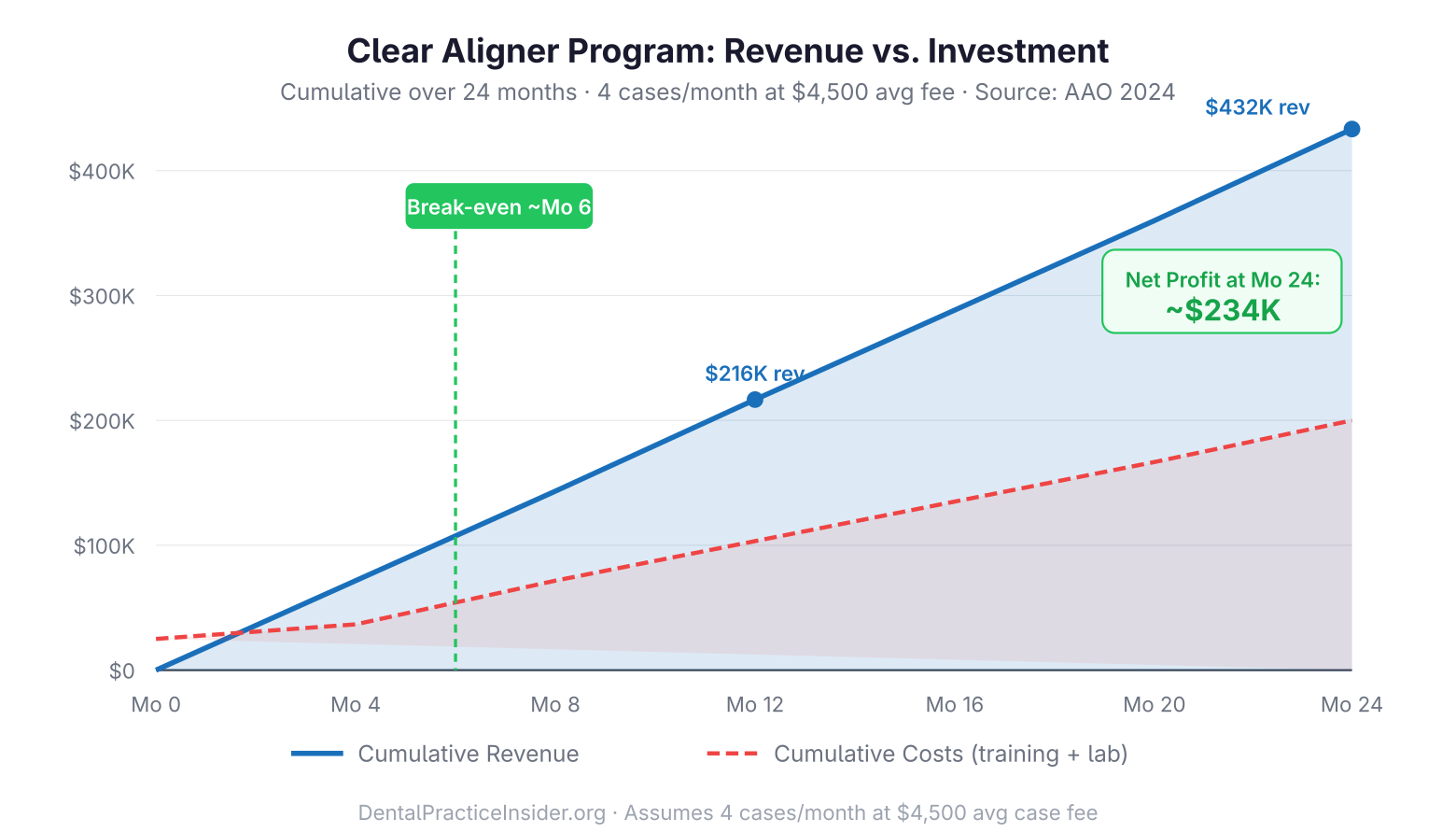
If you start without a scanner (using digital impressions from an existing workflow), the upfront investment drops to $15,000-$18,000 and the ROI period shortens to 30-45 days of case volume.
What Are the Competitive Dynamics in Clear Aligners?
The orthodontic aligner market faces two competitive pressures GPs need to understand:
Direct-to-Consumer (DTC) Aligners
Smile Direct Club’s 2023 bankruptcy removed the largest DTC player, but lower-cost DTC models continue to exist. Research consistently shows DTC aligners have higher complication rates and lower patient satisfaction, a Journal of Clinical Orthodontics study found 24% of DTC aligner patients required follow-up professional treatment for complications (JCO, 2024). Use this data when presenting to cost-sensitive patients who ask about DTC options.
Orthodontist Competition
Local orthodontists offer more complex cases and may have lower per-case lab costs from volume discounts. GPs differentiate on convenience (one location for all dental needs), existing patient relationships, and bundling opportunities (aligners + whitening + veneers consultations at the same practice).
For related reading, see our guide on patient financing options that improve clear aligner case acceptance rates.
For related reading, see our guide on how adding clear aligners shifts your overall break-even threshold.
Frequently Asked Questions
How many Invisalign cases does a GP need to be profitable?
Break-even on training and setup costs (assuming $15,000-$25,000 investment) is typically achieved after 8-12 cases, depending on your case fee and lab cost structure. At $2,500 gross profit per case, 10 cases covers a $25,000 investment. Most GPs who commit to the program reach break-even within 90 days of launching.
What Invisalign tier should a GP dentist reach for?
Invisalign’s tiered program (Preferred Provider, Platinum, Diamond) offers lab fee discounts at higher case volumes. Preferred Provider status starts at 10 cases/year (no lab fee discount). Platinum (25+ cases/year) provides meaningful lab fee reductions of 15-25%. Diamond (50+ cases/year) can reduce per-case lab costs by up to 35%, significantly improving margins.
Can you offer clear aligners without an intraoral scanner?
Yes. PVS impressions can be used for aligner fabrication, but digital scans produce more accurate results, faster turnaround times, and a better patient experience. Most platforms prefer digital scans and some (like Candid Pro) require them. If you’re serious about building this service line, a digital scanner is a worthwhile co-investment.
How do you market orthodontic treatment to existing patients?
The most effective marketing channels for aligner therapy in a GP setting: hygiene-driven consultations (train hygienists to identify and mention candidates), before/after photo galleries in the office and on your website, Google Ads targeting local “[city] Invisalign” searches, and patient email campaigns to your existing patient list. Internal marketing (patients who already know and trust you) converts at 3-5x the rate of external advertising.
Is there a risk of scope-of-practice issues with clear aligners?
No. Aligner therapy is firmly within the scope of practice for licensed general dentists in all 50 states. The ADA explicitly supports GP dentists offering orthodontic treatment commensurate with their training and competency. Some states require specific CE hours for orthodontic treatment; check your state dental board’s guidelines and ensure you have the training credentials to support the cases you accept.
Is ClearCorrect or Invisalign more profitable for a general dentist?
ClearCorrect typically delivers a higher gross margin per case for a GP: 55-70% versus 40-58% for Invisalign, because its lab cost runs $700-$1,200 per case against Invisalign’s $1,500-$1,900. Invisalign commands a higher median GP case fee ($5,500 vs $4,500) and far stronger patient brand recognition, so it often wins on case volume even when ClearCorrect wins on per-case margin. For most general practices the profit-maximizing answer is to offer both and route mild-to-moderate cases to ClearCorrect.
What is the ROI of adding clear aligners to a GP practice?
A general practice that commits to an aligner program nets roughly $150,000-$250,000 in year-one profit at about 13 cases per month, against a first-year investment of $43,500-$45,500 (or $15,000-$18,000 if you already own an intraoral scanner). Payback on equipment and training is typically 3-4 months of full case volume.
For more resources on this topic, see our complete guide to dental practice financial management.

Sajid Ahamed is a dental practice-management content strategist with 7+ years of experience marketing for dental practices. He covers dental service-line profitability and clear aligner economics for DPI, translating lab-cost and case-ROI data into adoption decisions for general dentists. Connect on LinkedIn.