Dental insurance credentialing is the process by which a payer verifies a provider’s qualifications and licensure before allowing that provider to bill as in-network. It runs on the provider’s CAQH ProView profile, typically takes 60-180 days per plan depending on the payer and state, and must be repeated (re-credentialing) every 2-3 years plus a mandatory 120-day CAQH re-attestation in between. The costliest and most under-discussed failure mode isn’t the initial application, it’s provider-level vs. practice-level enrollment: a practice can be in-network while a newly hired associate is not yet credentialed under that same plan, so every claim that associate generates in the interim pays out-of-network or denies outright. This guide covers the document package, the CAQH backbone, the financial cost of the credentialing gap, re-credentialing maintenance, and how to decide between doing it in-house, hiring a credentialing service, or folding it into outsourced RCM.
This article is general operational information for dental practice owners and administrators, not legal or compliance advice. Credentialing requirements, timelines, and fee schedules vary by payer, state, and plan type: verify specifics directly with each payer’s provider relations department and, where compliance or contract law questions arise, with qualified counsel.
What Is Dental Insurance Credentialing?
Credentialing is the process by which an insurance plan verifies a provider’s qualifications, licensure, and background before adding that provider to its network. Until credentialing and contracting are both complete, the provider cannot bill that plan as in-network. Even if the patient has active coverage and treatment is medically appropriate.
Three distinct processes get bundled together in casual conversation but function separately, and knowing the difference prevents wasted follow-up calls:
- Credentialing: The payer verifies credentials, degree, license, malpractice history, DEA registration, board certification, against primary sources.
- Contracting: The provider and the plan agree to a fee schedule and participation terms. Some payers run this alongside credentialing; others sequence it afterward.
- Enrollment (network activation): The provider is loaded into the payer’s claims-adjudication system with an effective date, which is what actually allows claims to pay in-network. A provider can be “credentialed” on paper before enrollment activates, and claims submitted in that gap still deny or price out-of-network.
For related reading, see our guide on creating a dental membership plan, negotiating better dental insurance rates, and managing PPO plan risks.
CAQH ProView: The Backbone of Modern Credentialing
CAQH ProView, maintained by the nonprofit Council for Affordable Quality Healthcare, is the credentialing data hub that the large majority of commercial dental insurers pull from instead of collecting a separate paper application from every provider. One profile, kept current, feeds every payer the provider authorizes, which is why a healthy CAQH profile is treated as step one of every credentialing project, not an optional add-on.
Profile Setup
Registration requires an NPI and produces a CAQH Provider ID. The profile asks for the full document package below plus practice location data, malpractice history, and work history with no unexplained gaps. Complete every field even when a payer’s own application skips it. Incomplete CAQH data is a common reason a coordinator puts a file on hold without calling first.
Re-Attestation: The Silent Failure Mode
CAQH requires every provider to log in and re-attest, confirm the data on file is still accurate, every 120 days (some states extend this window; confirm your state’s cycle). CAQH emails reminders ahead of the deadline, but a lapsed window flips the profile to expired. An expired profile is invisible to payers pulling fresh data, which can silently stall a pending application or jeopardize an already-credentialed provider’s next re-credentialing review before anyone notices. Put re-attestation on the same recurring calendar as license renewals, not in one person’s memory.
Document Expiry Management
Malpractice certificates, state licenses, and DEA registrations expire on their own schedules, and CAQH does not auto-refresh an uploaded document when the underlying credential renews. Someone has to re-upload it. A profile can be “attested” and still carry an expired malpractice certificate that a payer’s verification step catches, restarting part of the review clock.
Payer Authorization
CAQH ProView doesn’t push data to a payer automatically. Each payer must be explicitly authorized inside the profile to access it. A frequent, avoidable delay: a provider finishes CAQH assuming the job is done, but a plan applied to was never authorized, so it sees nothing to review. Authorize every target payer, and recheck the list whenever a new application goes out.
The Document Package You Need Before You Apply
Assembling this package before submitting a single application, rather than gathering it reactively, is the single highest-leverage step in avoiding delay.
| Document | Notes |
|---|---|
| State dental license(s) | Current, unrestricted, for every state where the provider will practice. |
| DEA registration | Required where the provider prescribes controlled substances; state-specific for multi-state providers. |
| Malpractice insurance certificate | Carrier name, policy number, and coverage limits. Payers set their own minimum limit requirements, so confirm each plan’s threshold before assuming your policy qualifies. |
| NPI, Type 1 (individual) | Assigned to the individual provider via an SSN application; identifies the rendering provider on claims. |
| NPI, Type 2 (organizational) | Assigned to the incorporated practice entity via its EIN; identifies the billing organization. A practice needs both types on file. Confusing the two is a common application error. |
| Signed W-9 | Tax ID verification for the billing entity. |
| Board certifications | Where applicable to the provider’s specialty. |
| CV with no unexplained gaps | Covering at least the past 5-10 years; any gap over roughly a month typically needs a written explanation. |
| Hospital or surgical-center privileges | Where relevant to the provider’s scope of practice. |
The NPI Type 1 vs. Type 2 distinction trips up more practices than any other item on this list. A solo, unincorporated practitioner billing under their own SSN only needs a Type 1. An incorporated practice, even a single-dentist PLLC, needs a Type 2 for the entity plus each dentist’s individual Type 1. A group with multiple associates needs one Type 2 for the group plus a Type 1 per associate. Applying with the wrong number, or leaving one off, routinely causes a returned application.
Provider-Level vs. Practice-Level Enrollment: The Trap That Costs Real Money
This is the distinction most credentialing content skips, and it carries the most money. A practice’s Tax ID being in-network with a plan does not automatically make every provider billing under it in-network. Each provider, identified by their Type 1 NPI, must complete their own credentialing and enrollment with that plan, even when the practice has been contracted for years.
The failure pattern is consistent: a practice hires an associate who starts seeing patients on day one because the practice is already in-network locally, and nobody checks whether that associate specifically has cleared credentialing with each plan yet. Every claim they generate against a plan they aren’t yet enrolled with denies or pays out-of-network, and the patient may be billed the balance, exactly what the front desk should catch at verification, not discover at payment posting.
Our insurance verification checklist covers catching this trap from the front-desk side, confirming a specific provider’s status for a specific plan before the appointment. This post is the fix-it-upstream counterpart: never let a new hire’s start date arrive before their credentialing has cleared, or at minimum, know exactly which plans they are and aren’t cleared for on day one.
Timeline Reality: Why Credentialing Takes So Long
A 60-180 day timeline feels unreasonable to a practice trying to hire, but it’s the product of several bottlenecks stacking on each other. DPI’s editorial characterization is that practices should plan around the long end of that range, not the short end:
- Payer backlogs. Large insurers process a continuous application queue; volume spikes (open enrollment, network expansions) push individual files back.
- Incomplete submissions. A file missing one document or one CAQH authorization typically gets returned rather than a phone call, and the clock effectively restarts.
- Primary source verification. The payer contacts dental schools, licensing boards, and malpractice carriers directly to confirm what’s on file, and waits on their response times.
- Committee review cycles. Many payers approve new providers only at scheduled committee meetings, monthly or quarterly. Missing a cycle by days can add 30-90 days before the next one.
Timelines vary too much by payer and state for a single reliable figure, so treat any day-count in this article as an editorial range, not a guarantee. Confirm the current estimate with each payer’s provider relations department when planning a hire.
The Financial Cost of the Credentialing Gap
This is the section with the most real money in it. An associate who treats patients before their credentialing with a given plan is complete generates claims that deny or pay out-of-network, and an unexpected out-of-network balance is a patient-experience problem, not just a collections one.
Illustrative model, not sourced data: the figures here are a worked example showing how the math behaves, not a benchmark to plug into your own numbers. An associate scheduled to start day one, generating claims against three plans the practice already participates in, could produce several thousand dollars in claims during a 60-day gap; any plan that denies uncredentialed-provider claims outright (rather than paying out-of-network) turns that portion into an uncollectible write-off. Run this math against your own average claim value and plan mix before deciding. The range is too wide to guess.
Practices generally choose among three options, none of them free:
- Delay the start date until credentialing clears for the plans that matter most locally. Cleanest administratively; costliest in lost production.
- Schedule only non-participating or self-pay patients until credentialing clears, keeping the chair productive without generating claims that deny or under-pay. Requires active schedule management.
- See patients as usual and absorb the write-off. Fastest to full scheduling, but converts a plannable cost into one that surfaces later in the A/R aging report.
Retroactive effective dates are payer-dependent and should never be assumed. Some plans backdate a provider’s effective date to the application date if approval lands within a window, a courtesy some extend and others don’t, and never guaranteed. Ask explicitly, get it in writing, and never schedule around an unconfirmed retroactive date.
Step-by-Step: How to Get Credentialed with Dental Insurance Plans
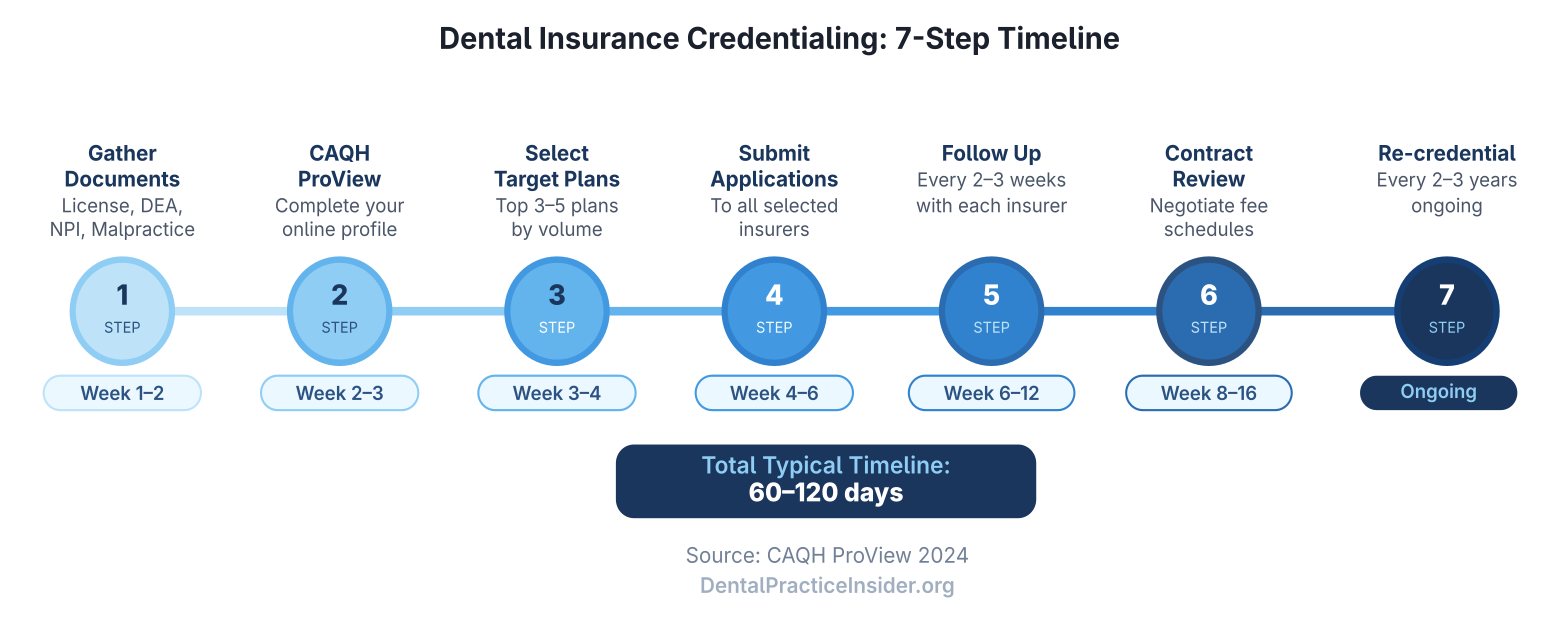
Step 1: Assemble the Document Package
Use the checklist above. Having every document ready before the first application goes out removes the single most common cause of delay.
Step 2: Complete and Authorize Your CAQH ProView Profile
Fill every field, upload every document, and explicitly authorize each payer applied to. Most applications reference the CAQH profile rather than duplicating the data.
Step 3: Identify Which Plans to Apply For
Don’t credential with every plan by default. Check which plans local employers offer, what patients ask about, and which publish reasonable fee schedules for your zip code. Payers must provide fee schedules on request. Most practices start with the three to five highest-volume plans locally.
Step 4: Submit Applications in Parallel
Submit to every target plan at once rather than waiting for one approval before starting the next. Each runs its own independent timeline, so serial submission only adds waiting.
Step 5: Follow Up on a Fixed Cadence
Contact provider relations every two to three weeks to confirm receipt, ask what’s missing, and request an estimated effective date. Log every contact, date, representative, what was discussed, because that log is the only leverage in a later dispute.
Step 6: Review and Sign the Provider Contract
Before signing, check the fee schedule against your top-billed codes, the termination notice period, claim submission deadlines, coordination-of-benefits terms, and any restriction on fee-for-service billing to patients outside the plan.
Step 7: Confirm the Effective Date Before Scheduling
Get the enrollment effective date in writing before scheduling the provider against that plan. Approval and activation aren’t always the same date.
Re-Credentialing and Maintenance: A Recurring Obligation, Not a One-Time Project
Most plans require re-credentialing every two to three years, and 120-day CAQH re-attestation sits inside that longer cycle. A lapse in either doesn’t always trigger a warning. It can mean silent termination from the plan’s roster, discovered only when claims start denying. Treat both as recurring calendar obligations with an owner assigned, not one-time projects filed away after approval.
A practical system covers three things: an expirables calendar tracking every license, DEA registration, malpractice certificate, and board certification renewal date per provider; a roster accuracy check confirming the payer’s published directory still lists the correct providers and contact details (a stale entry can itself flag a provider for review); and a standing 90-day-ahead reminder before each plan’s re-credentialing window opens.
Practice Changes That Trigger Re-Credentialing
Re-credentialing isn’t only a scheduled event. Certain changes trigger it out of cycle, each with its own payer notification deadline.
| Change | Why it matters |
|---|---|
| New practice location | Most plans credential and contract by location, not just by Tax ID, a new address is typically a new enrollment, not an update. |
| Tax ID (TIN) change | A new TIN generally means a new billing entity in the payer’s system, which can require re-enrolling every provider under it. |
| Ownership change | An acquisition can inherit an incomplete or lapsed credentialing project along with the practice, this is a standard line item in an acquisition due-diligence checklist and should be verified before closing, not after. |
| Adding an associate | Each new provider needs their own credentialing and enrollment per plan, see the provider-vs-practice-level section above. |
| Provider or practice name change | Legal name changes (marriage, entity rebranding) require updates across CAQH, NPPES, and every payer’s roster to keep records matching. |
For practices on either side of a sale, our practice acquisition operator’s checklist covers the broader due-diligence picture that credentialing status feeds into.
What Are the Most Common Credentialing Mistakes?
- Starting too late, plan for a 6-month lead time before a new provider needs to bill.
- Submitting incomplete applications, which plans typically return rather than call about.
- Letting the CAQH profile lapse past 120 days, or forgetting to authorize a payer inside CAQH.
- Not tracking application status, so a stalled file sits unnoticed in a payer’s queue.
- Signing a contract without reviewing the fee schedule, locking in low rates for two to three years.
- Treating practice-level participation as coverage for every provider, and letting a new associate see patients before their own credentialing clears.
- Missing a re-credentialing window and discovering the lapse only when claims start denying.
In-House vs. Credentialing Service vs. Outsourced RCM: The Honest Tradeoff
There are three broad ways to handle credentialing, and the right choice depends on volume, growth plans, and administrative bandwidth, not which option sounds more sophisticated.
- In-house. A practice manager or staff member owns CAQH maintenance, applications, and follow-up. Lowest direct cost, but requires real consistency. The failure mode is the task getting deprioritized whenever the practice gets busy, exactly when a lapse is most likely.
- A dedicated credentialing service. A specialist firm handles applications and CAQH maintenance for a per-application plus ongoing fee. Useful for a startup applying to eight to twelve plans at once, or a practice already burned by a missed re-attestation. Verify direct relationships with the plans applied to and references from practices in your state.
- Outsourced revenue cycle management (RCM). Some RCM vendors bundle credentialing into a broader package covering claims and collections, sensible if billing is already outsourced, since credentialing status feeds those workflows directly. Confirm it’s actually included, not billed as a separate add-on.
None is inherently correct; the honest comparison is time cost against dollar cost against how confident the practice is in its own follow-through on a recurring obligation. For a strategic view on managing insurance dependency long-term, see our guide on reducing insurance dependency in dental practices.
What to Track: Building a Credentialing Status Tracker
Whoever owns credentialing should maintain a single tracker covering every provider against every plan. Documentation is the only leverage in a later dispute over an effective date or a denied claim. At minimum, track:
- Provider name and NPI (Type 1) for each row, with the practice’s Type 2 NPI noted once per plan
- Plan name and application submission date
- Current status (submitted, under review, approved, contracted, active) and the date it last changed
- Payer reference or application number
- Confirmed or estimated effective date, and whether it was confirmed in writing
- A running contact log: date, representative name, and what was discussed on every follow-up call
- Next re-attestation due date (CAQH, 120-day cycle) and next full re-credentialing due date (per plan, typically 2-3 years)
A spreadsheet works for a single-location practice with a handful of providers; multi-location or high-turnover practices tend to outgrow it past a few dozen active applications, at which point a credentialing service’s tracking system earns its cost back in avoided lapses alone.
Frequently Asked Questions
Can I see patients before credentialing is complete?
Yes, as an out-of-network provider. Patients with out-of-network benefits may still receive partial reimbursement. Some plans offer retroactive claims processing once credentialing is approved, ask each plan specifically about this option before assuming it applies; retroactive effective dates are never guaranteed.
How long does Delta Dental credentialing take?
Delta Dental typically takes 60-90 days, but processing time varies by state affiliate. Delta Dental operates through independent state-based chapters. Apply to the chapter covering the practice’s location and confirm the current estimate with that chapter directly.
What is a credentialing effective date?
The effective date is when in-network participation begins. Only services rendered on or after that date can be billed in-network. Some plans backdate the effective date to the application date if approval lands within a certain window, ask about this explicitly when following up, and get the answer in writing.
Do I need to credential with Medicaid separately?
Yes. Medicaid credentialing runs through the state’s Medicaid agency, not the commercial insurers, and timelines vary widely by state. Many states also layer managed care organization (MCO) credentialing on top of state enrollment. Start this track early and treat it as a separate project from commercial credentialing.
What’s the difference between provider-level and practice-level credentialing?
Practice-level credentialing covers the practice’s Tax ID and location being in-network with a plan. Provider-level credentialing covers each individual dentist’s Type 1 NPI being cleared with that same plan. A practice can be fully in-network while a specific provider, commonly a newly hired associate, is not, and claims for that provider still deny or pay out-of-network until their individual credentialing clears.
What happens if a plan terminates my participation?
Plans can terminate participation with 30-90 days notice, depending on the contract, and most contracts preserve a right to appeal. On termination, the practice must notify affected patients and typically continue active treatment for a transition period. Review a contract’s termination clauses, particularly any “without cause” provision and its required notice period, before signing.
How often does CAQH require re-attestation?
Every 120 days in most states (some states extend this window, confirm the applicable cycle for your state). Missing the deadline flips the profile to expired, which can silently stall pending applications or jeopardize an already-credentialed provider’s next re-credentialing review.
For more resources on this topic, see our complete guide to insurance independence strategies and our practice management hub.