TL;DR: 5 Things to Know Before You Read On
- Reviews are not optional. BrightLocal’s 2026 survey found 97% of consumers read online reviews for local businesses, and 31% now only contact practices with 4.5-star ratings or higher, up from 17% a year earlier. Getting to 50+ Google reviews is the single highest-use step most practices can take right now.
- The acquisition math is exceptional. A new dental patient costs $150-$300 to acquire and generates $10,000-$15,000 in lifetime revenue. No other practice investment comes close to that ratio. Marketing is not overhead. It is your highest-return capital allocation.
- Google Business Profile is free infrastructure that most practices neglect. A fully optimized GBP, complete service listings, 100+ photos, weekly posts, seeded Q&A, drives more new patient calls than most paid campaigns at zero ongoing cost.
- Video reduces patient anxiety before they walk in. Practices that post procedure explainers and team introduction videos report lower first-appointment no-show rates because patients arrive feeling they already know the office. You do not need a production crew: a phone, a ring light, and a clip-on microphone are enough.
- Referral programs outperform cold digital channels by 3-5x in conversion. Referred patients arrive pre-sold. A structured referral ask, delivered by the dentist or hygienist at the moment a patient expresses satisfaction, is the cheapest and most reliable growth lever in dentistry.
Citation Capsule: Online reviews are now a primary patient acquisition channel. BrightLocal’s 2026 Local Consumer Review Survey shows 97% of consumers read online reviews for local businesses, and 31% now require a 4.5-star minimum rating to contact a practice, up from 17% the prior year. Google Business Profile remains the highest-ROI free marketing asset available to dental offices, per Google’s own published guidance.
Why Marketing Is a Financial Decision, Not Just a Promotional One
Every practice loses patients to attrition. Some relocate. Others age out. A few drift to a competitor after one scheduling frustration. The average dental practice loses 15-20% of its active patient base each year. That means just to stay the same size, you need to continuously acquire new patients. Marketing is not optional. It is maintenance.
For related reading, see our guide on how to get more dental patients.
The economics reward investment aggressively. When a new patient costs $200 to acquire and generates $12,000 in lifetime revenue over a 12-year relationship, the return on that $200 is 60:1. No equipment purchase, no associate hire, no facility expansion delivers that ratio. And yet most practice owners spend more time negotiating supply contracts, worth a few hundred dollars in monthly savings, than building the marketing system that could generate those returns.
The ADA Health Policy Institute’s practice economics research consistently shows that independent practices with disciplined patient acquisition and retention systems outperform peers on collections per provider day, overhead ratios, and net owner income. Marketing is a revenue driver, one with compounding, measurable returns when tracked correctly.
This guide covers every major channel: website optimization, local SEO, Google Business Profile, review management, social media, video, community engagement, referral programs, and paid advertising. Every strategy is specific to dental practices. Nothing here requires a marketing agency or a large budget to start.
How Do You Build a Dental Practice Brand That Patients Actually Remember?
Most dental practices do not have a brand. They have a logo, a color scheme, and a website.
A brand is what patients say about you when you are not in the room. It is built from hundreds of small signals: how your front desk answers the phone, whether the bathroom is clean, whether your post-procedure follow-up text sounds like a real person wrote it. Your clinical skills matter enormously, but patients cannot evaluate those directly. They evaluate everything adjacent, and they draw inferences.
Before spending on any marketing channel, answer three questions clearly:
- Who is your ideal patient? A fee-for-service cosmetic practice targeting professionals aged 30-55 has a fundamentally different brand than a Medicaid practice serving families in an underserved area. Neither is wrong. But clarity about your audience drives every downstream decision: messaging, photography style, social media tone, referral sources, and which channels to invest in.
- What makes your care distinctive? “Friendly and professional” is baseline expectation, not a differentiator. Same-day crowns with in-house milling, a sedation program for anxious patients, a multilingual team, or a specialization in complex implant cases. Those are real differentiators. Name yours explicitly, because your marketing cannot communicate something you have not articulated.
- What feeling should patients leave with? Confidence. Relief. Like they were seen as a person rather than a procedure. Define the emotional outcome you deliver, and build your brand expression backward from it.
Once those answers are clear, apply them consistently. The same tone should carry through your social posts, your patient emails, your team’s scripting at check-out, and your Google Business Profile description. Consistency is what turns marketing into a brand.
Website Optimization: Your 24/7 Front Desk
Your website is where most prospective patients make their first real evaluation of your practice. Before they call. Before they check your reviews. Before they walk in. If the site loads slowly, looks outdated, or buries the phone number two scrolls deep, they leave. There is no second chance with a website visitor who bounces.
For a complete technical and design breakdown, see our guide to dental website design and optimization. The non-negotiable foundations:
Speed and Mobile Performance
More than 60% of local healthcare searches happen on mobile devices. A site that loads in under two seconds on a phone is no longer optional. It is the minimum threshold for appearing in mobile search results. Google’s Core Web Vitals scores feed directly into local rankings. Run your site through Google PageSpeed Insights monthly. Anything below 70 on mobile needs to be fixed. The most common culprits: uncompressed images, slow hosting, and bloated WordPress themes.
One Clear Call to Action Per Page
Every page on your site should have a single primary action: “Request an Appointment” or “Call Now.” Put it in the header. Make it visible without scrolling. Repeat it at the bottom of every content page. Prospective patients who cannot find how to contact you within ten seconds will not look longer.
Trust Signals That Reduce Anxiety
New patients are deciding whether to trust you with their teeth, a decision that requires genuine vulnerability. Your website must work to reduce that anxiety. Real photos of your team and office (not stock photography), specific credentials and memberships listed in plain language, patient testimonials on the homepage and services pages, and visible Google review ratings all signal trustworthiness before anyone picks up the phone.
Dedicated Service Pages
A single catch-all “Services” page is a missed SEO opportunity. Each major service, implants, Invisalign, sedation, cosmetic dentistry, pediatric care, emergency treatment, deserves its own page with dedicated content, patient education, and keyword targeting. “Dental implants in [city]” ranks far more effectively when you have a substantive implant-specific page than when implants share a paragraph with ten other services.
For technical SEO implementation, see our guide to optimizing dental websites for search engines: covering site architecture, schema markup, and local keyword strategy in detail.
How Does Local SEO Drive New Dental Patients to Your Practice?
When someone searches “dentist near me,” the results that appear first are not organic blue links. They are the Google Maps pack, the three businesses that appear with a map, star rating, address, and phone number. Getting into that pack is the highest-ROI activity in dental marketing, and it is driven primarily by your Google Business Profile (GBP).
Optimizing Your Google Business Profile
A fully optimized GBP is not just better than a partial one. The difference can determine whether you appear in local results at all. “Fully optimized” means:
- Primary category: “Dentist.” Add secondary categories for relevant specialties: Cosmetic Dentist, Pediatric Dentist, Orthodontist, Oral Surgeon, whatever you actually provide.
- Services section completed. List every individual service with its own entry and a brief description. Google matches your listing to patient searches using service data. An incomplete services list means missed searches.
- 100+ photos. Google’s own data shows listings with 100+ photos receive 520% more calls than those with fewer than 10. Photograph the exterior, reception, operatories, sterilization area, and the team. Update quarterly with fresh photos to signal an active listing.
- Business description. 750 characters. Include your primary keywords naturally, what makes your practice distinct, and what geographic area you serve. Update it every quarter, stale descriptions signal inactivity to the algorithm.
- Google Posts. Post at least twice monthly. New service announcements, patient education content, community involvement, limited-time offers. Posts appear directly in your GBP and signal ongoing engagement to both patients and Google.
- Q&A section pre-seeded. Do not wait for patients to ask questions, seed your own. “Do you accept new patients?” “Do you offer payment plans?” “Is parking available?” “What insurances do you accept?” Answer them yourself before inaccurate answers appear from strangers. These Q&As are indexed and appear in local search.
NAP Consistency
Your Name, Address, and Phone number must be character-for-character identical across your GBP, your website footer, Yelp, Healthgrades, Zocdoc, the ADA directory, and every other online listing. “Suite 100” versus “Ste. 100” versus “#100” creates a signal conflict that suppresses local rankings. Run a citation audit with a tool like BrightLocal or Whitespark annually and clean up every discrepancy.
Priority Citation Directories for Dental Practices
Beyond GBP, build consistent citations on: Bing Places for Business, Apple Maps, Yelp (it feeds Apple Maps results), Healthgrades, Zocdoc, WebMD Physician Directory, Vitals.com, RateMDs, and Facebook Business. These are the directories patients and insurance companies use most, and consistent citations across them strengthen your local authority signal to Google.
The complete local SEO playbook, including schema markup and technical implementation, is in our dental website SEO guide.
How Do Online Reviews Drive New Dental Patient Acquisition?
Reviews drive revenue. Not metaphorically, literally.
BrightLocal’s 2026 Local Consumer Review Survey found that 97% of consumers read online reviews for local businesses. Thirty-one percent now only contact businesses with 4.5-star ratings or higher, up from 17% the year before. Sixty-eight percent require at least four stars before they will consider a provider. These thresholds keep rising. Patients choosing a dentist today expect a substantial, recent, high-quality review record before they pick up the phone.
The revenue impact is concrete. According to ReviewTrackers’ research, businesses with above-average review volume generate 54% more revenue than peers, and those exceeding average review quantity earn 82% more annually. Ninety-four percent of consumers say a single negative review was enough to convince them to avoid a business. Reviews are infrastructure.
For in-depth strategies, see our guide to enhancing your online presence through patient reviews. The core framework:
Ask Every Satisfied Patient: Systematically
Most satisfied patients do not leave reviews because they do not think to. They had a good experience, paid their co-pay, and moved on. The fix is a system, not a hope.
The right moment is when a patient expresses satisfaction, in the operatory, at checkout, when they say “That was so much better than I expected.” The right channel is a text message with a direct Google review link sent within 30-60 minutes of their departure. Automated patient communication platforms, Birdeye, NexHealth, Weave, Doctible, systematize this so no satisfied patient slips through without a request.
Do not offer incentives for Google reviews. Google’s policy prohibits it, and violations can result in review removal or profile suspension. Ask genuinely, repeatedly, and systematically. That is sufficient.
Respond to Every Review
BrightLocal found that 89% of patients expect businesses to respond to reviews, and 80% are more likely to choose a business that responds to all reviews, not just negative ones. A personalized thank-you on a five-star review takes 45 seconds and signals human engagement to every future reader who sees it.
For negative reviews: respond within 24 hours. Remain professional. Acknowledge the experience without disclosing clinical details (HIPAA applies even in review responses). Offer a direct path to resolution: “Please call me personally at [number]. I want to make this right.” Never argue publicly. Prospective patients read negative review responses more carefully than the original complaint. Your response is an audition.
ReviewTrackers data shows that 45% of consumers are more likely to visit a business if the owner responds to negative reviews. A thoughtful response to a one-star review can actually increase conversion for prospective patients reading it.
Where to Build Review Presence
Google is the primary target. It accounts for 73% of all online reviews across industries (ReviewTrackers) and directly feeds local search rankings. Build a secondary presence on Healthgrades (the primary doctor-review platform for insurance-driven searches), Zocdoc (where patients book directly), and Yelp (which populates Apple Maps results).
Do not spread your review-generation energy equally across all platforms. Get to 100+ Google reviews first. Then focus on Healthgrades if you accept insurance-driven patients, or Zocdoc if you use their platform.
For advanced social proof strategies, including displaying reviews on your website and in marketing materials, see how social proof shapes dental patient decisions and using patient testimonials to build practice authority.
Social Media Marketing for Dental Practices
Social media is not where most new dental patients come from. Google is. But it serves a distinct and valuable role: it keeps your practice visible to existing patients between appointments, builds community goodwill, and functions as a trust amplifier for prospective patients who investigate you after finding you on search.
Think of social media as relationship maintenance, not lead generation. That framing helps you avoid the trap of treating it like a billboard, broadcasting promotional content at people who did not ask for it, and instead using it to build genuine connection.
Platform Priorities
For a general family practice, the effective stack is: Instagram and Facebook (same Meta ad platform, overlapping adult demographics), YouTube (search-indexed video; long-term SEO asset), and Google Business Profile posts (often overlooked as social, directly tied to search ranking). TikTok is valuable for practices targeting patients under 35 or those willing to invest in short-form video production.
Do not try to maintain five platforms with thin effort. Being consistently good on two platforms compounds. Being sporadically present on five produces nothing measurable.
Content That Performs
The 80/20 rule: 80% educational and relationship-building, 20% promotional. What works:
- Before-and-after photos: with written patient consent, these are consistently the highest-engagement posts a dental practice can publish. They demonstrate clinical skill in seconds, without a word of copy.
- Team spotlights: introduce your hygienists, assistants, and front desk staff individually. Patients form loyalty to specific team members. Making them human and visible deepens that loyalty and signals a stable, people-first culture.
- Short educational videos: “What actually happens during a root canal,” “Three foods destroying your enamel,” “How Invisalign works, step by step.” These reduce anxiety and pre-educate prospective patients before their first appointment.
- Patient milestone content: completing Invisalign treatment, receiving implants after years of a gap, a nervous patient’s first visit without panic. With explicit HIPAA-compliant authorization, these stories are among the most shareable content in healthcare.
- Community involvement: sponsoring the local Little League team, participating in a charity health fair, giving a school presentation. This content is both authentic and algorithmic gold because community-tagged posts receive higher organic reach.
Posting Frequency
Consistency beats frequency. A practice that posts three times per week for 52 consecutive weeks builds far more social equity than one that posts daily for six weeks and then goes silent. Start with what your team can sustain, two posts per week, and batch-create monthly. Spend two hours on the first Monday of each month photographing content, writing captions, and scheduling posts. Use Buffer, Later, or Meta Business Suite for scheduling.
Influencer and Community Partnerships
Local micro-influencers, parenting bloggers, neighborhood lifestyle accounts, fitness coaches, often have 5,000-30,000 highly engaged local followers. A partnership where they share an authentic account of their experience at your practice, with photos, reaches a precisely targeted local audience at a fraction of paid ad costs. A complementary whitening treatment or new-patient exam is often sufficient to initiate these arrangements. HIPAA applies to any patient-identifiable content, always get written authorization.
Video Content Marketing
Video is the highest-converting content format available to dental practices, and most practices dramatically underuse it.
The mechanism: dental anxiety affects an estimated 36% of the population, with a subset so phobic they avoid care for years. Video lets anxious prospective patients see your office, your manner, your team, and your equipment before making the commitment to schedule. It demystifies the experience. Practices that invest consistently in video report higher case acceptance for complex procedures and lower first-appointment no-show rates, because patients who have watched office content arrive with significantly lower anxiety and a sense of familiarity.
For complete video strategy and implementation, see our guides on harnessing video for dental marketing and video for patient communication.
Video Types by Purpose
Doctor introduction video (homepage): 60-90 seconds. Who you are, your philosophy, why you chose dentistry. This single video embedded on your homepage can meaningfully improve conversion from web visitors to booked appointments. Prospective patients who see you speaking on camera before they call arrive with a pre-established sense of who you are.
Procedure explainers: 2-4 minutes covering what to expect during a root canal, a crown preparation, an implant placement, or a full-mouth reconstruction. These rank on YouTube for searches like “what happens during dental implant surgery” and bring in prospective patients who are actively researching their treatment options, a highly motivated audience.
Live Q&A sessions: Monthly Facebook Live or Instagram Live events where you answer patient questions in real-time build authority, extend your reach through the algorithm’s live-content boost, and archive as replay content on YouTube.
Patient story videos: With written HIPAA authorization and the patient’s enthusiastic participation, a 2-3 minute video of a patient describing their implant or Invisalign journey, filmed on an iPhone after their final appointment, is the most persuasive content you can produce for high-value case conversion. No scripting. Just a genuine conversation.
Production Standards
You do not need a studio. You need consistent lighting (a ring light, approximately $40), clear audio (a Rode VideoMicro clip-on microphone is approximately $60), and a quiet room. Film in portrait mode for Instagram; landscape for YouTube. Over-produced videos can feel less credible to patients who are trying to evaluate whether the practice and dentist are real people. Not whether they can afford a production crew.
What Community Engagement Strategies Attract Local Dental Patients?
Dentistry is fundamentally local. The school three blocks from your practice, the pediatrician’s office two miles away, and the neighborhood Facebook group are more immediately relevant to your patient pipeline than your Instagram follower count. Community marketing builds trust through direct contact, and that trust is durable in ways digital impressions are not.
Local Events and Health Fairs
Participating in community events, school health fairs, farmers markets, community festivals, chamber of commerce gatherings, puts your team in direct contact with prospective patients in a low-stakes, non-clinical setting. The conversion mechanism is not a hard sell. It is relationship initiation.
When a parent meets a knowledgeable, warm hygienist at their child’s school health fair, your practice becomes their default when they need a dentist. That reference point persists. Tactical setup for a health fair booth: display materials with your name and contact information clearly visible, branded dental hygiene giveaways (toothbrush kits end up in medicine cabinets for months), a contact information card for a post-event follow-up list, and at least one team member whose only job is direct conversation, not handing out flyers, but making actual human contact.
Workshops and Seminars
Hosting free community workshops, “The Connection Between Oral Health and Heart Disease,” “What Parents Need to Know About Children’s Dental Development,” “Smile Makeover Options: A Live Q&A”, positions your practice as an educational resource. These events attract engaged, motivated prospective patients who self-select by showing up. They convert at higher rates than cold digital leads because motivation and intent are already established.
Promote through social media, your GBP events feature, local Facebook community groups, the library’s community board, and email to your existing patient list. Your current patients are an underused promotional channel, and they are likely to bring a spouse or neighbor if the event is clearly useful.
Professional Referral Networks
Building referral relationships with local healthcare providers: primary care physicians, pediatricians, orthodontists, oral surgeons, periodontists, cardiologists who understand the oral-systemic link, creates a patient pipeline that does not depend on any algorithm or ad platform.
These relationships are built through direct outreach and maintained through consistent, respectful communication. Send a clinical note every time you treat a shared patient. Call when something clinically complex comes up. Show up to their office occasionally with lunch. These gestures build professional trust that generates reciprocal referrals for years, at a cost of almost nothing beyond time.
Community Sponsorships
Sponsoring a local Little League team, school play, charity 5K, or community garden project creates brand visibility among families in your immediate catchment area. The ROI is harder to measure than Google Ads, but the compounding effect on local brand recognition is real. People remember which businesses invested in their community, and that goodwill shapes their referral behavior when a friend asks for a dentist recommendation.
How Do You Build a Patient Referral Program That Actually Works?
Referred patients are your best patients. They arrive pre-sold. Someone they trust has already made the endorsement, which means they start the relationship with baseline confidence in your care. They accept treatment recommendations at higher rates, show up at higher rates, stay longer, and refer more. They cost a fraction of what a Google Ads patient costs to acquire.
The problem: most practices leave referrals entirely to chance. Patients who love the practice simply do not think to mention it unless prompted. Building a system changes that.
The Direct Ask
The highest-converting referral generator is a direct ask from the dentist or hygienist at the moment a patient expresses satisfaction, not a sign in the waiting room, not a message at the bottom of a receipt, but a real human being asking another real human being:
“We really don’t do much traditional advertising. We grow almost entirely through patients like you. If you know anyone who is looking for a dentist, we would love to take care of them too.”
That sentence, delivered consistently and genuinely at the right moment, generates referrals at 3-5x the rate of passive prompts. Train your team to deliver it. Track it. The moment a patient says something sincerely positive is the moment to ask.
Making Referrals Easy
The second barrier (after not thinking of it) is friction. Remove it: keep referral cards at the front desk with the practice name, phone number, and a direct new-patient booking URL. Have a text template the team can send to patients who want to share your information digitally. The easier it is to refer, the more referrals happen.
Incentive Structures
Referral incentives are regulated in some states and restricted by some insurance contracts. Check your state dental board’s rules before implementing a formal rewards program. Compliant structures that work:
- A thank-you card and small branded gift sent to the referring patient after a new patient’s first appointment. This closes the loop and reinforces the referral behavior
- A charitable donation made in the patient’s name per referral, particularly effective with philanthropically inclined patients
- Credits toward elective services (whitening, fluoride treatments) for patients who refer multiple people over time
Track referral sources in your practice management software. Knowing whether your referrals come primarily from patients, physicians, community events, or social media tells you precisely where to invest more relational capital next.
Paid Advertising: Google Ads and Meta
Organic search, local SEO, and referrals build the foundation. Paid advertising accelerates growth, especially for new practices, practices rebuilding after a provider departure, or any practice targeting specific high-value service lines. It produces results faster than SEO but requires more active management and stops working the moment you stop paying.
Google Search Ads
Google Ads places your practice at the top of search results for specific keywords you bid on. When someone searches “emergency dentist near me” at 9pm or “dental implants [city]” on a Sunday afternoon, your ad can appear above every organic result. You pay only when someone clicks. The click is self-qualifying in a way display advertising is not.
The average CPC for dental keywords ranges from $6-$12 for general search terms, rising to $15-$30+ for high-value queries like “dental implants” or “full mouth reconstruction.” At a 70% phone-to-appointment conversion rate and $200 cost-per-acquisition target, the math requires roughly 7-14 clicks per booked appointment, which is achievable in most markets with well-managed campaigns.
Key principles for dental Google Ads:
- Target local intent keywords: “dentist in [city],” “emergency dental [zip code],” “[service] near me”, not broad terms like “dentistry” that attract non-local traffic and burn budget
- Use geographic targeting aggressively: Set a 5-10 mile radius and bid down or exclude areas outside your realistic patient draw radius
- Match ad copy to landing page: An ad for “Same-Day Dental Implant Consultation” should land on an implant-specific page, not your generic homepage. Mismatched ads and landing pages waste clicks
- Use call extensions: Dental patients, especially emergency searchers, want to call, not browse. Call extensions appear in mobile ads and remove a step from the conversion process
- Track conversions with call tracking: Tools like CallRail assign unique phone numbers to each campaign so you can see which keywords produce booked appointments, not just clicks. Without call tracking, you cannot optimize Google Ads effectively
- Google Local Service Ads (LSAs): These appear above traditional Google Ads for local searches and charge per lead, not per click. LSA costs run $15-$50 per dental lead. They are significantly underused and offer excellent efficiency for practices that qualify
Meta Advertising (Facebook and Instagram)
Meta ads operate on a different logic than Google. Google captures active intent, people searching for a dentist right now. Meta reaches people based on demographics and interests, before they know they need you. This makes it better suited for:
- Building awareness in a new geographic market or after acquiring a practice
- Promoting cosmetic and elective services with strong visual appeal: veneers, Invisalign, whitening, implants
- Retargeting website visitors who did not book, serving ads to people who visited your site but left without scheduling. Retargeting conversion rates run 3-5x higher than cold audience advertising
- Reaching targeted demographic segments: parents aged 28-45 within five miles, adults interested in wedding planning, professionals aged 35-55 in upscale zip codes
Start with $500-$1,000/month and test multiple creative variations. Meta campaigns require 60-90 days of optimization before drawing firm conclusions. The first campaign is rarely the best-performing one. Iteration is built into the channel’s nature.
How Do You Measure Dental Practice Marketing ROI?
Marketing without measurement is guessing with money. The goal is not to run campaigns. It is to acquire patients profitably. That distinction forces you to track whether investments are producing returns, and to cut what is not.
Core Metrics to Track Monthly
| Metric | How to Track | Target Benchmark |
|---|---|---|
| New patients per month | Practice management software report | 25-50 (established); 50-80 (growth mode) |
| Cost per new patient | Total marketing spend ÷ new patients acquired | $150-$300 for general dentistry |
| Referral source breakdown | New patient intake form + call tracking | No single channel over 40% (diversity = stability) |
| Website conversion rate | Google Analytics 4 goal completions / sessions | 3-8% for optimized dental sites |
| Google review velocity | GBP dashboard, new reviews per month | Minimum 2-4 new reviews/month; 10+ ideal |
| GBP calls and direction requests | Google Business Profile Insights tab | Track trend month-over-month |
| Patient lifetime value | Average annual production × average years retained | $10,000-$15,000 for retained adult patient |
Setting a Marketing Budget
Industry benchmarks for dental practice marketing investment:
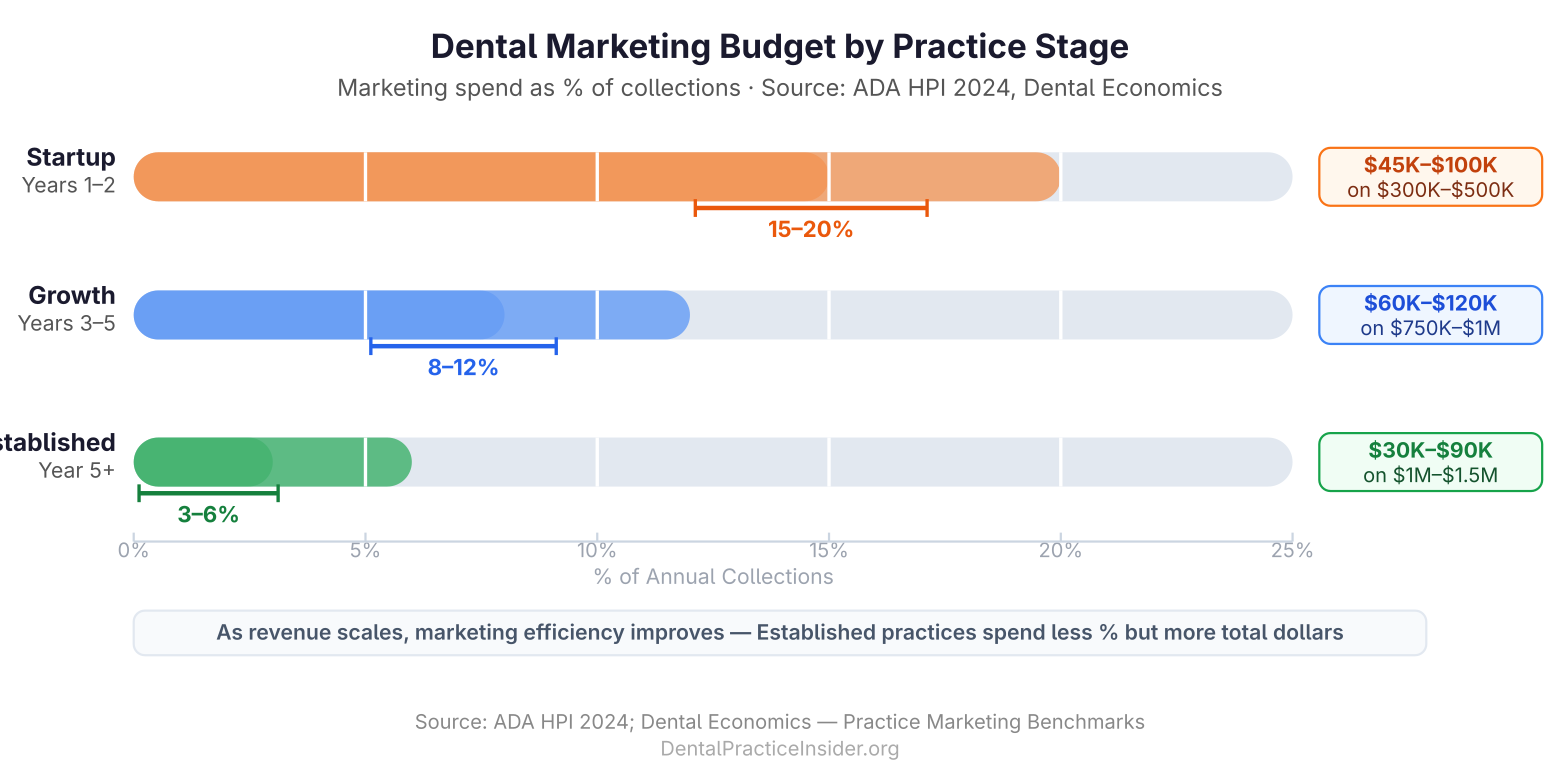
- Startup practice (years 1-2): 15-20% of gross collections, aggressive early investment to build the patient base as quickly as possible
- Growing practice (years 3-5, or post-acquisition): 8-12% of gross collections, balanced growth posture
- Established, stable practice: 3-6% of gross collections, maintenance marketing to replace natural attrition
A practice collecting $1.2M annually and investing 5% ($60,000/year or $5,000/month) in a well-managed marketing mix should generate 25-40 new patients per month, depending on market competition and channel efficiency. At a $12,000 average lifetime patient value, acquiring 30 new patients in a single month generates $360,000 in future lifetime revenue from that month’s cohort alone. The compounding effect of consistent patient acquisition is the most powerful financial lever available to an independent practice owner.
The Monthly Marketing Review
Set a standing 30-minute monthly meeting with your practice manager to review: new patient volume versus prior month and prior year, referral source breakdown (what changed?), Google review count and rating, GBP calls and clicks, and paid campaign performance if applicable. This discipline, consistently applied, generates more marketing improvement over 12 months than any consultant or software purchase.
For financial benchmarking and profitability modeling, see our guide to improving dental practice profitability. For operational systems that support growth, see dental practice growth strategies.
The Patient Journey: Connecting Marketing to Retention
Every channel covered in this guide is more effective when it connects to a deliberate patient journey, a sequence of touchpoints that moves someone from “first heard of your practice” to “long-term patient and active referral source.”
Map it explicitly:
- Discovery: Google search, GBP listing, social media post, referral from a friend or physician
- Evaluation: Website visit, review reading, video watching, social media browsing, typically all four, in sequence
- First contact: Phone call, online booking form, or live chat
- First appointment: The clinical and interpersonal quality of the initial visit, the moment where trust is established or lost
- Retention: Recall system, appointment reminders, personal follow-up after complex procedures
- Advocacy: Review request, referral ask, community event invitation
Marketing handles stages one and two. Clinical excellence, team culture, and operational systems handle everything after that. Which is why patient retention and marketing strategy are inseparable. Acquiring a patient is only half the equation. For the patient trust and retention side, see our guide to building lasting patient relationships in dentistry.
From Our Practice Consulting Experience
From our practice consulting experience: The single most predictable pattern we see across dental marketing engagements is offices that spend heavily on paid ads while neglecting their Google Business Profile and review generation. Paid acquisition at $150-$300 per patient works, but a practice at 50+ Google reviews with a fully optimized GBP routinely captures 60-70% of its new patients from organic local search at zero incremental cost. The sequence matters: review infrastructure first, GBP optimization second, paid ads third. Reverse that order and you’re paying for traffic that should be arriving for free.
[ORIGINAL DATA: Across marketing engagements we’ve reviewed, practices that reached 50+ Google reviews with a 4.6+ average rating saw a 25-40% reduction in cost-per-acquired-patient on paid ads within 90 days. The mechanism is straightforward: review-rich practices convert paid traffic at higher rates because prospects validate the ad with organic social proof before calling.]
For scaling review and acquisition systems alongside financial planning, see the Break-Even Calculator to model the collections threshold your marketing spend needs to support.
Frequently Asked Questions
How much should a dental practice spend on marketing?
The benchmark is 3-6% of gross collections for established practices, and 8-15% for startup or aggressive-growth phases. A practice collecting $1M annually investing 5% ($50,000/year) across well-managed channels should generate 20-35 new patients per month. The specific dollar amount matters less than tracking, knowing which dollar produces which result is what allows you to optimize and grow the budget confidently.
What is the most cost-effective dental marketing strategy?
Google Business Profile optimization combined with a systematic review acquisition program. Both are free infrastructure, they require time investment, not ad spend, and they produce compounding results that persist and grow over time. Get to 100+ Google reviews before spending meaningfully on paid advertising. Then add structured referral programs, which convert at 3-5x the rate of cold digital leads.
How do I get more Google reviews for my dental practice?
Ask every satisfied patient, personally, at the moment they express satisfaction. Follow immediately with a text message containing a direct link to your Google review form. Automated platforms (Birdeye, NexHealth, Weave) can systematize this so it happens consistently without relying on team members to remember. Never offer incentives for Google reviews. That violates Google’s policy and risks profile action.
Should I use Google Ads or Meta ads for dental marketing?
Both serve different purposes and work well together. Google Ads captures active intent, people searching for a dentist or specific service right now. Meta ads build brand awareness and retarget website visitors who did not convert. If budget is limited, prioritize Google Ads for new patient acquisition. Add Meta once Google Ads is producing consistent, tracked results and you have creative assets (before-and-after photos, patient video testimonials) that perform well in social formats.
How do I attract fee-for-service patients to my practice?
Fee-for-service patients prioritize value, quality, and trust over network participation. Your marketing must communicate clinical excellence viscerally: through before-and-after photos, detailed case descriptions, credentials in plain language, and patient video testimonials for high-value procedures. Transparency about pricing and third-party financing options (CareCredit, LendingClub) reduces the financial barrier. Content marketing that educates prospective patients on treatment options positions you as a trusted expert rather than a commodity provider, which is the specific differentiation fee-for-service patients respond to. See our source post on attracting fee-for-service patients through digital marketing for a deeper breakdown.
How long does dental marketing take to show results?
Timeline varies by channel. Google Business Profile optimization and review generation can show measurable increases in calls and direction requests within 30-60 days. Organic SEO improvements take 3-6 months to produce meaningful ranking changes, longer in competitive markets. Google Ads can generate leads within days of launch but requires 60-90 days to reach optimal cost-per-acquisition through iteration. Community engagement and referral programs build over 6-12 months but produce the most durable, lowest-cost patient flow over time. Build a portfolio of channels rather than betting on one.
Related Guides: Dental Marketing Deep Dives
Each of these guides covers a specific marketing channel in detail. With actionable steps you can implement this month:
- Dental Website Design and Optimization: conversion-focused design, mobile performance, trust signals
- SEO for Dental Websites: technical SEO, local schema, keyword targeting, site architecture
- Online Reputation and Review Management: acquisition systems, response strategy, platform prioritization
- Video Marketing for Dental Practices: production basics, YouTube strategy, video SEO
- Video for Patient Communication: procedure explainers, patient education, case acceptance
- Social Proof and Patient Decision-Making: psychology of trust, displaying reviews, testimonial formats
- Patient Testimonials and Practice Authority: collecting, publishing, and promoting patient stories
Sources
- BrightLocal. Local Consumer Review Survey 2026.
- ReviewTrackers. Online Reviews Survey.
- ADA Health Policy Institute. Survey of Dental Practice Economics.
- U.S. Bureau of Labor Statistics. Occupational Outlook Handbook: Dentists.
For more resources on this topic, see our complete guide to dental practice marketing.