Build the Relationship
This sounds like advice you’d skip, but it matters. Keep notes on the name of your Provider Relations contact at each insurer. When you get a good outcome, a brief follow-up email confirming the new terms and thanking them by name builds goodwill. People remember offices that communicate professionally. It doesn’t guarantee better treatment at renewal, but it doesn’t hurt.
Keep Your Bargaining Strength Current
Your position in any renegotiation is strongest when you’re actively submitting high claim volume to that plan. Track your annual claims total per insurer. If a plan is declining in your patient mix, your strength is declining too. Therefore, push for better terms while the volume is still high. Don’t wait until you’re marginal to the network.
Disclosure
This guide is for educational purposes. The letter templates and scripts provided are starting points. Actual fee-push results vary based on market conditions, carrier policies, practice volume, and state-specific rules. For complex situations involving contract disputes or state insurance commission matters, consult a healthcare attorney or a licensed dental billing consultant in your state.
Frequently Asked Questions
Can dentists negotiate PPO fee schedules?
Yes. Most PPO insurers allow fee schedule talks, though they don’t advertise it. Offices that prepare properly and request increases on specific high-volume procedures see 7-30% improvements (PPO Negotiation Solutions, 2025). Your bargaining advantage comes from claim volume, market scarcity, and documented evidence that your rates are below regional benchmarks. The process requires persistence, but it works. Start with the plan where your annual write-offs are highest. To set your ceiling correctly, see the UCR fee schedule guide.
How much revenue can PPO fee talks actually add?
A 15% increase across your top three plans typically adds $50,000-$150,000 in annual collected revenue for a general office producing $1 million or more. Even a 7-10% improvement on two or three high-volume procedures can add $20,000-$40,000 per year. Professional services report routine outcomes in the $50,000-$100,000 range for general practices after a full plan review (PPO Negotiation Solutions, 2025).
What is a silent PPO, and how does it affect my practice?
A silent PPO is when an insurer you have a direct deal with leases your discounted fee schedule to other plans without your explicit consent. You receive payments at your contracted discount from insurers you never agreed to join. The major leasing networks are PHCS, Zelis, MultiPlan, and Connection Dental. Identify them by auditing EOBs for network names that don’t match your signed agreements, then send opt-out correspondence to both the original payer and the leasing intermediary.
How often should practices renegotiate PPO contracts?
Every 24 months at minimum. Review your write-off percentages annually. If any plan’s write-off on your top procedures has climbed above 35-40%, initiate a review immediately rather than waiting for the renewal window. Ultimately, the best timing is 90 days before the agreement renews, when you still have real bargaining strength. Insurers are less responsive to renegotiation requests on recently renewed terms.
Should I hire a professional PPO negotiator or do it myself?
For offices with $40,000 or more in annual write-offs from a single insurer, professional services typically pay for themselves in year one. Performance-based models (25-40% of the first year’s increase) carry low upfront risk. DIY is viable for clinics with 1-3 agreements, a dedicated billing manager, and annual write-offs below $30,000 per plan. Ultimately, the main reason DIY efforts fail is follow-through, not the process itself.
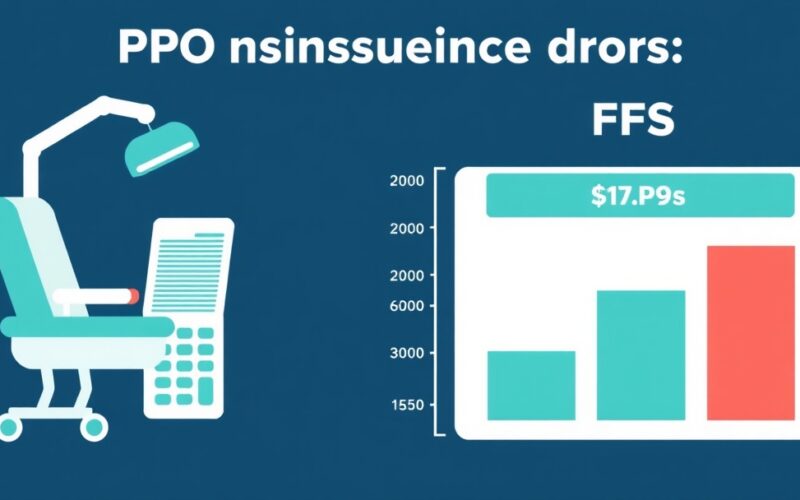
Is dropping a PPO plan a smart long-term strategy?
For the right office, yes. Fee-for-service practices grew from 6% to 16% of the market between 2010 and 2025 (ADA via PPO Negotiation Solutions, 2025), and almost 30% of dentists dropped at least one network in 2024 (ADA HPI Q4 2024). Start with your lowest-paying plan. Give 90-day patient notice. Supplement with a membership plan and accessible payment options. Insurance-dependent practices spend 18% of their time on admin vs. patient care (ADA 2024 Survey). Dropping selectively reduces that burden sharply. The full step-by-step process is in reducing insurance dependency.
Conclusion: Where to Start
The numbers are clear. PPO adjustments average 42-45% of production. A 15% improvement across your top three plans adds $50,000-$150,000 in annual collections for most general offices. That’s not a projection. It’s what documented fee-push results always show.
Start with the insurer where your annual write-off is highest. Pull 12 months of production data, identify your top 20 procedures, and calculate the write-off total per plan. That number is your opening argument. Send a formal letter to Provider Relations, not customer service. Follow up every two to three weeks. Document everything.
If you’re managing four or more agreements at once, or if previous attempts stalled, the performance-based professional services pay for themselves. If you’re starting with one or two plans and have the bandwidth, the DIY process described above works.
Before you negotiate, make sure your UCR fees are current. Your UCR fee schedule sets the ceiling for what you can request. If your UCR is stale, you’ll cap the push before it starts. While you’re evaluating your insurance mix, consider whether a dental membership plan makes sense as an alternative revenue stream that carries no write-offs at all.
The $3-6 million career write-off figure isn’t inevitable. Moreover, dentists who negotiate their fees, audit for silent PPO activity, and renegotiate on a 24-month cycle consistently outperform those who don’t. The work is administrative, not clinical. It just has to get done.
Citation Capsules
Section: How PPO Fee Schedules Work
A 15% drop in PPO payouts creates a 38% drop in dentist net income because overhead costs remain fixed. This math means insurers in markets with fewer participating providers face stronger bargaining pressure from individual offices (Team Training Institute, 2025).
Section: The Negotiation Process
Offices that successfully negotiate dental insurance fees see 7-30% increases on targeted procedures. Professional fee-push services routinely achieve 15% or higher, with most fees recouped in the first year through improved collections (PPO Negotiation Solutions, 2025).
Section: Silent PPOs
Silent PPO fee leasing, through intermediaries like PHCS, Zelis, and MultiPlan, allows an insurer to apply your contracted discount to plans you never agreed to join. Offices can identify this activity by auditing EOBs for network names that don’t match their signed agreements.
Section: Dropping a Plan
Fee-for-service dental clinics grew from 6% to 16% of the U.S. market between 2010 and 2025, reflecting a structural shift in how offices manage insurance dependency. Nearly 30% of dentists dropped at least one network in 2024 (ADA HPI Q4 2024).
Sajid Ahamed is a practice management content strategist specializing in dental insurance strategy, fee optimization, and revenue cycle workflows.
For the full revenue math on dropping a PPO contract, see our PPO Drop Economics operator guide.